


In cloud computing platforms, companies rent infrastructure, storage, and applications through the internet without having physical servers, which helps create global systems. Rather than purchasing and operating physical servers, companies are turning to the services of providers such as Amazon Web Services, Microsoft Azure, and Google Cloud Platform to host applications, auto-scale resources, and make them available globally.
A few years ago, to have a global system, one needed to own huge data centers, employ IT departments, and operate physical servers in different regions. In the present day, businesses run global applications such as banking systems to AI platforms without having even one server. This change is driven by cloud computing, in which companies lease infrastructure rather than create it. Gartner says that global cloud usage has already passed the $600 billion mark, which makes it one of the fastest-growing fields in technology. This guide describes precisely how businesses operate worldwide systems without acquiring servers using cloud computing, serverless architecture, and scalable infrastructure.
What Does “Running Without Servers” Actually Mean
When firms claim to have no servers, it does not imply that there are no servers. Rather, they are owned and operated by cloud providers, and companies can use them remotely via the internet.
Only what is consumed is paid for by businesses, and infrastructure is shared securely among multiple users. This model is usually divided into Infrastructure as a Service, Platform as a Service, and Software as a Service.

How Global Systems Work Without Physical Servers
Cloud Infrastructure (The Backbone)
Companies do not create their own data centers anymore, instead depending on cloud providers to store applications, databases, and storage. This allows deployment on a global scale immediately without the need to establish it physically.
As an example, a fintech company located in several countries can host its backend on AWS, work with distributed databases, and provide content to users all around the globe. McKinsey & Company states that with the adoption of the cloud, infrastructure costs can be decreased by 30–40 percent, and scalability can be improved.
Virtualization Technology
Virtualization enables a single physical server to support multiple virtual machines. This enhances efficiency as well as enabling various businesses to share infrastructure safely.
Global Data Centers
There are hundreds of data centers run by cloud providers throughout the world. This ensures that data is stored closer to users, which minimizes latency and enhances performance.
India can be used as an example, where a user can access data from a nearby region rather than depending on remote servers.
Auto-Scaling Systems
Scaling in the cloud is automatic based on demand. As traffic increases, additional computing resources are added. When traffic decreases, resources are reduced.
This guarantees optimal performance without human intervention.
Serverless Computing (Next Evolution)
Serverless computing eliminates infrastructure management altogether. Developers deploy code, and the cloud provider automatically executes it.
Only execution time is charged to businesses, making it very efficient and economical.
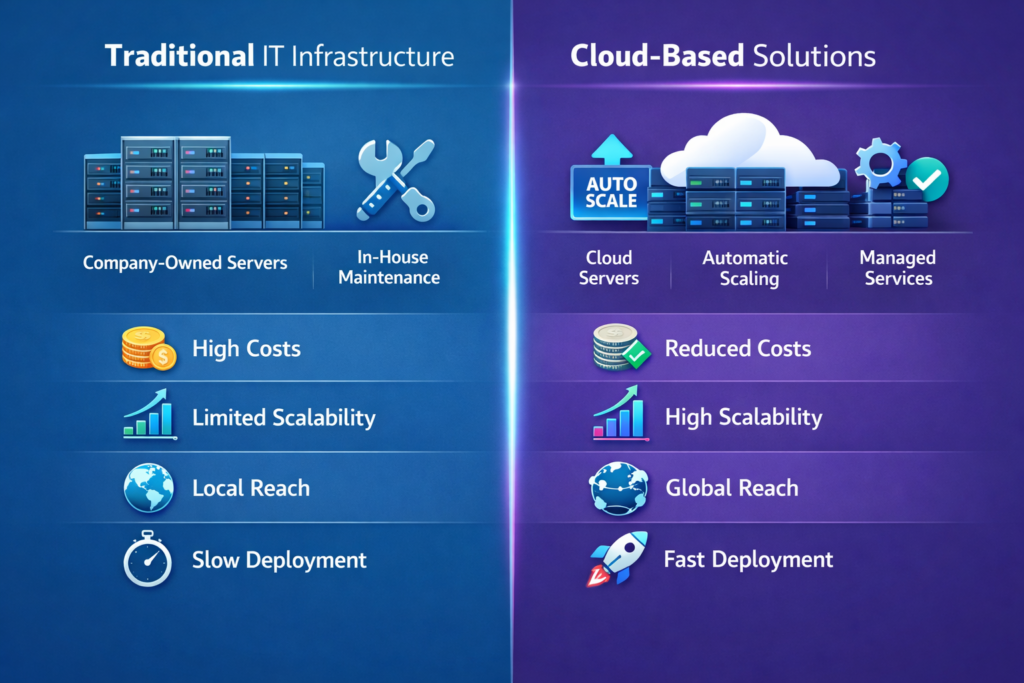
Traditional vs Cloud-Based Systems
| Feature | Traditional Infrastructure | Cloud-Based Infrastructure |
| Ownership | Company-owned servers | Third-party providers |
| Cost | High upfront investment | Pay-as-you-go |
| Scalability | Manual scaling | Automatic scaling |
| Maintenance | In-house IT team | Managed by provider |
| Global Reach | Limited | Instant global access |
| Deployment Speed | Weeks or months | Minutes |
Real-World Examples of Companies Using Cloud Without Servers
Netflix operates all its infrastructure on cloud systems, enabling it to stream content in over 190 countries and support millions of users at the same time. Spotify utilizes cloud computing to deliver music to customers worldwide with low latency and high availability. Airbnb uses cloud computing to manage bookings, payments, and user interactions globally without the need to maintain physical servers.
Why Companies Prefer This Model
Cost Efficiency
Companies do not need to invest heavily in hardware equipment and can minimize operational costs. HubSpot states that cloud adoption improves efficiency and reduces infrastructure costs.
Global Scalability
Businesses are able to expand into new markets instantly without constructing new infrastructure.
Faster Innovation
Application developers are able to release and update applications quickly, minimizing time-to-market.
Reliability and Uptime
Cloud providers offer high uptime, backup systems, and disaster recovery capabilities.
Cloud Service Models Explained
| Model | Meaning | Example |
| IaaS | Rent infrastructure | AWS EC2 |
| PaaS | Platform for developers | Google App Engine |
| SaaS | Ready-to-use software | Salesforce |
Data-Backed Insights (Authority Boost)
| Metric | Insight |
| Global cloud spending | $600B+ (Gartner) |
| Cost reduction | 30–40% (McKinsey) |
| Enterprise adoption | 90%+ organizations using cloud |
| Downtime reduction | Up to 60% after migration |
How do companies operate globally without infrastructure?
They use cloud platforms that provide global servers, automated scaling, and on-demand resources.
What replaces physical servers?
Virtual machines, containers, and serverless computing replace traditional hardware.
Is cloud cheaper than owning servers?
Yes, because businesses avoid upfront costs and pay only for actual usage.

In real-world B2B operations, companies rely on cloud infrastructure to manage global systems, process real-time data, and scale operations efficiently. Without cloud systems, managing multi-country operations would require heavy capital investment and complex infrastructure management.
If you want to scale globally without increasing infrastructure cost, focus on serverless architecture, auto-scaling environments, and first-party data systems. This approach improves performance, reduces cost, and enables personalization at scale.
Conclusion
Business enterprises do not need to own servers to operate global systems. With cloud infrastructure, virtualization, and serverless computing, they are able to scale efficiently, reduce costs, and deliver high performance worldwide. This model has become the foundation of modern digital businesses.
FAQ Section
How do businesses scale without buying hardware?
They work on cloud systems where resources are automatically distributed based on demand.
Why is serverless becoming popular?
Because it eliminates infrastructure management and charges only for execution.
Can startups use this model?
Yes, low initial investment and high scalability make it ideal for startups.
Is cloud computing secure for enterprise use?
Yes, cloud systems can be configured to offer strong security, compliance, and data protection.