

In the past, cybersecurity training was straightforward. The organization had an annual cybersecurity training session, employees took a test, and the firm considered itself “secure enough.” For many years, this strategy worked because cybercriminals operated at a slower pace, using generic phishing emails, basic malware, and predictable attacks.
However, the times have changed.
With artificial intelligence, cybercriminals now have access to a faster, smarter, and dynamic cyber environment. Cybercriminals can leverage AI technology to craft customized phishing emails, generate deepfake voice messages, develop malware, and identify security vulnerabilities instantly. On the other hand, most organizations have been depending on traditional cybersecurity training methods tailored for different cyber environments.
The situation is quite alarming. Despite spending millions of dollars on cyber awareness programs, human error is among the top reasons for security breaches globally. In 2026, reports indicated that AI-fueled cybercrimes were rising rapidly, but employees were still not adequately prepared.
The Evolution of Cybersecurity Threats
Cybersecurity threats have evolved dramatically over the last two decades. Understanding this evolution helps explain why traditional training methods are now ineffective.
| Era | Common Threats | Traditional Training Response |
|---|---|---|
| Early 2000s | Viruses, spam emails | Basic awareness sessions |
| 2010–2018 | Phishing, ransomware | Annual compliance training |
| 2019–2023 | Cloud attacks, social engineering | Simulated phishing tests |
| 2024–2026 | AI-powered phishing, deepfakes, automated attacks | Traditional methods failing |
Earlier cyberattacks depended heavily on human effort. Attackers manually crafted phishing emails and malware campaigns. Because threats moved relatively slowly, annual awareness programs were enough for many organizations.
Now AI changes everything.
Modern cybercriminals can use AI tools to:
- Write highly convincing phishing emails
- Mimic executive voices using deepfakes
- Create malware automatically
- Analyze employee behavior patterns
- Launch attacks at massive scale
- Personalize attacks in seconds
According to recent cybersecurity reports, AI-generated phishing attacks now account for the majority of phishing campaigns worldwide.
This means employees are no longer facing obvious scam emails with poor grammar. They are facing intelligent attacks specifically designed to fool them.
Traditional cybersecurity training was never designed for this level of sophistication.
The Changing Nature of Cyber Threats
There has been significant evolution in cybersecurity threats over the past two decades. Initially, cyberattacks consisted of spam, malware, and viruses, along with some other straightforward attacks. The attackers were poorly resourced and depended heavily on spam emails that were easily recognizable because of poor grammar, odd-looking links, and general wording in their messages.
With time, cybersecurity threats become complex and evolved, and new forms such as phishing, ransomware, identity stealing, and social engineering emerged, focusing on attacking employees working for corporations. In response, companies started conducting training sessions where employees learned about different cybersecurity threats and how to avoid falling for them.
AI came into play, and the entire landscape changed overnight. Using artificial intelligence, cyber criminals could carry out attacks on employees on an unprecedented scale. Current AI is capable of analyzing the behavior of employees, gathering data from social networks, creating personalized phishing emails, and generating human-like voiceovers in deepfakes.
Why Traditional Cybersecurity Training No Longer Works

One of the major factors contributing to the failure of conventional cybersecurity training is the focus on compliance rather than preparation. For example, in many organizations, cybersecurity awareness training is seen as an essential HR task rather than a crucial security procedure. Employees are forced to undergo the training either once or twice yearly via interactive online courses that contain videos, text, and quiz questions.
Unfortunately, employees typically go through the process of undergoing cybersecurity awareness training simply to satisfy the mandatory requirement, with minimal learning taking place. It is highly unlikely that any lasting knowledge will be gained since it is rarely reviewed periodically.
- Focus on compliance over real security preparedness
- Cybersecurity training treated as an HR formality
- Annual or bi-annual training sessions only
- Employees forced to complete mandatory modules
Moreover, traditional cybersecurity training programs are based on the assumption that cybersecurity risks do not evolve. Employees are trained to identify phishing emails through common traits such as poor grammar, suspicious hyperlinks, and general greetings. However, with the rise of artificial intelligence-based attacks, the phishing emails sent today are remarkably similar to official corporate correspondence.
AI Has Made Cybercrime Smarter
However, Artificial Intelligence (AI) has made cybercrime faster, greater in scale, and more intelligent. Cybercriminals can now automate tasks which would have needed considerable human intervention. AI applications help cybercriminals craft phishing emails, develop malware, exploit vulnerabilities, and personalize attacks within seconds.
One of the most worrying advancements in cybercrime involves AI-based phishing. Earlier phishing emails were easily identifiable since they had poor grammar, clumsy language, and suspicious formatting.
However, the latest generation of AI technology can craft emails that look official and credible. They may mention actual projects of companies, recent business news, or style of communication among executives of organizations.
AI has also helped cybercriminals conduct social engineering attacks. AI applications can collect data from LinkedIn pages, social networking sites, and corporate websites to launch a highly personalized attack.
Workers may receive emails that look as if they were sent by their colleagues, superiors, or business contacts.
Human Behavior Remains the Biggest Weakness
However, cybersecurity isn’t just about technologies. Psychology plays a significant role in cyber threats. The majority of attacks take place because of manipulations of human emotions such as fear, urgency, trust, or curiosity.
Employees tend to be less careful if they are busy, stressed, distracted, or pressured. AI-based attacks are especially efficient at triggering these emotions. For instance, an intruder might send a notification that says:
- “Urgent payment approval.”
- “Your salary account is hacked.”
- “Password change immediately.”
These notifications are specifically created to cause panic in employees, forcing them to act quickly without double-checking.
Conventional cybersecurity training tends to emphasize the importance of technical indicators, paying little attention to emotional manipulation. Employees can grasp basic cybersecurity principles in training but still act according to their instincts in attack situations.
Human errors remain one of the leading causes of cybersecurity problems globally due to that.
Employees Forget Most Training Quickly
A further flaw in conventional cybersecurity training is low information retention rates. The vast majority of awareness campaigns adopt passive learning techniques like videos and PowerPoint slides. While staff members can retain some information for testing purposes, they will forget much of it in just a few weeks’ time.
Learning psychology suggests that humans learn better by repeating actions and receiving constant feedback. However, numerous cybersecurity training programs neglect to offer consistent practice.
Staff members may participate in annual cybersecurity awareness training in January only to encounter an intricate phishing scam in March, at which point they have forgotten most of what they learned during the session.
Consequently, there exists a critical gap between the assumption that staff members have undergone proper training and the reality that they lack sufficient cybersecurity awareness.
Compliance Culture Is Hurting Cybersecurity
A lot of organizations pay more attention to ensuring compliance with the training course than checking whether the staff has learned how to protect themselves from possible cyberattacks.
Organizations monitor completion rates, scores on quizzes, and compliance reports because these parameters are relatively simple to track.
But compliance doesn’t guarantee safety.
For example, an employee could receive 100 percent on a cybersecurity quiz but become a victim of an AI-generated phishing email despite being fully aware of what phishing is.
It’s because practical skills are essential when dealing with real-world situations. Cybersecurity education needs to be directed at mitigating risks for an organization, not just meeting regulations.
The AI Era Requires Continuous Learning
Since the contemporary threat environment is dynamic and changes at an accelerated pace, annual cybersecurity training is inadequate for its timely coverage. Artificial intelligence attacks continue to develop, and hence, cybersecurity training should be continuous and flexible as well.
In place of lengthy cybersecurity training programs once or twice a year, companies need to implement shorter and more frequent training sessions. Employees should receive periodic updates concerning the latest cyber threats, phishing schemes, and social engineering techniques.
Such a learning process will help to develop good security practices among personnel and keep their cybersecurity skills sharp. In addition, regular training will make employees aware of potential cybersecurity threats and suspicious activities.
Similar to physical training, contemporary cybersecurity training should be continuous and repetitive.
Role-Based Training Is Essential
Every department within an organization faces unique cybersecurity risks. Finance teams deal with payment fraud and invoice scams. HR departments handle sensitive employee data and recruitment fraud. Executives face high-level impersonation attacks and deepfake threats.
The table below shows how cybersecurity risks vary across different business functions.
| Department | Common Cyber Threats |
|---|---|
| Finance | Payment fraud, invoice scams |
| HR | Employee data theft |
| Marketing | Brand impersonation |
| Sales | CRM compromise |
| Executives | Deepfake impersonation |
| IT Teams | Malware and vulnerabilities |
Traditional one-size-fits-all training does not prepare employees for these specific threats. Modern cybersecurity awareness programs must therefore become role-based and personalized.
When employees receive training directly related to their daily responsibilities, they become more engaged and better prepared to recognize attacks.
Why Modern Cybersecurity Training Should Be Interactive
The first reason why people dislike conventional training methods is that they are boring. It is hard to maintain focus when watching endless presentations and awareness videos.
Training in the era of modern cybersecurity needs to be more interactive. Companies should include phishing exercises, scenarios, gamification, and live attacks in their learning strategies.
Interactive training allows employees to make important decisions in real-time situations. Instead of being told about phishing attacks, people need to experience them first-hand.
Such a method will help employees learn better and also develop a certain level of confidence in dealing with cyberattacks.
Use of AI for Cybersecurity Awareness Training
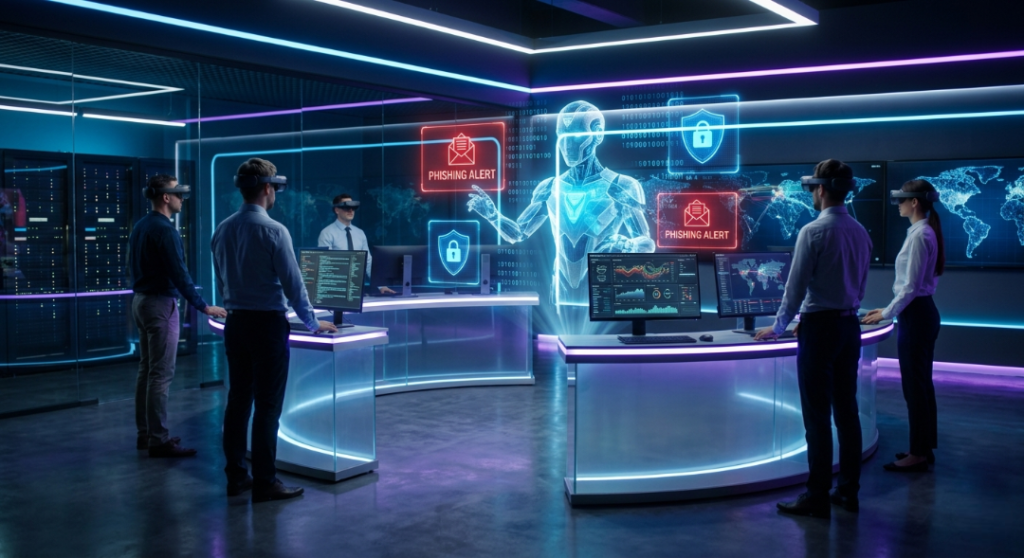
Curiously enough, the use of AI is not limited to cybercriminals. It may also be used to improve cybersecurity awareness training in organizations.
The modern AI-driven training systems are capable of evaluating user behavior, spotting weaknesses, and adapting to them. For instance, should a user constantly have problems recognizing phishing, the software will immediately generate personalized training sessions related to that particular issue.
Another feature of the AI is the possibility of creating interactive and highly realistic phishing scenarios which can be adapted to individual performance levels of employees.
In this way, businesses will have access to a whole new level of cybersecurity training programs.
Creating a Culture of Security
Technology itself will not be able to fix cybersecurity issues. Companies have to establish robust security cultures by educating employees about their contribution to maintaining company security.
Employees need to feel like it is safe for them to report any suspicious activities since cybercrimes often escalate due to delays in reporting errors.
Executive engagement is another important component. It is vital that executives are supportive of cybersecurity awareness programs and lead by example through exhibiting safe behaviors.
Cybersecurity culture makes awareness more than just a compliance measure.
The Financial Impact of Poor Cybersecurity Awareness
The cost of ineffective cybersecurity training can be enormous. Successful cyberattacks often lead to financial losses, operational disruptions, legal penalties, and reputation damage.
AI-powered attacks are becoming increasingly sophisticated, making employee preparedness more important than ever. Businesses that fail to modernize their training strategies may experience:
- Data breaches
- Customer trust loss
- Regulatory fines
- Business downtime
- Intellectual property theft
As cybercrime continues evolving, the financial risks associated with poor awareness programs will only increase.
The Future of Cybersecurity Education
The future of cybersecurity training will largely depend on behavioral science, adaptive learning, and AI-driven personalized training. Companies are slowly transitioning away from using static awareness modules for training purposes to implementing learning platforms.
Cybersecurity training in the future may comprise:
- Simulations by AI
- Real-time coaching
- Game-based learning
- Behavioral risk assessment
- Attack simulations in VR
- Customized awareness programs
The aim here will not be only to educate employees on the fundamentals of cybersecurity. Instead, companies will aim to change employee behavior through these trainings.
Companies that transition to these new modes of awareness training will develop greater resilience against future cyberattacks.
Conclusion
The traditional approach to cybersecurity training cannot be considered efficient as it does not take into account the change in the nature of cyber threats. Artificial Intelligence has made cybercrime a very complex and automated activity. Hackers can personalize emails, make realistic video content, and control people’s behavior.
However, some companies use old models for increasing cyber awareness among their employees. Compliance trainings per year, training programs, and passive learning methods cannot help one adapt to AI technology.
The contemporary approach to cybersecurity suggests that continuous learning, role-based training, simulated exercises, and behavioral training methods should be applied to prepare people to potential attacks.
Cybersecurity awareness training has always been associated with IT specialists only. However, in today’s reality, when AI technology changes everything, cybersecurity awareness training is crucial to ensure business survival.