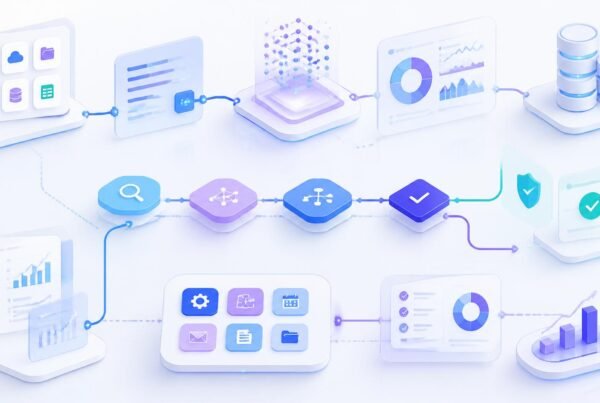


Artificial Intelligence is no longer just a “new technology trend” in IT it has become the foundation of modern enterprise infrastructure. Today, businesses are not just using AI as a tool; they are building their entire IT and enterprise software ecosystems around it.
This shift is called AI-Driven Infrastructure, where systems don’t just execute commands they learn, predict, optimize, and self-manage.
In this blog, we will explore how AI is transforming IT & enterprise software, how it enables global scalability, and why it is becoming the backbone of digital transformation.
What is AI-Driven Infrastructure?
AI-Driven Infrastructure refers to an IT ecosystem where Artificial Intelligence is embedded into core systems like servers, cloud platforms, databases, networks, and enterprise applications.
Instead of relying fully on human monitoring and manual configuration, the system uses AI to:
- Detect issues before they happen
- Automatically scale resources
- Optimize performance in real-time
- Improve security and compliance
- Reduce operational costs
It is an IT system that can think, predict, and self-correct without waiting for human intervention.
Why AI-Driven Infrastructure is Becoming Essential
Modern enterprises operate globally. They handle millions of users, massive data flows, and real-time transactions. Traditional IT systems cannot keep up with this complexity.
Key Reasons for Adoption:
- Exploding data volumes
- Demand for real-time processing
- Cloud migration at scale
- Cybersecurity threats
- Need for cost optimization
- Remote and hybrid work environments

Traditional vs AI-Driven Infrastructure
| Feature | Traditional Infrastructure | AI-Driven Infrastructure |
|---|---|---|
| Monitoring | Manual | Automated AI monitoring |
| Scaling | Reactive | Predictive & auto-scaling |
| Downtime Handling | After failure | Before failure prediction |
| Cost Optimization | Limited | Continuous optimization |
| Security | Rule-based | AI threat detection |
| Maintenance | Scheduled/manual | Self-healing systems |
The Intelligence Layer: How AI Actually Works in Infrastructure
AI in infrastructure is not a single tool. It is a layer of intelligence built on top of existing systems. This intelligence layer works in three major ways:
1. Learning from Data
Any system produces data, which includes logs, user activity, performance information, and any problems that occur. AI constantly analyzes these data to learn how “normal behavior” is.
For instance:
If your server usually receives 10,000 requests a minute, AI will learn this.
2. Recognizing Patterns and Deviations
Having learned about the usual pattern, AI starts finding abnormalities. If all of a sudden there are 50,000 requests per minute, then AI knows that something’s not right and gets ready for whatever’s coming.
3. Making Decisions Independently
Without any intervention from engineers, AI can do its job:
- More servers
- Load balancing
- Suspicious traffic blocking
- Performance optimization
This closed-loop system makes infrastructure self-operating.
AI in Cloud Infrastructure: The Backbone of Scalability
Cloud computing has become the core of contemporary corporate information technology systems. However, the incorporation of AI into cloud infrastructure makes it much more efficient.
Traditional cloud solutions rely on scalability, meaning that if there are any changes in the load, the system reacts by increasing its capacity. The process takes time and may cause some delays.
- Using AI within cloud infrastructure, the system can predict any load spikes.
- For instance, if an online store notices increased traffic during particular times of day or festive occasions, it uses this data to ensure that there are enough server resources available beforehand. As a result, the system will not have any downtime and will be able to perform at its best.
- In addition, AI can contribute to the optimization of costs. If the demand decreases at a particular moment, the system will shut down any unnecessary servers without interrupting the service.
- Such perfect combination of performance and cost management is a major benefit of AI for cloud infrastructure.
AIOps: The Brain of Modern IT Operations
One of the crucial advancements in this area involves AIOps, or Artificial Intelligence for IT Operations. In the conventional IT operations management setup, people spend a substantial amount of time monitoring log files, dealing with alerts, and solving failures in systems.
With the introduction of AIOps, however, the system operates differently. Here, AIOps works as an intelligence layer that constantly gathers information from different segments of the IT systems and analyses these inputs, helping to identify any anomalies that may arise.
If any issue arises in the system, or an anomaly becomes imminent, the AIOps solution detects this problem and finds the cause behind it instantly without human intervention. Engineers are no longer required to troubleshoot and solve such problems since AIOps does the job on their behalf.
AI in Enterprise Software: A Silent Revolution

As far as infrastructure goes, enterprise software applications are where the actual impact of AI is felt in business operations.
For example, within ERP applications, the use of AI enables organizations to plan their supply chain more efficiently through the prediction of demand using market trends, seasonal variation, and past purchase statistics.
- Within CRM applications, AI enables the improvement of customer relations through the analysis of consumer behavior and the delivery of relevant personalized recommendations.
- Within HR applications, AI assists companies in employing more successful personnel by analyzing applicants’ CVs and assessing their likelihood of success, as well as identifying at-risk workers.
- Finally, within financial applications, AI is responsible for fraud detection through the identification of anomalous behavior in financial transactions.
In this way, enterprise software applications are transformed from a mere tool into a system that can drive business decisions.
How AI Enables Global Scalability
With regard to the infrastructure aspect, enterprise software applications are the area where the real effect of AI is experienced.
Take, for instance, the ERP applications where AI makes it possible for businesses to better plan their logistics by predicting their demand based on market trends, seasonality, and previous purchasing patterns.
- The same case applies to CRM applications, where AI helps improve customer relationships by analyzing customer behaviors and making relevant recommendations.
- In HR applications, AI helps businesses employ effective employees by analyzing candidates’ resumes and their chances of success and identifying risky employees.
- Lastly, in financial applications, AI helps detect fraudulent activity by identifying unusual behavior in financial transactions.
- In such a way, enterprise software applications are not just tools but systems that influence decision-making.
Security in AI-Driven Infrastructure
Cybersecurity is now one of the most important issues for enterprises.
Traditional cybersecurity methods are based mostly on static rules. It makes them ineffective when dealing with new types of attacks.
The use of artificial intelligence solves the problem by emphasizing user behavior.
It doesn’t search for signs of attacks but monitors normal behavior patterns. Any anomaly such as logging in from a strange place or accessing strange data triggers an alarm.
Eventually, artificial intelligence gets better at spotting anomalies because of constant learning.
It leads to higher resistance to cybersecurity threats within enterprise infrastructure.
Challenges in AI-Driven Infrastructure
AI-powered infrastructure can be effective despite having its own difficulties.
One of the most serious problems is related to the complexity associated with incorporating the AI technology into existing legacy infrastructures, which are unable to support intelligent automation. In addition, many enterprises still use out-of-date infrastructure for their processes.
The problem of dependence on data may also be identified as an important challenge faced when using the technology. AI requires considerable amounts of high-quality data to perform properly. Bad data will lead to bad predictions made by the system.
| Challenge Area | Explanation |
|---|---|
| Legacy System Integration | Many enterprises still rely on outdated infrastructure that was not designed for AI or intelligent automation. Integrating modern AI systems with these legacy setups becomes complex, time-consuming, and costly. |
| Data Dependency | AI systems depend heavily on large volumes of high-quality data. If the data is incomplete, inconsistent, or poor in quality, the AI models generate inaccurate predictions and unreliable outputs. |
| Trust and Decision-Making | Organizations often hesitate to allow AI systems to make independent decisions in critical operations such as finance, security, or healthcare due to lack of full transparency and fear of system errors. |
| Skill Shortage | There is a significant shortage of professionals who understand both AI technologies and enterprise infrastructure. This skills gap slows down implementation and effective management of AI-driven systems. |
The Future of AI-Driven Infrastructure

The future of IT infrastructure is headed towards full autonomy. There will soon be systems that are not only operational but can operate themselves completely. Such systems will have the ability to detect problems, fix them, optimize themselves, and scale up on their own without any intervention by humans. This is known as self-healing infrastructure.
Ultimately, in the distant future, enterprise software itself would be fully AI-based. This means that AI would no longer be an additional capability but the core of all the software. Edge computing will also be very important in the future.
Conclusion
The advent of AI-based infrastructure has revolutionized the way IT and enterprise software function. It enables systems to become predictive rather than reactive, autonomous instead of being manually driven, and adaptive rather than static.
From an enterprise perspective, it is much more than a technical enhancement it is a fundamental transformation.
Organizations adopting AI-based infrastructure can enjoy benefits such as increased scalability, improved security, cost savings, and greater operational efficiency. Most importantly, they create systems that can keep evolving and adapting. Over the next few years, the gap between traditional IT and AI-powered IT will not only lie in performance but also in survivability. AI is no longer just helping infrastructure; it is becoming infrastructure itself.
FAQ’s
1. What is AI-driven infrastructure in simple terms?
AI-driven infrastructure is an IT system that uses artificial intelligence to automatically manage, monitor, and optimize itself. It reduces manual work by making systems smarter and more self-operating.
2. How does AI help in scaling global operations?
AI helps by automatically adjusting resources based on demand, predicting traffic spikes, balancing workloads across regions, and ensuring systems run smoothly for users worldwide without delays or downtime.
3. What industries benefit the most from AI-driven infrastructure?
Industries like IT services, e-commerce, banking, healthcare, SaaS platforms, logistics, and telecommunications benefit the most because they deal with large-scale, real-time data and global users.
4. Is AI-driven infrastructure expensive to implement?
Yes, the initial setup can be costly due to tools, cloud services, and integration. However, over time it reduces operational costs by optimizing resources, reducing downtime, and minimizing manual effort.
5. Does AI completely replace IT teams?
No, AI does not replace IT teams. Instead, it supports them by handling repetitive tasks, monitoring systems, and providing insights so IT professionals can focus on strategy and innovation.
6. What are the risks of using AI in infrastructure?
Some risks include dependency on high-quality data, security vulnerabilities, implementation complexity, and the need for skilled professionals to manage AI systems effectively.
7. How does AI improve cybersecurity in infrastructure?
AI detects unusual behavior, identifies potential threats in real time, blocks suspicious activities, and helps prevent cyberattacks before they cause damage.
8. What is the future of AI-driven infrastructure?
The future includes fully autonomous systems, stronger integration with cloud and edge computing, AI-powered DevOps (AIOps), and more energy-efficient and sustainable IT infrastructure.