

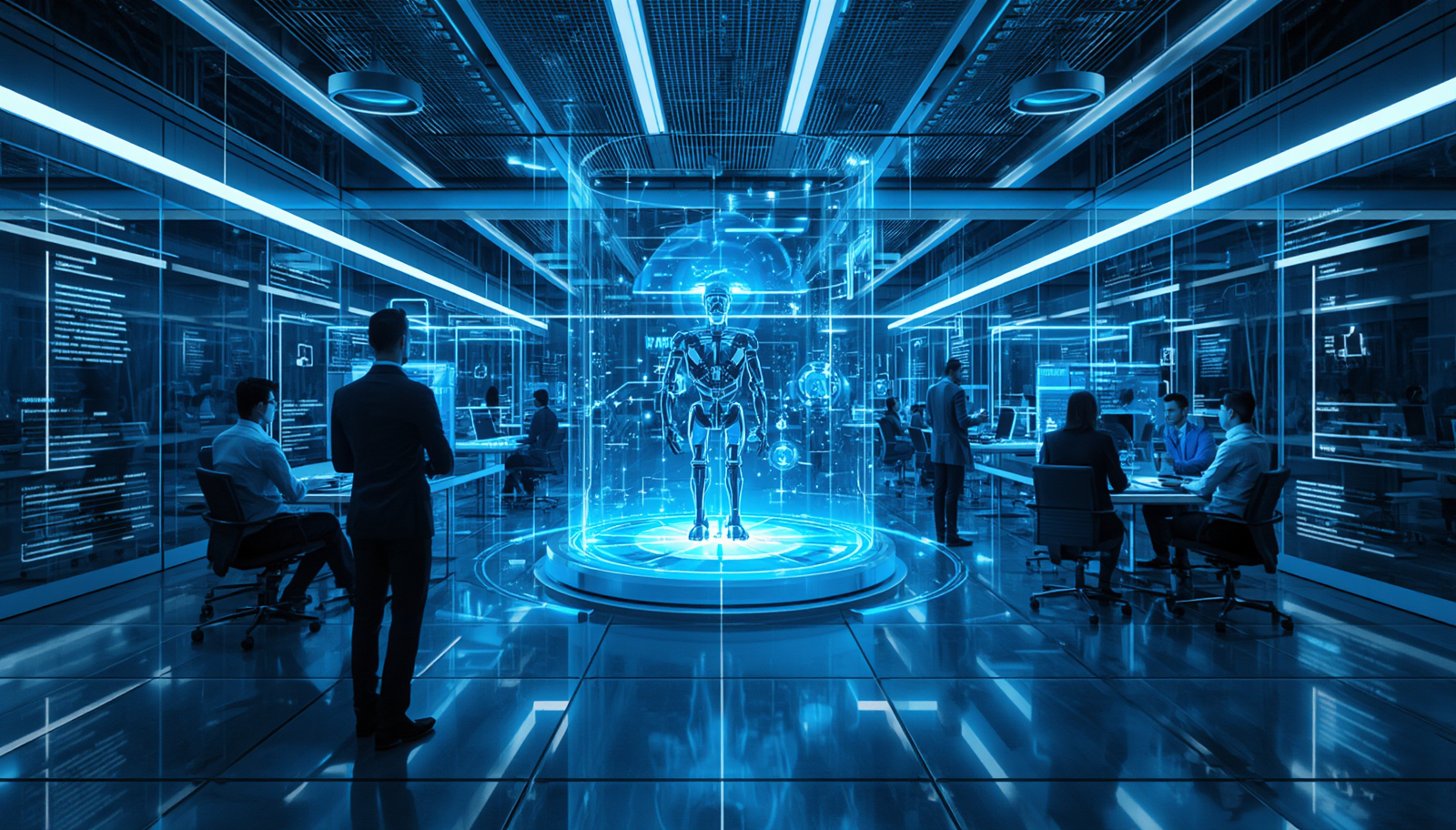
From science fiction to reality, Artificial Intelligence (AI) has become one of the most influential technologies in today’s business environment. Companies big and small are using AI for automating processes, improving user experience, decision making, and opening up new possibilities.
In the future of AI in business sphere, we have already seen such concepts as intelligent automation, prediction, generation of new information, autonomy, and decision-making support systems. By implementing those innovations, organizations gain advantages related to increased efficiency and reduced expenses, personalized services, and the ability to stay competitive in fast-paced environments.
With the development of AI technologies, companies are going to step over automation and create intelligent ecosystems in which machines and people work together. Instead of being replaced, humans are supposed to be enhanced in their abilities and receive support in decision-making due to analysis of huge amounts of data.
What Is AI in Business?
The meaning of Artificial Intelligence in the business sector is a system that involves computer systems with the ability to do the work normally performed by humans. These systems have the ability to learn from data, recognize patterns, understand languages, produce content, predict outcomes, and provide advice for running business operations.
Different from conventional software that follows programmed instructions, the AI system learns and becomes more effective over time by processing newly acquired information.
Modern businesses use AI to:
- Automate repetitive and time-consuming tasks
- Improve customer service through intelligent chatbots
- Analyze customer behavior
- Forecast market demand
- Detect fraud and security threats
As AI models become increasingly sophisticated, businesses are discovering innovative ways to integrate AI into daily operations, making it a core driver of digital transformation.
Why AI Is the Future of Business
The business world has become more competitive, data driven and customer centric as compared to ever before. Organizations are producing huge amount of data everyday. It becomes difficult for human beings to do analysis on their own.
Artificial Intelligence helps to solve this problem by analyzing huge datasets in real time and drawing useful insights from it.
Several factors explain why AI represents the future of business.
1. Data Is Growing Exponentially
Every online interaction, customer purchase, social media engagement, IoT device, and digital transaction produces valuable information.
AI enables organizations to transform raw data into actionable insights by:
- Identifying customer preferences
- Predicting future demand
- Detecting operational inefficiencies
- Recognizing emerging market trends
Businesses that effectively leverage AI-driven analytics gain a significant competitive advantage.
2. Customers Expect Personalized Experiences
Today’s consumers expect businesses to understand their needs and deliver personalized recommendations.
AI helps companies personalize experiences through:
- Product recommendations
- Dynamic pricing
- Customized email campaigns
- Personalized advertisements
- Intelligent customer support
- Behavioral analysis
Streaming services, eCommerce platforms, and financial institutions already rely heavily on AI personalization technologies.
3. Automation Saves Time and Money
Business leaders constantly seek opportunities to improve efficiency while reducing operational costs.
AI automates repetitive activities such as:
- Invoice processing
- Data entry
- Document classification
- Customer inquiries
- Appointment scheduling
- Email responses
- Inventory updates
Employees can then focus on strategic work requiring creativity, critical thinking, and relationship building.
4. Better Decision-Making
Business decisions increasingly depend on accurate, real-time data.
AI supports decision-makers by:
- Predicting future outcomes
- Simulating business scenarios
- Detecting hidden patterns
- Assessing business risks
- Providing actionable recommendations
Executives can make faster, evidence-based decisions rather than relying solely on intuition.
5. Competitive Advantage
Organizations adopting AI early often outperform competitors through:
- Faster innovation
- Higher operational efficiency
- Improved customer experiences
- Lower operational costs
- Better forecasting
- Smarter marketing campaigns
As AI adoption accelerates, businesses that delay implementation may struggle to remain competitive.
The Evolution of AI in Business
Understanding the future of AI requires examining how the technology has evolved.
Early Automation
The earliest business software focused on automating repetitive administrative tasks using predefined rules.
Examples included:
- Payroll software
- Accounting systems
- Inventory management
- Customer databases
Although helpful, these systems lacked learning capabilities.
Machine Learning Era
Machine learning introduced systems capable of learning from historical data.
Businesses began using AI for:
- Customer segmentation
- Fraud detection
- Sales forecasting
- Recommendation engines
- Predictive maintenance
This marked the transition from automation to intelligent decision support.
Deep Learning Revolution
Deep learning significantly improved AI performance in areas such as:
- Image recognition
- Speech recognition
- Natural language understanding
- Medical diagnosis
- Autonomous vehicles
Businesses started integrating AI into customer service, cybersecurity, healthcare, and manufacturing.
Generative AI Era
Recent advancements in generative AI have transformed business productivity.
Generative AI can create:
- Marketing copy
- Business reports
- Computer code
- Product descriptions
- Images
- Videos
- Presentations
- Business proposals
Instead of merely analyzing information, AI now generates entirely new content based on user prompts.
Top AI Trends Shaping the Future of Business
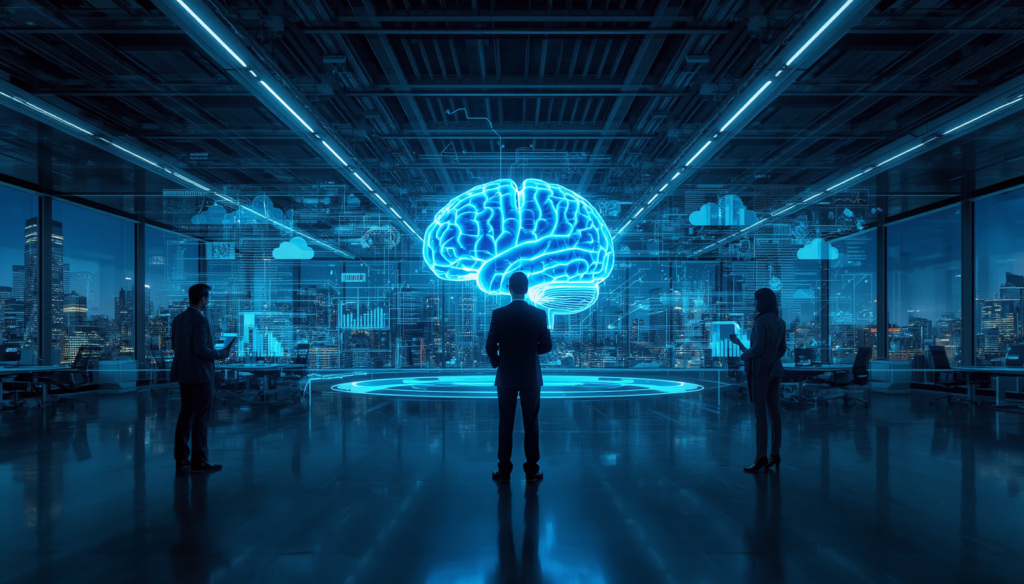
The future of AI in business will be driven by several transformative technologies.
1. Generative AI
Generative AI is changing how businesses create content and solve problems.
Applications include:
- Marketing content creation
- Customer support responses
- Software development assistance
- Product design
- Proposal writing
- Document summarization
Companies adopting generative AI report significant productivity improvements.
2. AI Agents
AI agents represent one of the most exciting developments in business technology.
Unlike traditional chatbots, AI agents can:
- Complete multi-step tasks
- Use multiple software applications
- Analyze documents
- Schedule meetings
- Conduct research
- Generate reports
- Coordinate workflows
Future organizations may rely on teams of AI agents working alongside employees.
3. Predictive Analytics
Predictive AI helps organizations anticipate future events using historical data.
Businesses use predictive analytics to forecast:
- Sales
- Customer churn
- Equipment failures
- Financial risks
- Market demand
- Employee turnover
Better predictions enable proactive business strategies.
4. Hyperautomation
Hyperautomation combines AI, robotic process automation (RPA), machine learning, and workflow automation.
Businesses automate:
- HR onboarding
- Invoice approvals
- Procurement
- Compliance
- Finance
- Customer support
Entire business processes become faster, more accurate, and less dependent on manual intervention.
5. AI-Powered Cybersecurity
Cyber threats continue evolving.
AI enhances cybersecurity by:
- Detecting unusual behavior
- Preventing fraud
- Identifying malware
- Monitoring networks
- Responding to attacks automatically
Future cybersecurity systems will rely heavily on AI-driven threat intelligence.
6. Conversational AI
Customer interactions are becoming increasingly AI-driven.
Businesses deploy conversational AI for:
- Customer support
- Virtual assistants
- Appointment booking
- Technical support
- Internal employee assistance
Advanced AI systems understand context, emotions, and user intent more effectively than previous chatbot technologies.
7. AI for Decision Intelligence
Executives increasingly depend on AI dashboards that combine analytics, forecasting, simulations, and recommendations.
Rather than replacing executives, AI serves as a strategic advisor by presenting insights that improve business planning and risk management.
Key Benefits of the Future of AI in Business
Organizations adopting AI can expect several long-term advantages.
Increased Productivity
AI automates repetitive work, enabling employees to focus on innovation, strategy, and customer engagement.
This leads to:
- Faster workflows
- Reduced manual effort
- Higher employee satisfaction
- Increased operational efficiency
Improved Customer Experience
AI helps businesses deliver faster, smarter, and more personalized customer interactions.
Benefits include:
- 24/7 customer support
- Personalized recommendations
- Faster response times
- Improved customer retention
- Better customer satisfaction
Lower Operational Costs
Automation reduces labor-intensive tasks while minimizing costly human errors.
Businesses save money through:
- Process optimization
- Efficient resource allocation
- Reduced downtime
- Lower administrative costs
- Improved inventory management
Better Business Insights
AI analyzes large datasets in seconds.
Organizations gain valuable insights into:
- Customer behavior
- Market opportunities
- Sales trends
- Operational bottlenecks
- Financial performance
These insights support informed decision-making across departments.
AI ROI: Measuring Business Success
Businesses should continuously measure AI performance to determine whether investments are generating measurable value.
Common AI KPIs include:
| KPI | Why It Matters |
|---|---|
| Cost Reduction | Measures operational savings |
| Employee Productivity | Tracks time saved |
| Customer Satisfaction | Measures AI service quality |
| Revenue Growth | Evaluates business impact |
| Forecast Accuracy | Measures prediction quality |
| Customer Retention | Indicates personalization success |
| Process Automation Rate | Shows workflow efficiency |
Monitoring these metrics helps organizations optimize AI systems and justify future investments.
AI Applications Across Different Industries

Artificial intelligence is no longer exclusive to tech companies. All businesses are implementing AI solutions in their operations to increase efficiency, improve customer experience, and make more informed decisions. The development of AI solutions will keep affecting all sectors of the global economy even further.
Healthcare
The healthcare industry is undergoing some of the biggest transformations in AI. Hospitals, clinics, pharma companies, and medical researchers are using AI technology to increase efficiency and save costs.
The use of AI helps doctors to analyze medical imaging, diagnose conditions at an early stage, assess risks, and suggest treatments. AI also speeds up the process of drug discovery analyzing millions of papers and datasets in a fraction of the time.
Finance and Banking
Every bank processes millions of transactions each day, which makes it perfect for using AI technology.
Banks are using AI for detecting fraudulent activities in real-time, assessing credit risks, automating loan approvals, predicting market trends, and providing customers with intelligent assistance through chatbots.
Retail and E-commerce
Personalized experience is a key selling point of AI in retailing businesses. Recommendations generated through recommendation engines consider users’ browsing habits and purchase history along with their preferences and help retailers to increase conversion rates.
AI technologies optimize inventory management by allowing forecasting demand, decreasing stock-outs and excess inventories. Pricing algorithms allow setting prices based on customers’ demand, competition and other factors automatically.
Manufacturing
Manufacturing companies widely use AI in order to streamline their operations and manufacturing processes and improve quality of manufactured products.
Predictive maintenance allows identifying potential issues with machines before their failure happens. Computer vision algorithms check for defects much faster than traditional inspection techniques.
Marketing and Sales
Marketing became revolutionized due to the emergence of AI-based applications.
AI helps salespeople to prioritize leads, make forecasts, manage relations with customers and send automatic messages. Marketing people can also use generative AI to create blog posts, social media posts, advertisements, product descriptions and marketing campaigns.
Human Resources
Human resource departments widely use AI throughout employees’ life cycle in the company.
HR specialists use AI in order to screen CVs of candidates, find qualified job seekers, schedule interviews and assess their skills. AI helps predicting turnover, engagement of employees
Education
More and more schools and universities utilize AI to make their educational processes personalized.
AI-based tutoring systems adjust lessons depending on student results, which allows for students to move at their own speed. AI offers teachers automatic assessments, content suggestions, and predictions about which students need further help.
Logistics and Supply Chain
The supply chain is composed of many different factors, which makes AI particularly useful in this area.
AI helps to optimize delivery routes, forecast demand, manage warehousing, monitor shipments, and plan inventory.
Industry-Wise AI Applications
| Industry | AI Applications | Key Benefits |
|---|---|---|
| Healthcare | Diagnosis, Medical Imaging, Drug Discovery | Better patient outcomes |
| Finance | Fraud Detection, Credit Scoring, Forecasting | Reduced financial risks |
| Retail | Recommendations, Inventory Management | Higher customer satisfaction |
| Manufacturing | Predictive Maintenance, Robotics | Increased productivity |
| Marketing | Content Generation, Personalization | Improved campaign performance |
| HR | Recruitment Automation, Workforce Analytics | Faster hiring decisions |
| Education | Personalized Learning | Enhanced learning outcomes |
| Logistics | Route Optimization, Demand Forecasting | Lower operational costs |
Emerging AI Technologies That Will Shape the Future
The next decade will introduce technologies that fundamentally redefine business operations.
Autonomous AI Agents
AI agents represent one of the most exciting developments in artificial intelligence. Unlike traditional software, these systems can independently perform multi-step tasks while interacting with multiple business applications.
Multimodal AI
Future AI systems will understand text, images, videos, audio, and structured business data simultaneously.
Businesses will use multimodal AI to analyze customer feedback, product images, contracts, presentations, videos, and market reports within a single intelligent platform.
Edge AI
Instead of processing information entirely in cloud servers, Edge AI enables data processing directly on devices.
This reduces latency, improves privacy, and enables faster decision-making in manufacturing, healthcare, transportation, and smart cities.
Explainable AI
Businesses increasingly require transparency in AI decision-making.
Explainable AI enables organizations to understand why AI reached a particular recommendation or prediction, helping build trust while supporting regulatory compliance.
Quantum AI
Although still in its early stages, Quantum AI promises to solve complex optimization problems far beyond the capabilities of today’s computers.
Industries such as pharmaceuticals, finance, logistics, and scientific research could benefit enormously from quantum-powered AI.
AI and the Future Workforce
The issue that is most frequently debated when it comes to AI is the effect of AI on the job market. Even though some jobs will be taken away because of automation, others will arise, and they will require higher-order skills in terms of technical, analytical, and creative skills.
What AI is more likely to do is transform the job that people currently have by removing repetitive work from them and leaving room for strategy, innovation, and communication.
Challenges and Ethical Considerations
Despite its huge potential, the adoption of AI poses several risks that organizations need to be aware of and manage.
Data Privacy
The performance of AI depends highly on big datasets. It is necessary to collect, store, and process all the customer information safely and follow data protection laws.
Potential Biases and Inequalities
AI learns from the existing dataset which might be biased. Without proper control measures, AI could generate biased results leading to unfair hiring decisions, recommendations, etc.
It is important for businesses to periodically audit AI models to maintain their fairness and inclusiveness.
Security Challenges
While AI improves cybersecurity, criminals use AI to perform even more advanced cyberattacks.
It is necessary for companies to continually upgrade their security solutions to resist AI-driven attacks.
Workforce Change
Automation may decrease the need for some jobs while increasing the need for other professions.
It is important for organizations to focus on workforce development through offering employees AI training.
Compliance
Governments introduce laws regulating the development and deployment of AI technologies.
It is important for organizations to develop an AI governance framework including transparency, accountability, security, and ethics.
Many organizations want to adopt AI but are unsure whether they are ready. Before investing in AI technologies, businesses should evaluate their current digital maturity, data quality, employee skills, and existing technology infrastructure. Companies with well-organized data, cloud-based systems, and clear business objectives can typically achieve faster AI implementation.
An AI readiness assessment should include:
- Availability of clean and structured data
- Current automation capabilities
- Employee digital skills
- Cybersecurity preparedness
- Executive support for AI initiatives
- Budget and implementation roadmap
Organizations that evaluate these factors early reduce implementation risks and improve return on investment.
AI Maturity Model for Businesses
| Stage | Characteristics | Business Goal |
|---|---|---|
| Beginner | Manual operations with limited automation | Identify repetitive tasks |
| Developing | Basic automation and analytics | Improve efficiency |
| Advanced | AI-powered predictions and insights | Optimize decision-making |
| Intelligent | AI integrated across departments | Drive innovation |
| Autonomous | AI agents managing workflows | Continuous optimization |
How Businesses Can Prepare for an AI-Powered Future
Future preparation with regard to AI in business cannot solely be defined as acquiring AI programs. Companies require a strategy that will make sure that all the AI activities carried out within an organization are consistent with organizational goals, workforce capabilities, and customer needs.
Organizational leaders should start by pinpointing those areas that incorporate many routine activities, much data, and decision-making. These can provide the quickest ROI for AI investment.
Data management is also crucial for any organization that plans on incorporating AI into its operations. Considering the fact that AI is dependent on high quality data, low-quality data can cause bad performance.
Staff training is also crucial when it comes to the implementation of AI in business. The purpose of training is to educate the employees about the usage of AI technologies, while promoting cooperation as opposed to rejection.
Lastly, AI should be implemented step-by-step through pilot projects.
Best Practices for AI Adoption
| Best Practice | Business Impact |
|---|---|
| Define clear AI goals | Better ROI |
| Improve data quality | More accurate predictions |
| Invest in employee training | Higher adoption rates |
| Start with pilot projects | Reduced implementation risks |
| Monitor AI performance | Continuous improvement |
| Establish AI governance | Ethical and compliant AI usage |
Future Predictions for AI in Business
In the coming decade, AI is going to be an essential part of every corporate function. Assistive robots will work with employees, customer engagement will get more personalized, and predictions by AI will help in making decisions for strategic purposes.
Companies will need to utilize self-operating intelligent AI bots who can handle the workflow on their own. Business intelligence in real time will become commonplace, allowing executives to react immediately to any changes in the market.
Through hyperautomation, several administrative activities will get automated, and through AI-driven security systems, digital threats will get mitigated effectively.
The companies which are able to make use of AI technology alongside proper governance and workforce development are likely to perform the best in such a scenario.
Conclusion
The future of artificial intelligence in the business world is built around three core factors: intelligent automation, better decision-making capabilities, and constant innovation. In order to survive in a competitive environment and process increasing amounts of data, businesses will need AI in order to increase productivity, enhance customer experience, optimize processes, and discover potential sources of growth.
However, for the effective implementation of AI into business models, companies will need to focus on ethical use of AI, high-quality data management, improved cybersecurity, and development of skills among the workforce.
Businesses that understand the power of AI now will be able to adapt to changes in the business world, become more innovative, and build competitive advantages for themselves in the long run. Instead of becoming a replacement for human knowledge and experience, AI will become an excellent tool for organizations in their work.
Frequently Asked Questions (FAQs)
1. What is the future of AI in business?
The future of AI in business involves intelligent automation, predictive analytics, AI agents, personalized customer experiences, and data-driven decision-making that improves efficiency and innovation.
2. How will AI change businesses?
AI will automate repetitive processes, improve customer engagement, enhance decision-making, reduce operational costs, and create new opportunities for innovation.
3. Which industries benefit the most from AI?
Healthcare, finance, retail, manufacturing, logistics, education, marketing, and customer service are among the industries experiencing the greatest AI-driven transformation.
4. Will AI replace human jobs?
AI will automate some repetitive tasks but is more likely to transform jobs than eliminate them. New roles focused on AI development, management, and collaboration will continue to emerge.
5. What are the biggest challenges of AI adoption?
Key challenges include data privacy, cybersecurity, bias, regulatory compliance, implementation costs, and employee reskilling.