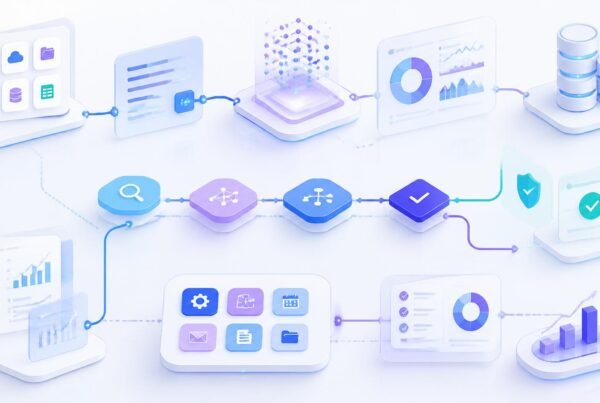


Modern companies do not only use employees’ accounts for logging into digital systems. Various other entities like agents, service accounts, applications, APIs, bots, and automated workloads interact with companies’ platforms and share sensitive information with each other. Although these identities act autonomously and do not involve any human interaction directly, yet they have access to critical systems and valuable data.
The rise of cloud computing, automation, and AI-driven applications has increased the amount of non-human identities exponentially. Every such entity will require credentials and access to several services. If there is an exposure in these credentials, hackers will be able to gain access to corporate systems without having to compromise any employee’s account.
It becomes very important for companies to ensure Non-Human Identity Security in the current context of cyber threats.
What Is Non-Human Identity Security?
Non-Human Identity Security is the management of the identities of digital entities that are not owned by humans. Non-human identities can be utilized to authenticate applications, machines, software, and AI to access the available resources.
Contrary to the identities of employees, non-human identities are usually autonomous. Such identities can make use of API keys, certificates, tokens, credentials of service accounts, among other types of authentication techniques.
For instance, in case of an automated backup service that uses machine identities to connect to cloud storage and to transfer files of the enterprise, theft of the credentials would enable the hacker to gain entry into the cloud storage environment.
Non-human identity security ensures the control of credentials, restriction of permissions, surveillance of activities, and removal of unnecessary identities.
The Importance of Non-Human Identity Security
Companies rely more and more on automation and applications that are connected together. Each connection, each cloud workload, and each AI service could have its own identity that will be used to perform operations.
Machine identities cannot be logged out; unlike human accounts, they do not have breaks. Also, some of them might keep having access even after they are no longer needed.
The stolen machine identity allows hackers to access data bases, manipulate automated workflows, get confidential data, or travel across interconnected applications.
Good Non-Human Identity Security can help companies mitigate those risks and manage each digital identity effectively.

Types of Non-Human Identities
Organizations need to first have an understanding of the various identities present in the environment before taking any security measures.
- Service Accounts: These are unique accounts which allow applications and services to interact with the operating system, databases, and resources.
- AI Agents: AI-based agents that carry out activities using credentials and connected devices.
- API Keys & Tokens: These are credentials that enable applications and services to log in to the API.
- Machine Identities: Machine identities that are associated with devices, servers, and automated processes.
- Workload Identities: These are identities of cloud applications, containers, and automated workloads.
- Digital Certificates: These are cryptographic credentials which are used for identifying systems and encrypting communications.
All the above-mentioned identities need appropriate authentication and access control.
Major Security Risks Associated With Non-Human Identities
1. Exposure of Machine Credentials
API keys, passwords, and access tokens can be included in code, configuration files, repositories, or logs. When they become exposed, hackers have no difficulty locating them. By using the credentials, they can easily infiltrate systems associated with them. Protection of machine credentials needs to be ensured.
2. Excessive Access Rights
Some service accounts can be granted more access than they need. Once an attacker manages to gain control over the account, he can use its excessive access rights to commit data theft, modify critical resources or navigate through the system. It would be better to limit access rights as far as it is possible.
3. Unmanaged and Abandoned Identities
Service accounts and API keys may be kept active even after the application or project they belong to ceases to function. Such abandoned identities can serve as vulnerabilities to exploit. They can be leveraged to get into the system, especially when no one monitors them anymore.
4. AI Agent Misuse
AI agents may access internal documents, APIs, databases, and external applications. If an agent is manipulated through malicious instructions or operates with excessive permissions, it may perform unauthorized actions or expose sensitive information.
5. Weak Credential Rotation
Long-lived credentials increase the potential impact of exposure. When organizations fail to rotate or revoke credentials, compromised access may remain available for extended periods.
Ways to Improve the Machine Identity Security
The process of machine identity security requires constant care. The steps related to it should be introduced at the initial stage of the identity lifecycle till the end.
1. Create a Complete List of All Identities
Firstly, it is necessary to discover all human identities running in the cloud environments, apps, databases, APIs, and within the internal networks.
Every machine identity should be provided with its owner, description, purpose, associated application, access level, and expiration date. Identifying such accounts and searching for them regularly would help security teams to detect all unknown accounts and eliminate unnecessary credentials.
2. Provide Appropriate Access Permissions
Each machine identity should be granted only with appropriate permissions that are required by the application itself. For example, the reporting app will only require reading the records but not the ability to modify the database independently.
Role-based access controls and permission policies per workload will help minimize the privileges of applications. Moreover, teams should review the permissions periodically depending on the changes within the app and business requirements.
3. Securely Store Secrets
Credentials should never be hardcoded in application source code. Kept in loose configuration files. Organizations should use the purpose-built secret management tools to securely store, retrieve and manage API keys, passwords and access tokens.
Only the correct individuals should gain access to such secrets. Access shall be verified on a regular schedule. If any credential becomes exposed it shall be revoked immediately.
4. Rotate Credentials on a Regular Schedule
Credential validity period creates additional exposure. Organizations should implement policies which will ensure automatic rotation of API keys, passwords, certificates and other machine credentials independently of a user.
When possible, lived tokens and dynamic credentials reduce the need for persistent secrets. Expired automatically and renewable credentials reduce credentials’ validity period.
5. Constrain AI Agent Scope of Access and Behavior
Access by AI agents shall be limited. Organizations shall know what applications, tools and data sources are accessible to each AI agent.
Any potentially critical actions performed by the agent, such as financial data changes, permissions modifications and data exfiltration shall require prior approval.
Testing of agent behavior and response to improper instructions and unexpected inputs should also be implemented.
6. Monitor Identity Activity at All Times
Observation is essential in order to detect anomalies in the behavior of machine identities. IT professionals need to monitor such factors as log-ins, any unusual API calls, data transfer and access attempts that go beyond requirements.
A centralized logging tool, in addition to an identity monitoring solution, can be instrumental in correlating identity activity across connected systems. An alert should be generated in case of an identity performing some anomalous actions.
7. Get Rid of Unneeded Identities
Inanimate identities should be audited regularly. Such accounts that have been associated with defunct applications and services should be terminated after the need for their existence has been identified.
This will minimize the number of credentials that could potentially be used by an attacker.
Technologies That Support Non-Human Identity Security
Organizations can combine identity management, secrets protection, and monitoring technologies to strengthen machine identity security.
| Security Technology | Purpose |
|---|---|
| Privileged Access Management (PAM) | Controls privileged account access |
| Secrets Management | Protects passwords, tokens, and API keys |
| Identity and Access Management (IAM) | Manages identity permissions |
| Public Key Infrastructure (PKI) | Manages digital certificates |
| Security Information and Event Management (SIEM) | Analyzes identity activity and security events |
| Workload Identity Solutions | Provides authentication for applications and cloud workloads |
These technologies help improve visibility and control, but they should operate within a clearly defined identity governance strategy.

Conclusion
Non-human identities have become integral to the functioning of modern companies by facilitating AI agents, automated processes, cloud computing, and integration between various systems. At the same time, lack of control over such identities, too much access, and insufficient monitoring can make these entities an attractive target for cyber attacks.
Managing Non-Human Identities properly involves keeping track of such entities, using least-privilege approach, protecting machine credentials, automating their rotation, and constant monitoring of the activity. AI agents also require precise permissions and proper human supervision.
Given the increased reliance on automated and connected systems, the protection of non-human identities is going to become a crucial aspect of enterprise cybersecurity efforts.
Frequently Asked Questions (FAQs)
1. What is Non-Human Identity Security?
It is the practice of protecting digital identities used by applications, machines, service accounts, APIs, and AI agents to access business systems.
2. Why are non-human identities a cybersecurity risk?
They often operate automatically, may have extensive permissions, and can retain active credentials without regular human review. Compromised identities can provide attackers with access to sensitive systems.
3. How can businesses protect machine credentials?
Businesses should use secure secrets management, short-lived credentials where possible, automated rotation, restricted permissions, and continuous activity monitoring.
4. What is the difference between human and non-human identities?
Human identities belong to individual users, while non-human identities are assigned to applications, services, machines, workloads, and automated systems.
5. How does Non-Human Identity Security protect AI agents?
It limits which resources AI agents can access, controls their credentials, monitors their actions, and requires approval for sensitive operations.