

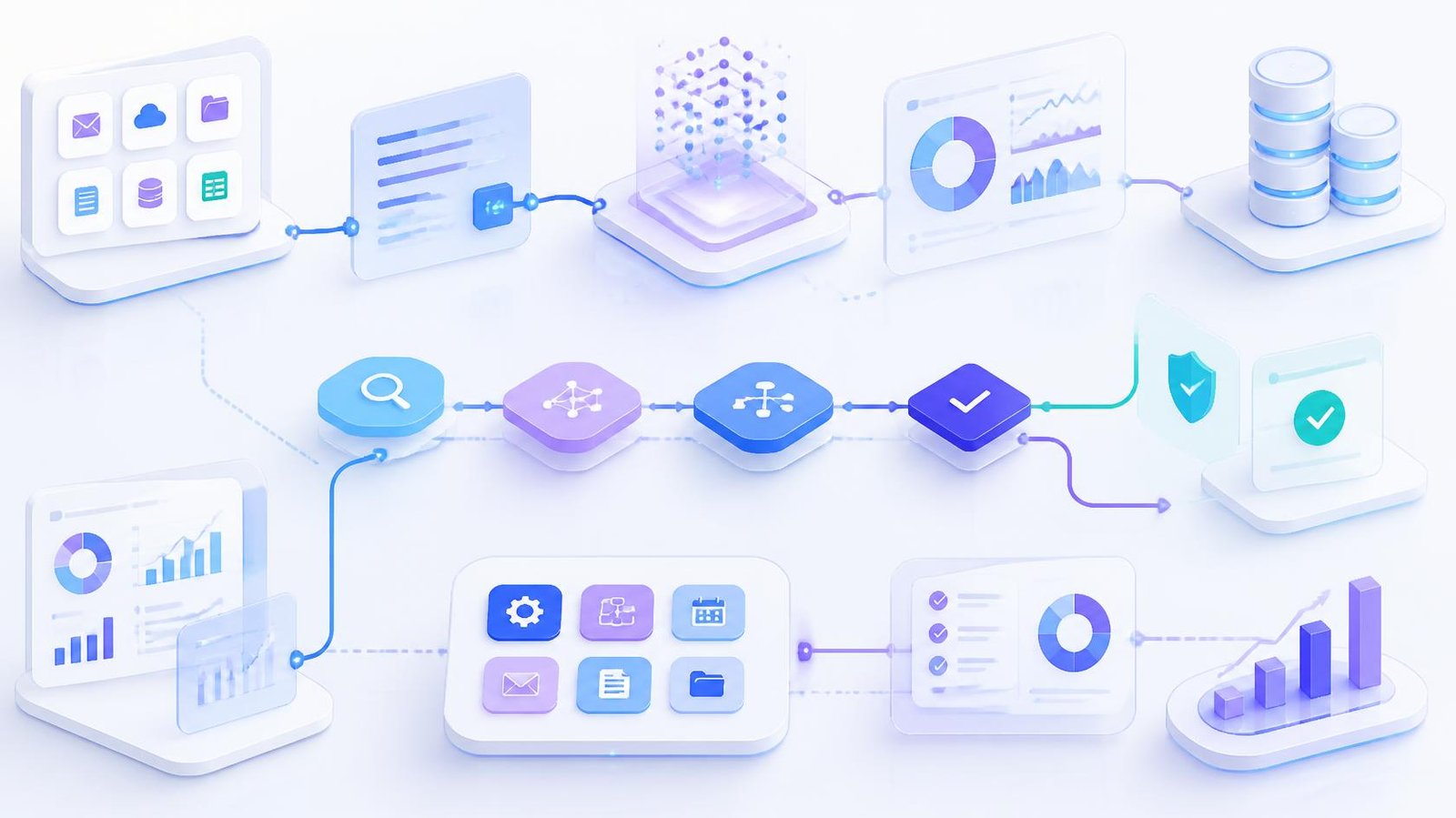
AI agents are moving beyond simple experiments. Enterprises are increasingly exploring AI systems that can analyze information, make decisions, interact with software, and complete multi-step workflows with less human intervention.
This shift has created a major opportunity for businesses. AI agent automation can help organizations improve productivity, reduce repetitive work, accelerate decision-making, and coordinate complex processes across multiple systems. However, greater autonomy also creates greater responsibility.
When AI agents can access enterprise data, call APIs, update business systems, trigger workflows, or communicate with customers, organizations need more than powerful AI models. They need governance.
That is why Governed AI Agent Automation is becoming an enterprise priority. Businesses are realizing that AI agents must operate within clear rules, permissions, security controls, monitoring systems, and accountability frameworks.
The question is no longer simply, “What can an AI agent do?”
Enterprise leaders are increasingly asking:
- What data can the agent access?
- Which actions can it perform?
- Who approves high-risk decisions?
- How can organizations monitor agent behavior?
- What happens when an agent makes a mistake?
- How can businesses scale AI agent automation without losing control?
As AI agents become more capable, governed automation is becoming essential for responsible enterprise adoption.

What Is Governed AI Agent Automation?
Governed AI Agent Automation refers to the use of AI agents to perform business tasks within a controlled framework of policies, permissions, security measures, monitoring, and human oversight.
An AI agent may be capable of performing actions such as:
- Analyzing customer information
- Searching internal knowledge bases
- Updating CRM records
- Generating reports
- Sending communications
- Calling APIs
- Creating support tickets
- Triggering workflows
- Recommending business actions
However, governance determines how, when, and under what conditions those actions are allowed.
For example, an AI sales agent may be allowed to:
- Research a prospect
- Summarize account activity
- Score a lead
- Draft a personalized email
- Recommend the next sales action
But it may not be allowed to:
- Change pricing
- Approve contracts
- Access unrelated customer records
- Delete CRM data
- Send certain communications without approval
This is the core difference between simply deploying an AI agent and implementing governed AI agent automation.
The goal is not to remove every limitation from AI systems. The goal is to give AI agents enough autonomy to create business value while maintaining the control required for enterprise operations.
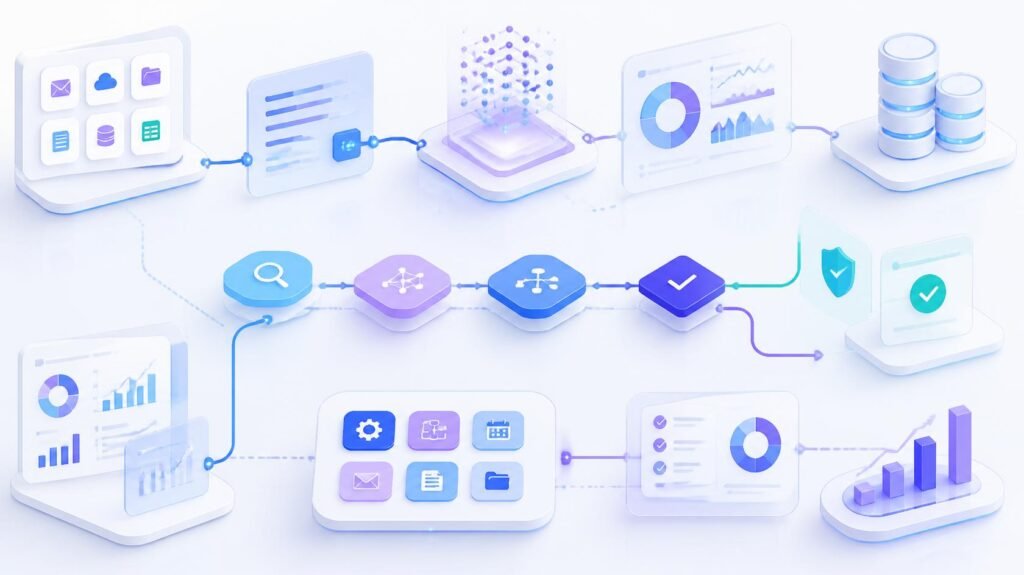
A Simple Governed AI Agent Workflow
| Stage | AI Agent Activity | Governance Control |
|---|---|---|
| Trigger | Receives a task | Validates source and request |
| Analyze | Understands context | Applies policy rules |
| Retrieve | Accesses information | Enforces data permissions |
| Decide | Selects next action | Checks risk level |
| Act | Uses approved tools | Limits available actions |
| Verify | Checks result | Records activity |
| Escalate | Requests human help | Requires approval for high-risk tasks |
| Monitor | Tracks performance | Supports auditing and improvement |
This structure helps enterprises introduce autonomy without creating uncontrolled automation.
Why AI Agent Automation Needs Governance
Traditional automation usually follows predefined instructions.
For example:
When a customer submits a form, create a CRM record.
The workflow is predictable.
AI agent automation is different because the agent may need to interpret information and choose between different actions.
For example:
Review the incoming lead, research the company, determine buying intent, check previous interactions, prioritize the opportunity, and recommend the next action.
The exact path may change depending on the context.
This flexibility is valuable. However, it also creates new governance challenges.
An enterprise AI agent may interact with:
- Customer data
- Internal documents
- Financial information
- Cloud platforms
- Business applications
- APIs
- Security systems
- Communication tools
Without clear controls, an AI agent could potentially access too much information or take actions beyond its intended purpose.
Governance helps organizations answer three critical questions:
1. What Can the AI Agent See?
Data access should be controlled according to business requirements.
An agent working in marketing should not automatically have access to sensitive financial information simply because it is connected to the organization.
2. What Can the AI Agent Do?
Every action should have a defined permission level.
For example, an AI agent may be allowed to create a support ticket but require approval before closing a high-priority customer complaint.
3. Who Is Responsible for the Outcome?
Enterprises need accountability.
When AI agents make recommendations or perform actions, organizations should be able to understand:
- What happened
- Why the action occurred
- Which data was used
- Which system was affected
- Whether a human approved the action
Governance creates the structure required to manage these responsibilities.

The Shift From AI Experiments to Enterprise Automation
Many organizations initially adopted generative AI through simple use cases.
Employees used AI tools to:
- Draft content
- Summarize documents
- Generate ideas
- Write code
- Answer questions
The next stage is more operational.
Instead of simply asking AI for an answer, businesses are beginning to explore whether AI can complete parts of the workflow.
This is where AI agent automation becomes important.
Consider the difference.
Traditional AI Interaction
Employee → Ask AI a question → AI provides an answer → Employee completes the task
AI Agent Automation
Business event → AI agent analyzes → AI retrieves information → AI selects next action → AI uses approved tools → AI completes or escalates the task
The second model creates greater potential for productivity, but it also increases operational complexity.
When AI becomes part of business execution, enterprises need to manage it like any other important technology system.
They need:
- Access controls
- Monitoring
- Logging
- Security
- Policies
- Approval mechanisms
- Performance measurement
This is why governance is becoming an important part of AI agent automation strategy.
Why Enterprises Are Making Governed AI Agent Automation a Priority
1. AI Agents Are Becoming More Autonomous
Early AI tools were primarily reactive.
A user entered a prompt and received an output.
AI agents can operate differently.
They may:
- Receive goals
- Plan multiple steps
- Retrieve information
- Use connected tools
- Evaluate results
- Continue through a workflow
As autonomy increases, enterprises need stronger boundaries.
The challenge is not necessarily that AI agents are becoming dangerous. The challenge is that they are becoming operationally important.
An AI agent that can only answer a question has limited impact on enterprise systems.
An AI agent that can update records, send messages, trigger workflows, and interact with APIs requires much stronger governance.
2. Enterprises Need to Protect Sensitive Data
Enterprise data is often distributed across multiple systems.
This may include:
- Customer records
- Employee information
- Financial documents
- Product data
- Intellectual property
- Sales information
- Security information
AI agents require access to information to perform useful tasks.
However, access must be limited.
A strong governed AI agent automation strategy uses principles such as:
- Role-based access
- Least-privilege permissions
- Data classification
- Authentication
- Authorization
- Activity logging
The AI agent should have access only to the information required to complete its specific task.
More access does not automatically make an agent more effective.
In many cases, excessive access creates unnecessary risk.
3. AI Agents Can Take Real Business Actions
One of the most important differences between AI assistants and AI agents is action.
An AI assistant may recommend:
This lead should be assigned to the enterprise sales team.
An AI agent may actually:
- Update the CRM
- Assign the lead
- Create a task
- Notify the sales representative
- Generate a follow-up draft
This creates significant business value.
It also means enterprises need to control what actions an agent can perform.
A useful approach is to divide actions into categories.
| Action Type | Example | Governance Level |
|---|---|---|
| Low Risk | Summarize a document | Automated |
| Moderate Risk | Create a draft response | Automated with review |
| High Risk | Send customer communication | Conditional approval |
| Critical Risk | Approve a financial transaction | Human approval required |
This approach allows organizations to scale automation without treating every action the same way.
4. Enterprises Need Visibility Into AI Agent Decisions
Traditional software workflows are generally easier to trace.
If a workflow follows:
Trigger A → Step B → Step C
the process is relatively clear.
AI agents may make decisions based on context.
For example:
Why did the agent escalate this customer issue?
A governed system should help provide useful information about the workflow.
Organizations may need to track:
- Agent objective
- Input source
- Data accessed
- Tools used
- Actions taken
- Approval decisions
- Errors
- Final outcome
This creates a more transparent environment for managing AI automation.
5. Regulation and Compliance Are Increasingly Important
Organizations operating in regulated industries face additional responsibilities.
Industries such as:
- Financial services
- Healthcare
- Insurance
- Government
- Legal services
often have strict requirements around data access, security, accountability, and decision-making.
Governance can help organizations align AI agent automation with existing enterprise policies.
Instead of creating a separate uncontrolled AI environment, businesses can integrate AI agents into their broader governance framework.
This may include existing policies for:
- Identity management
- Data security
- Risk management
- Compliance
- Audit
- Access management
The objective should be integration rather than fragmentation.
Key Components of Governed AI Agent Automation
A strong governance framework does not depend on one technology.
It is a combination of policies, processes, controls, and monitoring.
Identity and Authentication
Every AI agent should have a defined identity.
The enterprise should know:
- Which agent is performing the action
- Which application initiated the workflow
- Which credentials are being used
Anonymous automation creates unnecessary risk.
Identity is the foundation of accountability.
Access and Permission Controls
AI agents should receive only the permissions required for their tasks.
For example, a customer support agent may need permission to:
- Read customer account details
- Search the knowledge base
- Create support tickets
It may not need permission to:
- Modify payment systems
- Access HR information
- Change administrator settings
This principle is known as least-privilege access.
Policy Enforcement
Policies define the boundaries of agent behavior.
For example:
The agent may send a standard follow-up email.
But:
The agent cannot offer discounts above 10%.
Or:
The agent may recommend a refund but cannot approve one above a defined amount.
Policies help transform broad AI capabilities into controlled business processes.
Human Approval Workflows
Not every AI decision requires human review.
However, high-impact decisions should include appropriate approval mechanisms.
Examples include:
- Financial approvals
- Contract decisions
- Customer account changes
- Security modifications
- Data deletion
This is often described as human-in-the-loop automation.
The objective is not to slow AI down unnecessarily.
It is to introduce human judgment where the consequences of an error are significant.
Monitoring and Logging
Enterprises should be able to monitor agent activity.
Important information may include:
- Number of tasks completed
- Tools accessed
- Failed actions
- Escalations
- Human corrections
- Policy violations
Monitoring helps organizations understand whether an AI agent is actually creating value.
It also helps identify unusual behavior.
Evaluation and Testing
AI agents should be evaluated before and after deployment.
Testing should include:
- Normal requests
- Incomplete information
- Incorrect information
- Conflicting instructions
- Tool failures
- Unexpected scenarios
Testing only the ideal workflow is not enough.
Enterprise systems must also be prepared for exceptions.
Governed AI Agent Automation vs Traditional Automation
Traditional automation remains important.
The goal is not to replace every automation workflow with AI agents.
| Feature | Traditional Automation | Governed AI Agent Automation |
|---|---|---|
| Workflow path | Fixed | Dynamic within defined boundaries |
| Decision-making | Rule-based | Context-aware |
| Data | Usually structured | Structured and unstructured |
| Actions | Predefined | Policy-controlled |
| Adaptability | Limited | Higher |
| Governance | System controls | System + AI governance |
| Human approval | Workflow-based | Risk-based |
| Best use case | Predictable tasks | Complex multi-step tasks |
Traditional automation is often better for simple processes.
For example:
Move a completed form from one system to another.
AI is unnecessary.
Governed AI agent automation becomes more valuable when the workflow involves interpretation.
For example:
Analyze the customer request, retrieve account information, determine the appropriate response, perform approved actions, and escalate unusual cases.
The strongest enterprise automation strategy will likely combine both approaches.
Real-World Use Cases for Governed AI Agent Automation
AI Agent Automation for Sales
Sales organizations manage large volumes of information.
A governed sales agent can:
- Research accounts
- Analyze engagement
- Identify buying signals
- Score opportunities
- Update CRM records
- Recommend next actions
However, the agent should operate within clear permissions.
For example, it may update a lead score but require approval before changing a major opportunity stage.
Workflow
New Account → Research → Analyze Intent → Check CRM → Score Opportunity → Recommend Action → Human Review When Required
AI Agent Automation for Customer Support
AI agents can help manage repetitive support tasks.
A governed support workflow may:
- Receive a customer request
- Identify the issue
- Retrieve relevant account information
- Search the knowledge base
- Generate a response
- Perform approved actions
- Escalate sensitive cases
This can improve speed without allowing the agent unlimited control over customer accounts.
AI Agent Automation for IT Operations
IT teams receive large numbers of alerts.
An AI agent can help:
- Analyze alerts
- Group related incidents
- Identify possible causes
- Search historical incidents
- Create tickets
- Notify the correct teams
However, infrastructure changes may require approval.
For example:
The AI agent can recommend restarting a service but cannot automatically make production changes without authorization.
This is a practical example of governed autonomy.
AI Agent Automation for Marketing
Marketing agents can analyze campaign performance and identify potential improvements.
A governed workflow might include:
Campaign Data → Performance Analysis → Identify Opportunity → Generate Recommendation → Human Approval → Execute Changes
The AI agent may identify underperforming campaigns.
However, major budget changes should remain under human control.
AI Agent Automation for Finance Operations
Finance workflows often involve sensitive data and important business decisions.
AI agents can assist with:
- Invoice classification
- Document analysis
- Payment matching
- Exception detection
- Report generation
However, payment approval should remain subject to appropriate governance.
This creates a balance between automation and financial control.
The Risks of Ungoverned AI Agents
The benefits of AI agent automation are significant.
However, uncontrolled autonomy can create operational problems.
Excessive Permissions
An AI agent with broad access can potentially affect systems beyond its intended purpose.
The solution is clear permission management.
Incorrect Actions
AI agents can misunderstand instructions or context.
A mistake may have limited consequences in a research workflow.
The same mistake could be serious in:
- Finance
- Security
- Healthcare
- Customer accounts
Risk-based governance helps determine when human approval is necessary.
Lack of Accountability
If an enterprise cannot determine why an action occurred, managing the system becomes difficult.
Logging and monitoring help create accountability.
Shadow AI
Employees may use AI tools outside approved governance frameworks.
This can create inconsistent security and data practices.
Organizations need practical approved alternatives.
Simply restricting AI without providing useful tools may encourage ungoverned adoption.
How Human Oversight Supports AI Agent Automation
Human oversight does not mean humans must approve every AI action.
That would eliminate many of the productivity benefits.
Instead, enterprises can use different levels of oversight.
Human-in-the-Loop
The AI agent performs analysis, but a human approves the final action.
Human-on-the-Loop
The AI agent performs approved actions independently while humans monitor activity.
Human-out-of-the-Loop
The system performs fully automated actions without direct human involvement.
The appropriate model depends on the risk.
| Workflow | Recommended Oversight |
|---|---|
| Document summarization | Human-on-the-loop |
| Lead scoring | Human-on-the-loop |
| Customer refund | Human-in-the-loop |
| Security configuration change | Human-in-the-loop |
| Financial approval | Human-in-the-loop |
| Routine data transfer | Human-out-of-the-loop |
The objective is to match the level of oversight to the potential impact.
Best Practices for Building Governed AI Agent Automation
1. Start With a Specific Business Problem
Do not begin with:
We need an AI agent.
Begin with:
We need to reduce the time required to resolve repetitive customer requests.
The business problem should determine the automation strategy.
2. Define the Agent’s Role Clearly
Every AI agent should have a specific responsibility.
For example:
The agent analyzes incoming leads and recommends the next action.
Avoid giving one agent responsibility for unrelated business processes.
Clear roles improve control and accountability.
3. Apply Least-Privilege Access
Give the agent only the permissions required for its job.
Review permissions regularly.
This is one of the most important principles of governed AI agent automation.
4. Define Action Boundaries
Clearly document:
- Actions the agent can perform
- Actions requiring approval
- Actions the agent cannot perform
This reduces ambiguity.
5. Build Escalation Paths
Every enterprise workflow should have a path for unusual situations.
The agent should know when to stop.
Examples include:
- Missing information
- Policy conflicts
- High-risk requests
- Low-confidence decisions
- Tool failures
Escalation is not a failure.
It is a critical part of responsible automation.
6. Test Before Scaling
Start with a limited workflow.
Measure:
- Accuracy
- Task completion
- Error rates
- Human intervention
- Business value
Then expand gradually.
Large-scale deployment should follow successful evaluation rather than assumptions.
7. Monitor Business Outcomes
Do not measure only how many tasks the agent completed.
Also measure business outcomes.
For example:
- Did support resolution improve?
- Did sales response time decrease?
- Did employee productivity increase?
- Did error rates decline?
- Did customer satisfaction improve?
Technology metrics and business metrics should work together.
How Enterprises Can Measure AI Agent Automation Success
A successful AI agent automation program should have measurable outcomes.
Operational Metrics
Track:
- Workflow completion rate
- Average processing time
- Error rate
- Escalation rate
- Tool failure rate
Employee Metrics
Measure:
- Hours saved
- Manual tasks reduced
- Productivity improvements
- Human correction requirements
Business Metrics
Evaluate:
- Cost reduction
- Revenue impact
- Customer satisfaction
- Conversion improvement
- Operational efficiency
Example Measurement Framework
| Metric | Before Automation | After Automation |
|---|---|---|
| Average response time | Baseline | Improvement target |
| Manual steps | Baseline | Reduction target |
| Task completion | Baseline | Improvement target |
| Human corrections | Baseline | Reduction target |
| Customer satisfaction | Baseline | Improvement target |
The purpose is to prove business value rather than simply demonstrate AI activity.
The Future of Governed AI Agent Automation
AI agents are likely to become more deeply integrated into enterprise operations.
Businesses may increasingly use multiple agents for different responsibilities.
For example:
- Research agent
- Sales agent
- Customer support agent
- Marketing agent
- Finance agent
- IT operations agent
These systems may eventually coordinate with each other through controlled workflows.
However, greater interoperability will make governance even more important.
The future enterprise environment may require organizations to manage:
- Agent identity
- Agent permissions
- Agent communication
- Agent actions
- Agent performance
- Agent accountability
The next stage of enterprise AI will not be defined only by model intelligence.
It will also be defined by how effectively organizations can control and manage intelligent systems at scale.
The companies that succeed will not necessarily be the ones that deploy the largest number of AI agents.
They may be the ones that build the strongest operational foundation for responsible AI autonomy.
Final Thoughts
Governed AI Agent Automation is becoming an enterprise priority because AI agents are moving from assistance to action.
As AI systems gain the ability to access data, use enterprise tools, and complete multi-step workflows, businesses need stronger controls around how those systems operate.
The future is not likely to be completely autonomous or completely manual.
It will be a combination of:
- AI intelligence
- Traditional automation
- Enterprise data
- Security controls
- Governance frameworks
- Human oversight
The most successful enterprises will focus on building AI agent automation that is not only powerful but also reliable, secure, transparent, and measurable.
Organizations should begin with focused use cases, establish clear governance, limit permissions, monitor outcomes, and gradually expand successful workflows.
The goal is not to give AI agents unlimited autonomy.
The goal is to create governed AI agent automation that delivers business value without sacrificing enterprise control.
As AI agents become a larger part of everyday operations, governance will no longer be treated as an additional feature. It will become one of the foundations of successful enterprise AI adoption.
Frequently Asked Questions
What is governed AI agent automation?
Governed AI agent automation is the use of AI agents within a controlled framework that includes permissions, policies, security controls, monitoring, and human oversight.
Why do AI agents need governance?
AI agents may access enterprise data and perform real actions across business systems. Governance helps organizations control access, reduce risk, monitor activity, and maintain accountability.
What is the difference between AI agent automation and traditional automation?
Traditional automation follows predefined rules. AI agent automation can interpret context and choose between approved actions within a defined governance framework.
Can AI agents operate without human oversight?
Yes, for low-risk and predictable actions. However, high-impact decisions should usually include appropriate human oversight and approval.
What are the main benefits of governed AI agent automation?
Key benefits include:
- Improved productivity
- Faster workflows
- Reduced manual work
- Better scalability
- Controlled AI autonomy
- Improved accountability
- Reduced operational risk
What should enterprises do before deploying AI agents?
Organizations should define the business use case, establish permissions, identify risks, create action boundaries, build escalation paths, test workflows, and monitor outcomes.