

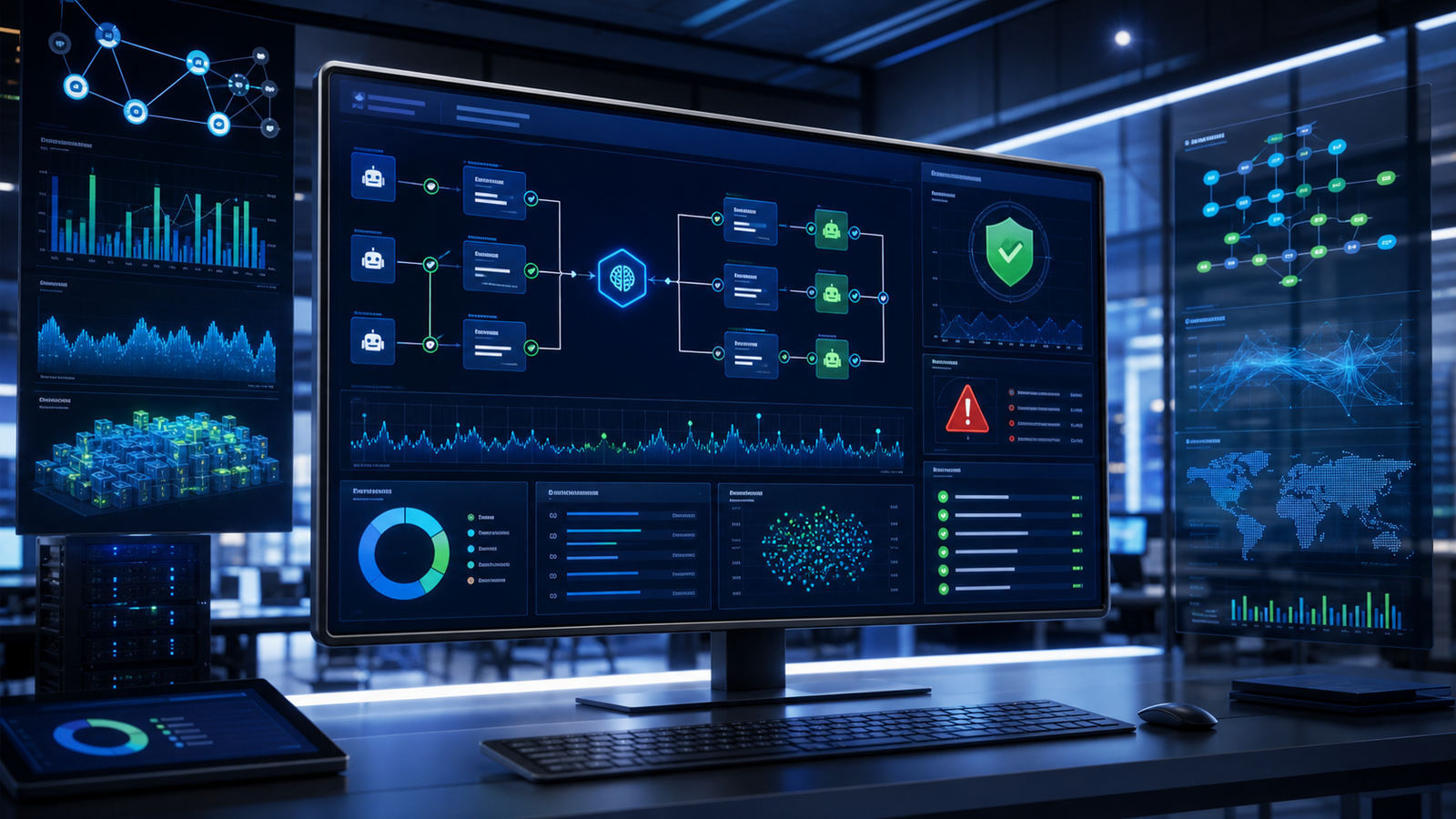
AI agents are moving from experiment rooms into real business workflows. They are no longer just answering questions or helping employees write faster emails. In many companies, agents are now checking data, summarizing customer records, routing support tickets, preparing reports, triggering workflows, and helping teams make decisions. This shift is exciting, but it also creates a new problem: leaders need to see what these agents are actually doing.
In simple words, AI Agent Observability means watching, measuring, and understanding how AI agents behave inside enterprise systems. It helps teams answer practical questions. Did the agent complete the task correctly? Which tools did it use? Did it access the right data? Did it follow policy? Did it ask for human approval when needed? Did it create value or create risk?
Why AI Agent Observability Is Becoming a 2026 Priority
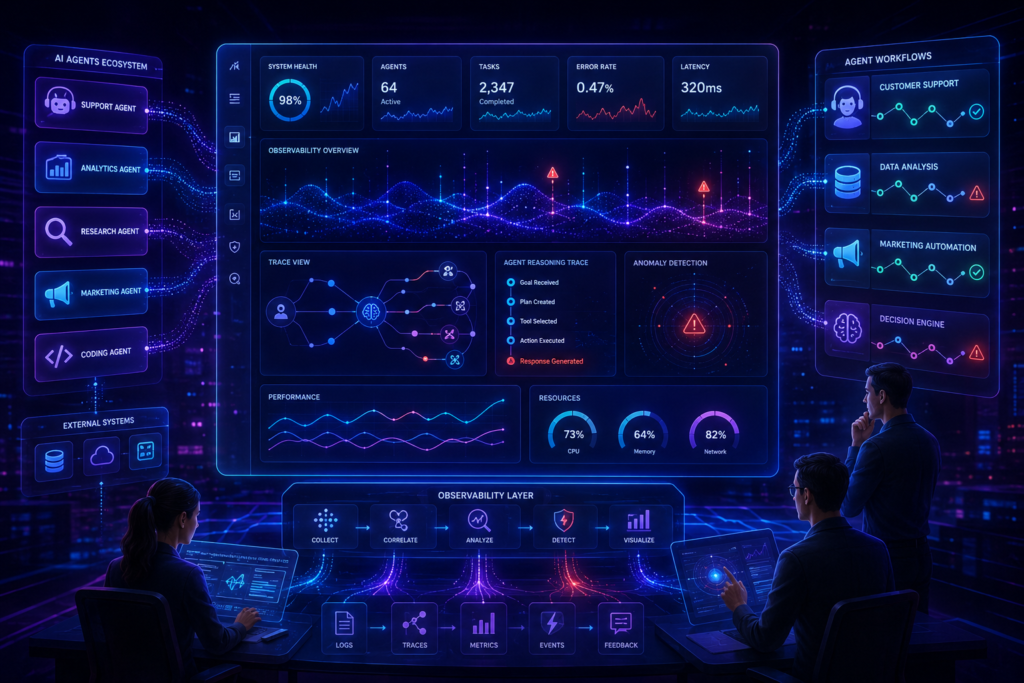
The enterprise AI conversation has changed. In 2023 and 2024, many companies asked, “Can generative AI help us work faster?” In 2025, the question became, “Can AI agents complete tasks across systems?” In 2026, the more serious question is, “Can we trust agents enough to run them in production?”
An AI agent may look helpful during a demo. It may complete a simple task in a controlled environment. But production is different. Real workflows include messy data, unclear instructions, changing business rules, sensitive customer information, and unexpected edge cases. Without observability, teams may not notice when an agent quietly takes the wrong action, repeats a mistake, or creates a compliance concern.
AI Agent Observability gives leaders a way to move from hope to evidence. Instead of assuming an agent is working, teams can measure it. Instead of waiting for a customer complaint, teams can catch quality issues early. Instead of relying on vague AI enthusiasm, teams can connect agent performance to real business outcomes.
This is why observability is becoming part of the enterprise AI foundation. Governance defines what agents should do. Observability shows what agents actually did.
AI Agent Observability Basics for Enterprise Leaders
At its core, AI Agent Observability has three parts: visibility, interpretation, and action.
Visibility means collecting information from the activity. This can include prompts, responses, tool calls, system events, data sources, approval requests, errors, and outputs.
Interpretation means turning that information into useful insight. A raw log may show that an agent called a CRM tool, but a leader needs to know whether that call was necessary, allowed, accurate, and helpful.
Action means using the insight to improve the system. If an agent creates weak summaries, the team may adjust prompts, improve retrieval, add validation, or change the approval flow. If an agent accesses too much data, the team may reduce permissions.
The best observability systems connect all five layers. Technical metrics alone are not enough. A fast agent can still make a bad decision. A low-error workflow can still create poor business results. A true AI Agent Observability program looks at the full picture.
Why Normal Monitoring Is Not Enough
Many technology teams already monitor software. They use dashboards, alerting tools, application logs, and performance metrics. These tools are still useful, but they do not fully explain AI agent behavior.
A normal application usually follows a fixed path. If a user clicks a button, the system runs a predictable process. If something fails, engineers can often trace the failure through code, infrastructure, or configuration.
An AI agent is different. It may decide which tool to call. It may choose how to break down a task. It may use retrieved knowledge from different sources. It may generate an answer that sounds confident but needs verification. It may also behave differently when the same user asks the same question in a slightly different way.
This makes agent monitoring more complex.
For example, a sales operations agent may be asked to prepare a weekly pipeline summary. It may pull CRM data, compare current deals with last movement, identify stalled opportunities, and recommend next steps. A normal monitoring dashboard may show that the workflow completed successfully. But AI Agent Observability asks deeper questions:
- Did the agent use the correct CRM fields?
- Did it exclude outdated or duplicate records?
- Did it explain the assumptions behind its recommendation?
- Did it avoid exposing sensitive customer notes?
- Did a manager approve the final summary before it was shared?
These questions matter because business trust depends on more than system uptime.
Human Oversight Is Still Part of the System

Some people think autonomous agents mean humans disappear from the workflow. That is not a realistic enterprise strategy. In most serious business settings, humans still need to supervise, approve, correct, and improve agent behavior.
AI Agent Observability supports this shift from “human in the loop” to “human on the loop.” Instead of manually doing every task, people supervise the process and step in when risk is high. The agent handles routine work, but humans remain responsible for judgment, accountability, and exceptions.
This is especially important in areas like finance, healthcare, cybersecurity, legal operations, HR, and customer data management. A small mistake in these areas can create large consequences. Observability helps teams decide when an agent can act alone and when it must pause for approval.
Human oversight works best when alerts are meaningful. If every small event triggers an alert, people stop paying attention. If alerts are too rare, teams may miss important issues. A good observability program uses risk-based thresholds. Low-risk actions can be monitored quietly. High-risk actions should create clear review points.
The Metrics That Matter Most
AI Agent Observability should not drown leaders in dashboards. The goal is not to track everything forever. The goal is to track the right signals.
Different agents need different metrics. A customer support agent should be measured by answer accuracy, escalation rate, resolution time, customer satisfaction, and policy compliance. A finance agent may need accuracy, auditability, approval history, and exception handling. A developer agent may need code quality, security findings, test success, and review acceptance.
Still, most enterprise agents share a few important metric groups.
| Metric Group | Example Measures | Business Question |
|---|---|---|
| Quality | Accuracy, hallucination rate, correction rate | Can we trust the output? |
| Efficiency | Time saved, cost per task, workflow speed | Is the agent improving productivity? |
| Safety | Policy violations, risky actions, blocked requests | Is the agent staying within guardrails? |
| Reliability | Failed tool calls, retries, timeout rates | Does the workflow work consistently? |
| Adoption | User acceptance, repeat usage, satisfaction | Do employees actually want to use it? |
| Value | Revenue impact, savings, reduced workload | Is the agent worth scaling? |
These metrics should be reviewed together. An agent that saves time but creates too many corrections may not be ready for wider use. An agent that is accurate but too expensive may need a different design. An agent that users avoid may need better workflow integration.
Audit Trails Are Non-Negotiable
Audit trails are one of the most important parts of AI Agent Observability. They create a clear record of what happened.
A useful audit trail should show the user request, the tools used, the data accessed, the output created, and any human approval or correction. This record helps teams investigate problems, improve prompts, prove compliance, and explain decisions.
Without audit trails, companies may struggle to answer basic questions after something goes wrong. If an agent sends the wrong report, who approved it? If it used the wrong data, where did that data come from? If it made a recommendation, what evidence supported it?
Audit trails also support accountability. Enterprise leaders do not need every employee to understand every technical detail of an AI system. But they do need a reliable way to review actions and decisions.
In regulated industries, this becomes even more important. Compliance teams may need to prove that sensitive data was handled correctly. Legal teams may need to understand how an automated decision was made. Security teams may need to investigate unusual access patterns. Observability turns agent behavior into something the organization can inspect.
AI Agent Observability and Governance Work Together
AI governance and AI Agent Observability are closely connected, but they are not the same thing.
Governance defines rules, ownership, risk levels, approval processes, and acceptable use. Observability shows whether those rules are being followed in real workflows.
Think of governance as the map and observability as the dashboard. The map says where the agent is allowed to go. The dashboard shows where it actually went.
This connection is important because many companies have AI policies on paper but weak visibility in practice. They may say agents should not access sensitive data, but they may not have a clear record of what data was retrieved. They may say humans approve high-risk actions, but they may not track how often approvals are skipped or rushed.
| Governance Question | Observability Answer |
|---|---|
| Who owns this agent? | Owner, team, lifecycle status |
| What can the agent access? | Actual data sources and permissions used |
| What decisions can it make? | Tool calls, actions, and approval history |
| Is it following policy? | Violations, warnings, blocked actions |
| Is it creating value? | Outcome metrics and business impact |
When governance and observability work together, leaders can scale agents with more confidence. They can identify strong use cases, retire weak ones, and improve risky workflows before they become major problems.
Common AI Agent Observability Mistakes
The first mistake is tracking only technical health. If an agent is fast and available, that is good, but it does not prove the agent is useful or safe.
The second mistake is ignoring business context. A dashboard full of logs may help engineers, but executives need to understand whether the agent improves productivity, quality, customer experience, or revenue.
The third mistake is giving agents too much access too early. Observability can reveal over-permissioned agents, but teams should also design access carefully from the start.
The fourth mistake is treating observability as an afterthought. It should be built into the agent workflow before production, not added only after something breaks.
The fifth mistake is failing to involve human reviewers. Observability works best when business teams, compliance teams, security teams, and technical teams can all understand the signals that matter to them.
AI Agent Observability Roadmap
Enterprises do not need to build a perfect observability program on day one. A practical roadmap is better.
Start with the most important agents. Choose the agents that touch sensitive data, customer-facing workflows, financial decisions, or high-volume operations. These agents deserve the most attention.
Next, define success clearly. What should the agent achieve? What counts as a good output? What counts as a risky action? What must be escalated to a human?
Then collect the right data. Track requests, outputs, tool calls, data access, approvals, corrections, and business outcomes. Keep the system useful, not overwhelming.
After that, create review routines. Teams should look at agent performance regularly, not only after incidents. Weekly or monthly reviews can help identify patterns before they become serious.
Finally, improve continuously. Agents should not be treated as finished products. They should be updated as workflows, data, regulations, and business goals change.
Seven Powerful Steps to Start
- List every AI agent currently used in the organization.
- Assign an owner to each agent and define its business purpose.
- Classify agents by risk level based on data, decisions, and workflow impact.
- Track prompts, responses, tool calls, data sources, and approvals.
- Create quality metrics that match the agenda.
- Add human review points for high-risk actions.
- Review agent performance regularly and retire agents that do not create value.
These steps are simple, but they create discipline. Many AI problems come from unclear ownership and weak follow-through. A basic observability practice can prevent a lot of confusion.
How to Keep AI Agent Observability Practical
The best observability programs are practical. They help people make decisions. They do not create dashboards that nobody reads.
Start with a few meaningful questions. Is the agent accurate? Is it safe? Is it useful? Is it improving over time? Is someone accountable for it?
Then build visibility around those questions.
For a support agent, practical observability may mean tracking customer satisfaction, escalation rate, answer accuracy, and policy warnings. For a sales intelligence agent, it may mean tracking CRM field usage, summary quality, manager edits, and time saved. For a security agent, it may mean tracking alerts investigated, false positives, suspicious tool calls, and response time.
Every metric should connect to a decision. If a metric does not help anyone improve the agent, reduce risk, or prove value, it may not be worth tracking.
The Future of AI Agent Observability
AI agents will become more common, more connected, and more capable. As that happens, observability will become a standard part of enterprise AI architecture.
In the future, companies may manage agents the way they manage employees, applications, and cloud services. Each agent will have an identity, purpose, permissions, performance history, risk rating, and lifecycle status. Leaders will not ask only how many agents they have. They will ask which agents are trusted, which are improving, and which should be retired.
This is a healthy shift. It moves enterprise AI away from hype and toward operational maturity.
The companies that win with agents will not be the ones that deploy the most bots. They will be the ones that understand what their agents are doing, measure whether those agents create value, and keep humans in control of important decisions.
Conclusion
AI Agent Observability is becoming essential because enterprises cannot scale what they cannot see. As agents take on more tasks, leaders need clear visibility into behavior, data access, decisions, outcomes, and risk.
Good observability helps companies trust AI agents without blindly depending on them. It supports governance, improves quality, reduces risk, and helps teams prove business value. Most importantly, it keeps AI accountable in the real world, where workflows are messy and decisions matter.
For enterprise leaders, the message is simple: do not wait until agents fail in production to start watching them. Build AI Agent Observability early, keep it practical, and use it as the foundation for safe, useful, and scalable autonomous workflows.