
Software development is moving faster than ever before. Modern applications are built by distributed teams, updated frequently, and expected to meet high standards for security, performance, and reliability. As projects grow in complexity, ensuring code quality through manual reviews alone has become increasingly difficult. Developers often spend hours reviewing pull requests, identifying bugs, checking coding standards, and suggesting improvements, which can slow down the entire development process.
This is where AI code review automation is changing the way software teams work. By using artificial intelligence to analyze source code automatically, organizations can detect issues earlier, improve consistency, and reduce the time required for code reviews. Instead of replacing developers, AI acts as an intelligent assistant that handles repetitive review tasks and allows engineers to focus on solving complex problems.
As businesses continue adopting DevOps, continuous integration, and continuous delivery practices, automated code reviews powered by AI are becoming an essential part of modern software development. They help development teams release software faster while maintaining high-quality standards across every stage of the software development lifecycle.
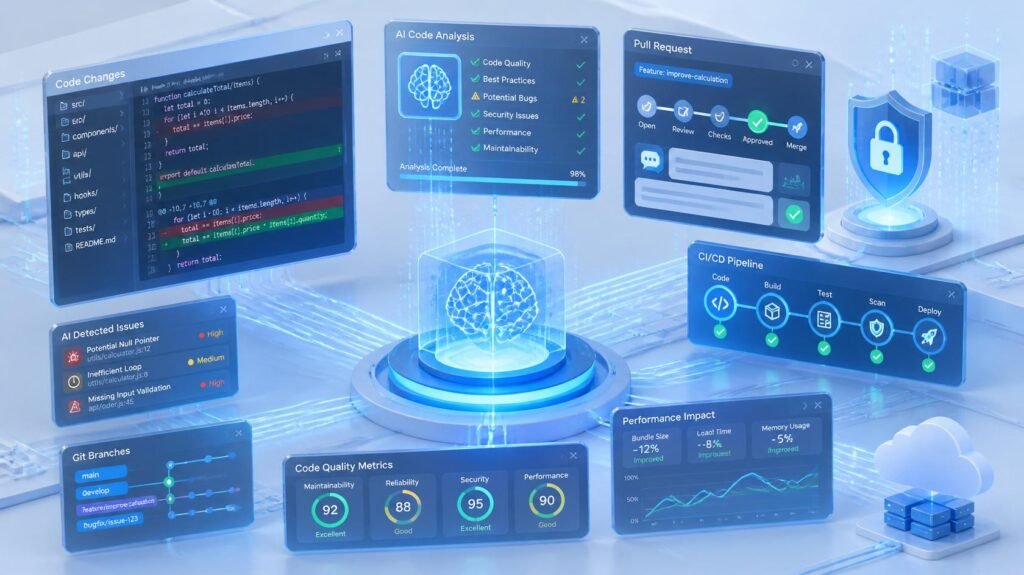
What Is AI Code Review Automation?
AI code review automation refers to the use of artificial intelligence and machine learning technologies to automatically inspect source code for bugs, security vulnerabilities, coding standard violations, performance issues, and maintainability concerns. Unlike traditional static analysis tools that rely only on predefined rules, AI-powered systems can understand programming context, recognize coding patterns, and generate intelligent recommendations based on large datasets of software projects.
These systems integrate directly with platforms such as GitHub, GitLab, Azure DevOps, and Bitbucket. Whenever a developer creates a pull request or commits new code, the AI engine immediately analyzes the changes and provides detailed feedback. It can identify duplicated logic, inefficient algorithms, security risks, inconsistent naming conventions, and opportunities to improve readability before a human reviewer even opens the pull request.
By automating repetitive review tasks, AI enables developers to spend more time on architecture, innovation, and business logic instead of repeatedly checking formatting errors or simple coding mistakes.
This is exactly how the entire 4,000-word blog will be written paragraph-based, humanized, SEO-friendly, and without divider lines.
Why Traditional Code Reviews Are No Longer Enough
Software development has evolved rapidly over the past few years. Agile methodologies, DevOps practices, and continuous integration have shortened release cycles, making it difficult for developers to spend hours reviewing every pull request manually. While traditional code reviews remain valuable, they often struggle to keep pace with modern development demands.
Large engineering teams may generate hundreds of code changes every day. Reviewing each change thoroughly requires significant time and expertise. As workloads increase, reviewers may unintentionally miss bugs, security vulnerabilities, or performance issues, leading to defects reaching production environments.
Common Challenges of Manual Code Reviews
| Challenge | Impact on Development |
|---|---|
| Time-consuming reviews | Delays feature releases |
| Human errors | Bugs can be overlooked |
| Reviewer fatigue | Inconsistent feedback |
| Limited scalability | Difficult for large projects |
| Knowledge dependency | Heavy reliance on senior developers |
| Different coding styles | Lack of consistency |
Manual reviews also vary depending on the experience of the reviewer. One engineer may focus on security, while another prioritizes code readability. This inconsistency makes it difficult to maintain uniform coding standards across large organizations.
Some additional limitations include:
- Slow turnaround for pull request approvals.
- Difficulty reviewing thousands of lines of code.
- Limited ability to detect hidden security vulnerabilities.
- Increased developer waiting time.
- Higher technical debt over time.
AI code review automation addresses these challenges by providing instant, consistent, and context-aware feedback before human reviewers begin their evaluation.
How AI Code Review Automation Works
The workflow of AI code review automation starts immediately after a developer commits code to a version control platform such as GitHub, GitLab, or Bitbucket. The AI engine automatically scans the modified files and compares them with coding standards, security best practices, and historical programming patterns.
Instead of simply checking syntax, modern AI systems understand the structure and intent of the code. They analyze dependencies, function calls, data flow, and overall maintainability to provide intelligent recommendations.
AI Code Review Workflow
| Step | What Happens |
|---|---|
| Code Commit | Developer pushes new code |
| Automated Scan | AI analyzes modified files |
| Static Analysis | Detects syntax and quality issues |
| Security Review | Identifies vulnerabilities |
| Performance Analysis | Finds optimization opportunities |
| Recommendations | Suggests fixes and improvements |
| Human Review | Engineers validate AI findings |
| Merge | Code is approved and deployed |
The AI engine can complete this process within minutes, allowing developers to resolve issues while the code is still fresh in their minds. This significantly reduces review cycles and improves collaboration across distributed teams.
What AI Reviews Automatically
- Coding standard violations
- Duplicate code
- Security vulnerabilities
- Performance bottlenecks
- Code complexity
- Memory optimization
- API misuse
- Documentation quality
- Test coverage gaps
- Best practice recommendations
By automating these repetitive tasks, AI enables software engineers to focus on system architecture, business logic, and innovation instead of spending valuable time identifying routine coding issues.
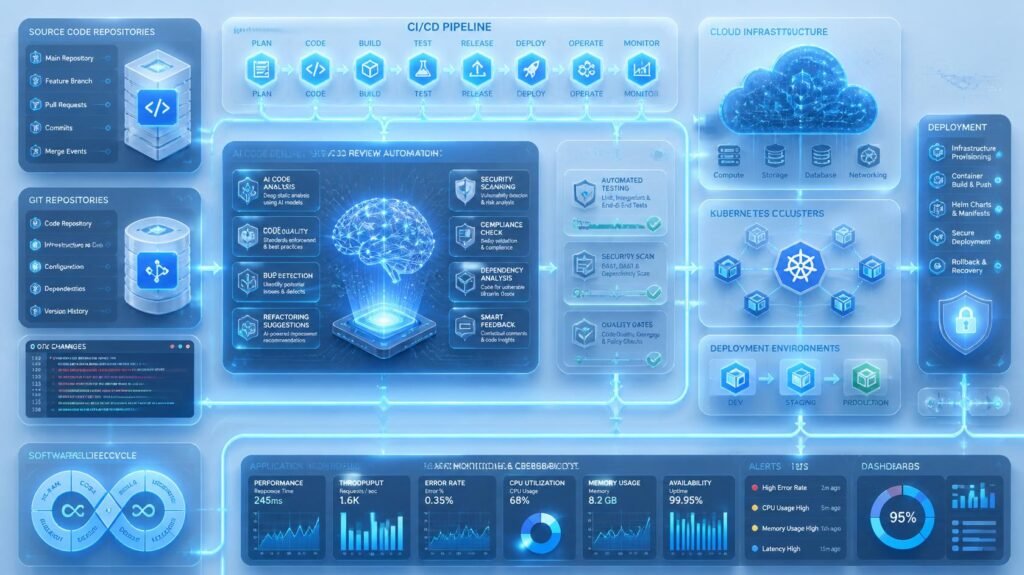
How AI Code Review Automation Works
Understanding how AI code review automation works helps organizations see why it has become an essential part of modern software development. Unlike traditional code review tools that simply check predefined rules or coding styles, AI-powered platforms analyze code in context. They understand how different parts of an application interact, identify potential risks, and provide intelligent recommendations that improve both code quality and developer productivity.
The review process begins the moment a developer pushes code to a repository or creates a pull request. Instead of waiting for another developer to manually inspect the changes, the AI engine automatically starts analyzing the new code. Within a few minutes, developers receive detailed feedback highlighting potential bugs, security vulnerabilities, performance issues, and coding standard violations.
The biggest advantage of AI code review automation is that it performs these tasks consistently across every project. Whether an organization has five developers or five thousand, AI reviews every pull request using the same quality standards, helping teams maintain consistency throughout the software development lifecycle.
The AI Code Review Workflow
Although different platforms use different technologies, most AI-powered review systems follow a similar workflow.
| Step | Process | Outcome |
|---|---|---|
| 1 | Developer commits code | Source code is pushed to the repository |
| 2 | AI detects new changes | Automated review process begins instantly |
| 3 | Code parsing | AI understands the code structure |
| 4 | Static code analysis | Syntax and quality issues are identified |
| 5 | Machine learning analysis | AI compares patterns with best practices |
| 6 | Security scanning | Vulnerabilities are detected |
| 7 | Performance evaluation | Optimization opportunities are identified |
| 8 | Recommendation generation | AI suggests improvements |
| 9 | Human review | Developers validate AI findings |
| 10 | Code merge | High-quality code is deployed |
This automated workflow significantly reduces review time while ensuring that developers receive actionable feedback early in the development process.
Step 1: Detecting New Code Changes
The process starts when a developer commits new code or submits a pull request using version control systems such as GitHub, GitLab, Azure DevOps, or Bitbucket. Modern AI review tools integrate directly with these platforms and continuously monitor repositories for new changes. As soon as code is submitted, the AI engine begins its analysis automatically without requiring any manual action.
This seamless integration ensures that reviews happen as part of the normal development workflow, allowing developers to receive immediate feedback before another team member even starts reviewing the code.
Step 2: Parsing the Source Code
Once the code is detected, the AI parses the entire source file. Parsing means understanding the structure of the code rather than simply reading it as plain text.
During this stage, AI identifies:
- Classes
- Objects
- Functions
- Variables
- Loops
- Conditional statements
- APIs
- Database queries
- Dependencies
- Imported libraries
Instead of only recognizing keywords, AI understands how these components relate to one another. This contextual understanding allows it to detect issues that traditional rule-based tools often miss.
For example, AI can determine whether a function is becoming overly complex or whether a particular class is handling too many responsibilities, making future maintenance more difficult.
Step 3: Static Code Analysis
After parsing the source code, the platform performs static analysis. Unlike runtime testing, static analysis examines the code without executing the application.
Static analysis helps detect a wide range of issues, including:
- Syntax errors
- Unused variables
- Duplicate code
- Dead code
- Incorrect naming conventions
- Missing exception handling
- Formatting inconsistencies
- Deprecated functions
- Incorrect imports
- Potential memory leaks
These issues may appear small individually, but together they can significantly reduce code quality and maintainability if left unresolved.
Common Problems Identified During Static Analysis
| Issue | Why It Matters |
|---|---|
| Duplicate code | Increases maintenance effort |
| Dead code | Makes applications harder to manage |
| Unused variables | Reduces readability |
| Poor naming | Makes code difficult to understand |
| Missing exception handling | Can cause unexpected failures |
| Deprecated APIs | May create compatibility issues |
| Code complexity | Makes debugging more difficult |
Static analysis provides developers with immediate feedback before software enters testing or production environments.
Step 4: Machine Learning Pattern Recognition
One of the most powerful aspects of AI code review automation is machine learning. Machine learning models are trained using millions of open-source repositories, enterprise applications, and programming examples. Instead of relying only on predefined rules, these models recognize coding patterns that distinguish high-quality software from poor implementations.
For example, AI can identify inefficient loops, repeated business logic, unnecessary object creation, or overly complicated algorithms by comparing them with better coding practices learned from thousands of successful software projects.
This enables AI to recommend improvements that are practical rather than purely theoretical. Some platforms can even predict which sections of code are more likely to cause bugs in future releases based on historical defect patterns.
Step 5: Security Vulnerability Detection
Security has become one of the biggest priorities in software development. Applications process sensitive customer information, payment details, healthcare records, and confidential business data. Even a small coding mistake can expose organizations to serious cyber threats.
AI-powered review platforms automatically scan code for common vulnerabilities before deployment.
Security Risks Commonly Detected
| Vulnerability | Potential Risk |
|---|---|
| SQL Injection | Database compromise |
| Cross-Site Scripting (XSS) | Browser attacks |
| Hardcoded passwords | Credential exposure |
| Weak authentication | Unauthorized access |
| Insecure API calls | Data leakage |
| Buffer overflow | Application crashes |
| Sensitive data exposure | Compliance violations |
| Insecure encryption | Data theft |
Instead of waiting for penetration testing or security audits, developers receive immediate alerts whenever risky coding practices are detected. This early detection significantly reduces the cost and complexity of fixing security vulnerabilities later in the software development lifecycle.
Step 6: Performance Analysis
Writing functional code is only one part of software development. Applications must also perform efficiently under different workloads. AI analyzes the efficiency of algorithms, database queries, loops, memory allocation, and resource usage to identify potential performance bottlenecks.
For example, AI may recommend replacing nested loops with more efficient data structures or suggest caching frequently accessed data to reduce database load. Performance analysis also considers scalability. Recommendations often focus on ensuring that applications continue performing well as user traffic increases.
Some common optimization suggestions include:
- Reducing unnecessary database queries.
- Optimizing memory usage.
- Eliminating redundant API calls.
- Improving algorithm efficiency.
- Reducing CPU-intensive operations.
- Simplifying complex logic.
These improvements help organizations build applications that remain fast and reliable even under heavy demand.
Step 7: Intelligent Recommendations
Unlike traditional code analyzers that simply report problems, AI explains why an issue exists and how it can be resolved. Many modern platforms provide alternative code snippets, documentation references, and detailed explanations that help developers understand the reasoning behind each recommendation. For junior developers, this creates an excellent learning opportunity. Instead of simply correcting mistakes, they learn better programming practices while working on real projects.
Examples of AI recommendations include:
- Simplifying complex functions.
- Improving variable naming.
- Refactoring repetitive code.
- Adding missing validation.
- Enhancing error handling.
- Improving code readability.
- Replacing outdated methods.
- Strengthening security implementations.
Because these recommendations are context-aware, developers receive practical guidance rather than generic coding advice.
Step 8: Human Validation
Although AI code review automation is highly effective, human expertise remains essential. AI excels at identifying repetitive issues, enforcing coding standards, detecting vulnerabilities, and recommending improvements. However, experienced software engineers are still responsible for reviewing business logic, architecture, user experience, and product-specific requirements.
This combination creates a hybrid review process where AI handles repetitive technical analysis while developers focus on strategic decision-making.
AI vs Human Responsibilities
| AI Handles | Human Developers Handle |
|---|---|
| Syntax analysis | Business logic |
| Security scanning | Product requirements |
| Performance suggestions | Architecture decisions |
| Coding standards | Customer needs |
| Duplicate code detection | Design discussions |
| Documentation suggestions | Complex technical trade-offs |
This collaborative approach produces better software while reducing the workload on engineering teams.
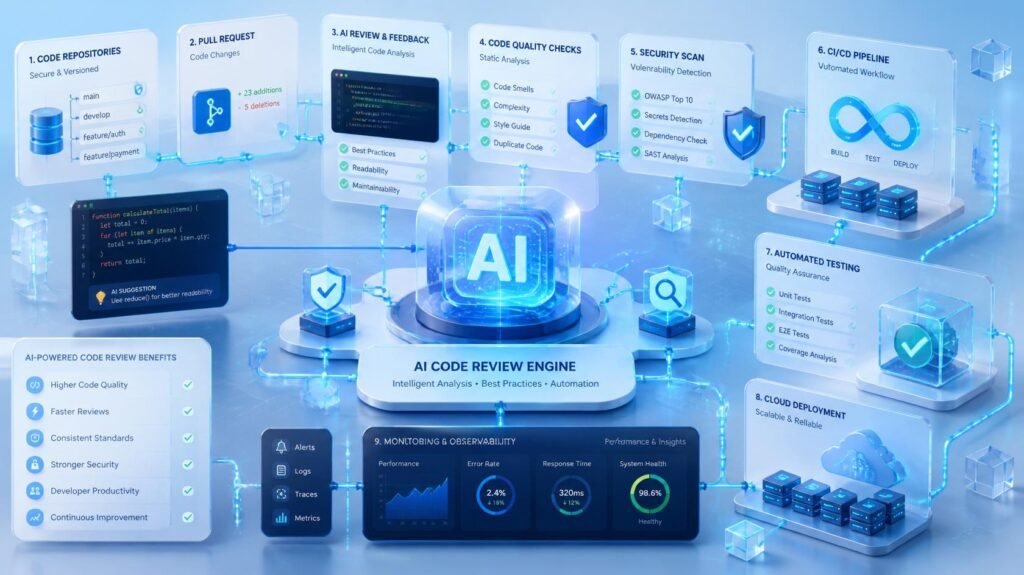
Why This Workflow Improves Software Development
Integrating AI code review automation into the software development lifecycle delivers measurable improvements across every stage of development. Automated reviews reduce waiting time, improve collaboration, minimize human error, and ensure consistent coding standards across projects. Developers receive feedback almost immediately after submitting code, allowing them to resolve issues before they become larger problems. This short feedback loop reduces rework, accelerates releases, and improves overall developer productivity.
For organizations practicing Agile and DevOps, this speed is especially valuable because it supports continuous integration and continuous delivery without sacrificing code quality. Ultimately, AI-powered reviews help teams build more secure, reliable, and maintainable software while enabling developers to spend less time on repetitive review tasks and more time creating innovative solutions.
Technologies Behind AI Code Review Automation
The effectiveness of AI code review automation comes from a combination of advanced technologies that work together to analyze source code, understand programming logic, identify potential risks, and recommend improvements. Unlike traditional rule-based code analyzers, AI-powered platforms continuously learn from millions of code repositories, allowing them to provide smarter and more context-aware suggestions.
Each technology plays a unique role in improving code quality. Together, they create an intelligent review system capable of detecting issues that would otherwise require hours of manual inspection. Understanding these technologies helps organizations appreciate why AI-powered reviews are becoming an essential component of modern software development.
Machine Learning
Machine Learning (ML) is the foundation of most AI code review automation platforms. Instead of relying only on predefined rules, machine learning algorithms analyze vast amounts of historical code to recognize programming patterns and identify best practices.
AI models are trained using millions of open-source and enterprise software projects. During training, they learn what high-quality code looks like, how experienced developers solve problems, and which coding patterns frequently lead to bugs or security vulnerabilities.
When developers submit new code, the machine learning model compares it with previously learned patterns. If it identifies inefficient logic, unnecessary complexity, or risky implementations, it recommends better alternatives.
Machine learning also improves over time. As organizations continue using AI-powered review tools, the system learns from accepted recommendations, rejected suggestions, and developer feedback, making future reviews more accurate.
Benefits of Machine Learning in Code Reviews
- Learns from millions of software repositories.
- Detects coding patterns beyond predefined rules.
- Improves recommendation accuracy over time.
- Identifies hidden quality issues.
- Predicts areas likely to introduce future bugs.
- Supports continuous improvement across projects.
Large Language Models (LLMs)
Large Language Models have transformed the capabilities of AI code review automation. Unlike traditional analysis engines, LLMs understand programming languages similarly to how they understand human language.
These models can interpret complex programming logic, explain difficult code, generate documentation, recommend cleaner implementations, and even answer developer questions in natural language.
Instead of simply highlighting a problem, LLMs explain why the issue exists, how it affects the application, and what developers can do to fix it.
For example, if a developer writes an inefficient database query, the AI may recommend an optimized version while explaining how the improvement reduces execution time and improves scalability.
This conversational capability makes AI particularly valuable for junior developers who are still learning software engineering best practices.
Capabilities of Large Language Models
| Capability | Benefit |
|---|---|
| Code explanation | Easier understanding of complex logic |
| Refactoring suggestions | Cleaner and maintainable code |
| Documentation generation | Better project documentation |
| Bug detection | Faster issue resolution |
| Code optimization | Improved application performance |
| Learning assistance | Helps developers improve skills |
Natural Language Processing (NLP)
Software development involves much more than writing code. Developers also create documentation, comments, issue descriptions, commit messages, design documents, and technical specifications.
Natural Language Processing (NLP) enables AI systems to understand this written information alongside the source code.
For example, NLP allows AI to determine whether a commit message accurately describes the changes made to the application. It can also identify missing documentation or unclear comments that may confuse future developers.
By understanding both programming languages and human language, AI provides recommendations that better align with project requirements and team communication standards.
Some platforms even compare code changes with project requirements to ensure implementations match the intended functionality.
Applications of NLP
- Understanding commit messages.
- Improving documentation quality.
- Detecting inconsistent comments.
- Explaining code changes.
- Supporting multilingual development teams.
- Improving collaboration between developers.
Static Code Analysis
Static code analysis has been part of software engineering for many years. It examines source code without executing the application and identifies syntax errors, coding standard violations, duplicate logic, and maintainability issues.
Modern AI code review automation enhances static analysis by adding intelligence to the process.
Traditional static analysis tools generate long lists of warnings, many of which may not be important. AI prioritizes findings based on their potential impact, helping developers focus on issues that matter most.
This reduces alert fatigue and increases productivity.
Issues Detected Through Static Analysis
| Code Issue | Business Impact |
|---|---|
| Syntax errors | Build failures |
| Duplicate code | Increased maintenance cost |
| Dead code | Lower readability |
| Unused variables | Poor code quality |
| Missing exception handling | Unexpected application crashes |
| Deprecated functions | Compatibility issues |
| High complexity | Difficult debugging |
Static analysis provides a strong foundation for automated reviews, while AI enhances its effectiveness through contextual understanding.
Semantic Code Analysis
Semantic analysis focuses on understanding what the code actually does instead of only examining its structure.
Two functions may have identical syntax but perform completely different tasks. Semantic analysis enables AI to understand these differences by evaluating relationships between variables, functions, classes, APIs, and data flow.
For example, AI can recognize when sensitive customer information is processed without proper encryption, even if the syntax itself appears correct.
Semantic analysis also helps identify logical inconsistencies that traditional rule-based systems may overlook.
Examples include:
- Incorrect business logic.
- Improper validation.
- Faulty authorization flows.
- Missing security checks.
- Inefficient data processing.
- Incorrect API implementations.
This deeper understanding allows AI to provide recommendations that improve both functionality and security.
Deep Learning
Deep learning is an advanced branch of machine learning that enables AI to identify highly complex programming patterns.
These neural networks analyze enormous volumes of software code to recognize subtle relationships between different components of an application.
Deep learning is especially effective at identifying:
- Complex security vulnerabilities.
- Performance bottlenecks.
- Memory optimization opportunities.
- Architectural weaknesses.
- Hidden coding patterns.
- Potential future defects.
Unlike rule-based systems, deep learning continuously improves as more data becomes available.
This allows AI review platforms to remain effective even as programming languages and development practices evolve.
Knowledge Graphs
Some advanced AI code review automation platforms use knowledge graphs to understand relationships between software components.
Knowledge graphs connect information about classes, methods, APIs, databases, external libraries, and application architecture.
Instead of reviewing files individually, AI evaluates how changes affect the entire software ecosystem.
For example, modifying one API endpoint may impact authentication services, payment processing, analytics systems, and mobile applications.
Knowledge graphs help AI identify these dependencies before deployment, reducing integration issues.
Cloud Computing
Modern AI review platforms rely heavily on cloud computing.
Rather than performing complex analysis on local developer machines, most platforms process code securely in cloud environments equipped with powerful computing resources.
Cloud infrastructure provides several advantages:
- Faster analysis of large codebases.
- Support for distributed development teams.
- Easy integration with CI/CD pipelines.
- Automatic software updates.
- Scalable computing resources.
- Reduced infrastructure costs.
Cloud-based AI also enables organizations to review thousands of pull requests simultaneously without affecting developer productivity.
Integration with DevOps Pipelines
One of the reasons AI code review automation has become so popular is its ability to integrate seamlessly into modern DevOps workflows.
Instead of functioning as a separate quality assurance process, AI becomes part of the Continuous Integration and Continuous Deployment pipeline.
Whenever developers submit new code, automated reviews begin immediately without interrupting existing workflows.
Common Integrations
| Development Platform | AI Integration Purpose |
|---|---|
| GitHub | Pull request reviews |
| GitLab | Merge request analysis |
| Bitbucket | Repository scanning |
| Azure DevOps | Continuous code validation |
| Jenkins | CI pipeline automation |
| Kubernetes | Deployment quality checks |
These integrations ensure that quality assurance becomes a continuous process rather than a final development stage.
How These Technologies Work Together
Although each technology provides unique capabilities, their true strength comes from working together.
- Machine learning recognizes coding patterns.
- Large Language Models explain recommendations in natural language.
- Natural Language Processing understands documentation and developer intent.
- Static analysis identifies structural issues.
- Semantic analysis evaluates programming logic.
- Deep learning uncovers complex vulnerabilities.
- Knowledge graphs understand relationships between software components.
- Cloud computing enables scalable processing.
Together, these technologies transform AI code review automation into a powerful engineering assistant capable of improving software quality throughout the entire development lifecycle.
Why These Technologies Matter
Modern software development demands speed, security, and reliability. Manual reviews alone cannot keep up with the growing complexity of applications, especially as organizations adopt cloud-native architectures, microservices, artificial intelligence, and distributed development teams.
The technologies behind AI code review automation allow organizations to detect defects earlier, improve coding consistency, strengthen security, and accelerate software delivery. More importantly, they free developers from repetitive review tasks, enabling them to focus on innovation, architecture, and solving real business challenges.
As artificial intelligence continues to evolve, these technologies will become even more sophisticated, making automated code reviews an indispensable part of the future software development process.
Challenges and Limitations of AI Code Review Automation
Despite its many advantages, AI code review automation is not a perfect solution. While artificial intelligence can significantly improve code quality and accelerate development, it still has limitations that organizations should understand before implementing it. AI works best when it complements human expertise rather than replacing it.
One of the biggest challenges is understanding business logic. AI can identify coding errors, security vulnerabilities, and performance issues, but it may not fully understand the unique business requirements behind a feature. A piece of code may technically be correct while still failing to meet business objectives. Human reviewers remain essential for validating whether the implementation aligns with customer needs and organizational goals.
Another limitation is the possibility of false positives and false negatives. AI may sometimes flag code that is actually correct or fail to identify a complex issue that requires deeper contextual understanding. Although AI models continue to improve, developers should always validate recommendations before applying them.
Common Challenges
| Challenge | Impact | Possible Solution |
|---|---|---|
| Limited understanding of business logic | May miss functional issues | Combine AI with human reviews |
| False positives | Unnecessary review effort | Fine-tune AI rules and models |
| False negatives | Some issues may go undetected | Continue manual validation |
| Integration complexity | Slower adoption | Gradual implementation |
| Privacy concerns | Risk to sensitive code | Use secure enterprise platforms |
| Overreliance on AI | Reduced critical thinking | Maintain human oversight |
Although these limitations exist, they are generally outweighed by the significant improvements AI brings to software development when used responsibly.
Best Practices for Implementing AI Code Review Automation
Successfully adopting AI code review automation requires more than simply installing a tool. Organizations should establish clear processes that combine artificial intelligence with human expertise to maximize value.
One of the most effective practices is to introduce AI gradually. Teams can begin by using AI for non-critical projects, allowing developers to become familiar with its recommendations before expanding its use across larger applications.
Organizations should also customize AI review rules according to their coding standards and project requirements. Every company follows different development practices, so tailoring the review process ensures more relevant and accurate feedback.
Regularly updating AI models is equally important. As programming languages, frameworks, and security threats evolve, AI systems should be kept current to provide accurate recommendations.
Another best practice is integrating AI directly into the CI/CD pipeline. Automated reviews should occur immediately after every code commit, ensuring developers receive instant feedback without interrupting their workflow.
Teams should also encourage developers to review AI suggestions critically instead of accepting every recommendation automatically. This maintains engineering judgment while still benefiting from automation.
Best Practices Checklist
- Integrate AI into existing CI/CD pipelines.
- Customize coding standards and review policies.
- Keep AI models and security databases updated.
- Use AI alongside experienced human reviewers.
- Train developers to understand AI recommendations.
- Monitor AI performance and improve configurations regularly.
- Review high-risk code manually before deployment.
- Continuously measure improvements using development metrics.
Following these practices helps organizations maximize the benefits of AI while minimizing implementation challenges.
Future Trends in AI Code Review Automation
Artificial intelligence is evolving rapidly, and its role in software development will continue to expand over the coming years. Future advancements will make AI code review automation even more intelligent, personalized, and integrated into the software development lifecycle.
One major trend is the rise of autonomous AI coding assistants. Instead of only identifying issues, these systems will automatically generate optimized code, fix vulnerabilities, create test cases, and prepare pull requests for developer approval.
Another emerging trend is predictive code quality analysis. Rather than reviewing completed code, AI will analyze ongoing development activities and predict which changes are most likely to introduce bugs, allowing teams to prevent issues before they occur.
AI is also expected to become more context-aware. Future systems will understand project documentation, architectural diagrams, user stories, and business requirements alongside the source code, enabling more meaningful recommendations.
Integration with DevSecOps will become increasingly common. AI-powered reviews will automatically verify compliance with security standards, regulatory requirements, and organizational policies throughout the development lifecycle.
As Large Language Models continue to improve, AI will provide more conversational support for developers. Engineers will be able to ask complex coding questions, receive architecture recommendations, generate documentation, and understand unfamiliar codebases through natural language interactions.
Emerging Trends
| Future Trend | Expected Impact |
|---|---|
| Autonomous AI coding assistants | Faster software development |
| Predictive bug detection | Earlier issue prevention |
| Context-aware code reviews | More accurate recommendations |
| AI-generated documentation | Improved maintainability |
| DevSecOps integration | Stronger application security |
| Real-time coding assistance | Increased developer productivity |
| Self-healing code suggestions | Reduced debugging effort |
| Continuous learning models | Better review accuracy over time |
These innovations will further strengthen the role of AI as an essential partner for modern software engineering teams.
Conclusion
As software development becomes more complex and release cycles continue to accelerate, maintaining high code quality through manual reviews alone is becoming increasingly difficult. Development teams must balance speed, security, performance, and maintainability while delivering new features faster than ever before. In this environment, AI code review automation has emerged as a powerful solution that helps organizations meet these demands without compromising software quality.
By combining machine learning, natural language processing, semantic analysis, and Large Language Models, AI-powered review platforms can automatically identify coding errors, detect security vulnerabilities, recommend performance improvements, and enforce coding standards within minutes. This enables developers to receive immediate feedback, reduce repetitive review tasks, and focus on solving complex engineering challenges instead of spending valuable time on routine inspections.
Although AI cannot replace the creativity, critical thinking, and business understanding of experienced software engineers, it significantly enhances the review process by acting as an intelligent development partner. When used alongside human expertise, AI code review automation creates a faster, more consistent, and more secure software development workflow.
Frequently Asked Questions (FAQs)
1. What is AI code review automation?
AI code review automation is the use of artificial intelligence to automatically analyze source code for bugs, security vulnerabilities, coding standard violations, performance issues, and maintainability concerns before the code is merged into a project.
2. Can AI replace human code reviewers?
No. AI is designed to assist developers rather than replace them. It handles repetitive review tasks efficiently, while human reviewers focus on business logic, software architecture, and strategic decision-making.
3. Which programming languages are supported by AI code review tools?
Most modern platforms support popular programming languages such as Python, Java, JavaScript, TypeScript, C#, C++, Go, PHP, Ruby, Kotlin, Swift, and many others.
4. How does AI improve software security?
AI automatically scans source code for vulnerabilities such as SQL injection, cross-site scripting, insecure authentication, hardcoded credentials, and insecure API usage, helping developers resolve security issues before deployment.
5. Is AI code review automation suitable for small businesses?
Yes. Many cloud-based AI code review platforms offer affordable pricing and scalable solutions, making them suitable for startups, small businesses, and large enterprises alike.