
Over the past ten years, there has been a tremendous adoption of technology by businesses. Businesses spent on CRM software, automation, analytics, and AI-based software. This was superficially an improvement. It made work faster, processes digital and decision making data-driven. However, there was still something lacking. Despite the introduction of several tools, a number of companies still remained to deal with productivity, efficiency and actual business development. Overloading of teams persisted. Still, workflows were disjointed. Decision-making was slow. This is where a new change is occurring in 2026. In future of IT AI tools are no longer being used by businesses. They are beginning to embrace what can be termed as AI employees.
What Are AI Employees in Simple Words
In order to grasp this concept well we must simplify it.
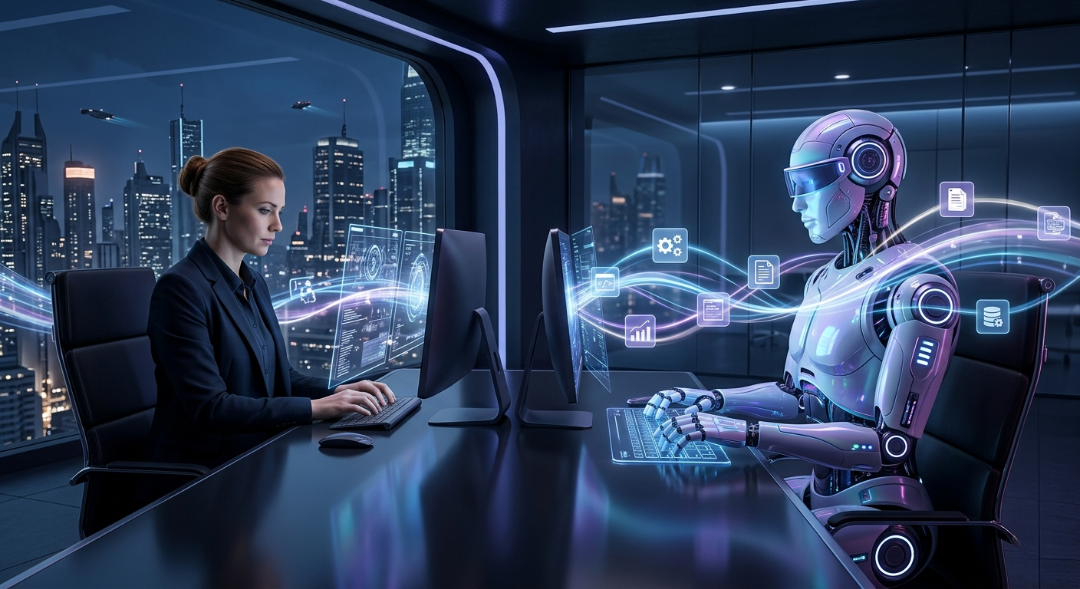
The AI employees are the systems which are able to execute work, make decisions and complete workflow with minimum human influence. They are not simple tools that help users. They act as digital workers.
In conventional arrangements, workers work with tools in order to accomplish tasks. As an illustration, a sales executive employs CRM software, email packages, and analytics programs to handle leads.
However, when it comes to AI employees, the process is handled by the system itself. It is able to take a lead, process the data, transmit a response, arrange a meeting and update records automatically.
This implies that the system is no longer a support tool. It is made a productive member of the workforce.
That is why lots of specialists believe that the future of IT processes is not in the improvement of tools but in the smart systems that behave like human workers.
The Evolution of IT Workflows: From Manual Work to AI Execution
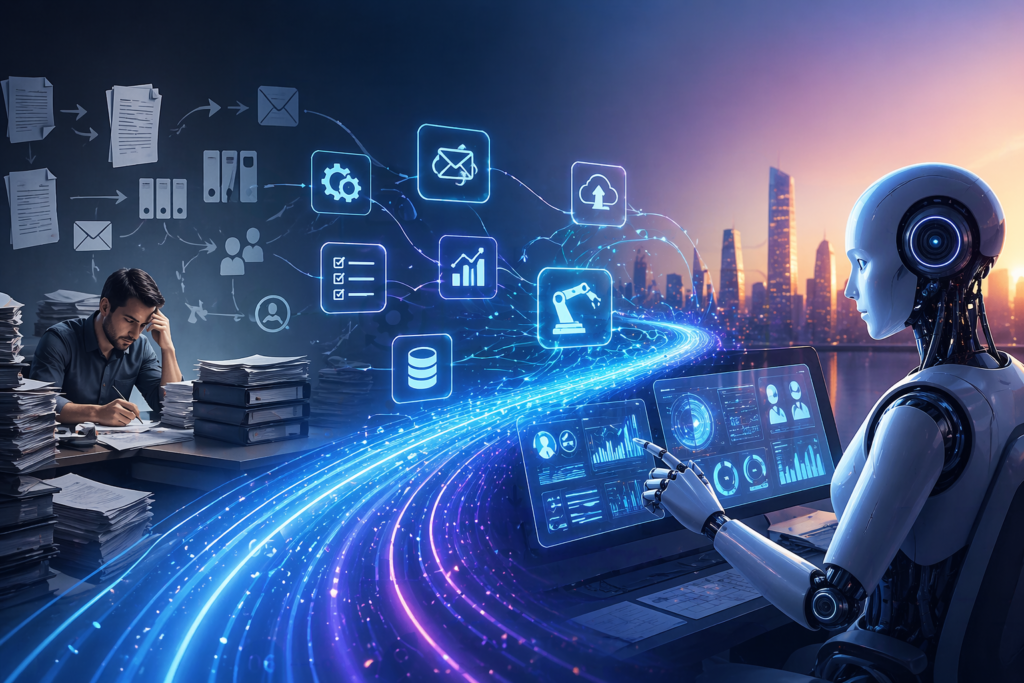
It is necessary to examine how future of IT workflows have changed over the years. All this was done manually before. Data, communication and processes were done manually by teams. This was time-consuming, labor-intensive and there were high chances of errors.
Next there were software tools. These tools assisted teams in organizing work in a better way. Information could be stored, work could be traced and communication became simpler. Nonetheless, the labor remained very manual.
Automation was the subsequent step. Monotonous functions such as mailing of emails or updating of records were automated. This was time saving, although automation was minimal. It was only applicable under predefined conditions and was unable to make complex decisions.
- IT workflows started as manual, slow, and error-prone.
- Software tools improved organization but still required manual work.
- Automation reduced repetitive tasks but was rule-based.
- AI tools added insights but still needed human execution.
- In 2026, AI employees handle complete workflows independently.
Why Businesses Are Moving Toward AI Employees
The shift to AI workers is not occurring simply due to innovation. It is occurring due to real challenges of the businesses that the traditional systems cannot address.
The excessive use of tools is one of the largest issues. A lot of companies have invested in various platforms, yet rather than enhancing efficiency, it has complicated it. Workers are more occupied with tools than work.
- Workflow fragmentation is another significant problem. Various systems do not necessarily communicate. This results in information gaps, delays and inter team misalignment.
- The price is also a significant consideration. Recruiting and staffing is costly. Employee training, system maintenance and productivity are very costly. Companies are seeking means to decrease expenses and stay efficient.
- Speed has also become a very important factor. In the current competitive world, the quickest responding companies are obviously at an advantage. Late response may result in missed chances.
- The AI employees tackle all these difficulties by developing interconnected, effective and quick workflows.
AI Tools vs AI Employees: Understanding the Difference
To fully grasp the impact of this shift, it is important to compare AI tools and AI employees.
| Factor | AI Tools | AI Employees |
|---|---|---|
| Role | Assist users | Perform tasks independently |
| Workflow handling | Partial | End-to-end |
| Decision making | Limited | Advanced |
| Human dependency | High | Low |
| Output | Support-based | Result-driven |
| Efficiency | Moderate | High |
This comparison clearly shows that AI employees are not just an upgrade. They represent a completely new way of working.
Applications of AI Employees in the Real World.
AI employees are already utilized in various industries. These systems are changing the way businesses are conducted.
- AI employees are able to handle whole campaigns in marketing. They are able to study how people act, improve ads and modify strategies on the fly. This minimizes the process of monitoring manually.
- AI workers are able to manage leads in sales. They are able to answer questions, screen leads and book meetings. This accelerates the sales process and increases the conversion rates.
- Another section that AI employees are leaving a significant imprint is customer support. They are able to deal with routine questions, offer solutions, and refer to complex questions when necessary. This will provide 24/7 support without the need to incur extra expenses.
- AI employees can facilitate the recruitment process in HR. They are able to filter resumes, arrange interviews and filter candidates according to pre-set criteria. This saves on time taken in hiring.
These instances demonstrate that AI workers do not have a single role. They are applicable throughout the organization.
Arkentech AI Workforce Model.
Businesses must be organized to successfully implement AI employees. This is where the Arkentech AI Workforce Model will come in handy.
The first one is to define repetitive activities. They are those jobs that take time but do not involve creativity. Automation of these processes is of direct advantage.
Integration of systems is the next step. Companies should integrate their CRM, marketing and analytics solutions. This guarantees an efficient flow of data.
Small Business Transformation
A small business was struggling with lead management. Their response time was slow, and many opportunities were lost.
After implementing AI employees, the system started handling incoming leads automatically. It responded instantly, qualified prospects, and scheduled meetings.
The results were significant.
| Metric | Before | After |
|---|---|---|
| Response Time | 24 hours | 2 minutes |
| Conversion Rate | 5% | 18% |
| Productivity | Low | High |
Enterprise-Level Transformation
A large enterprise faced challenges with disconnected systems and slow decision-making.
By integrating AI employees across departments, they were able to streamline workflows.
| Metric | Before | After |
|---|---|---|
| Workflow Efficiency | 60% | 90% |
| Operational Cost | High | Reduced by 35% |
| Decision Speed | Slow | Real-time |
This case highlights the scalability of AI employees.
Common Mistakes Businesses Make

Despite the potential of AI, many companies fail to achieve results. This usually happens due to common mistakes.
One mistake is adopting AI without a clear strategy. Businesses invest in tools without understanding how they will improve workflows.
- Adopting AI without a clear strategy
- Investing in tools without defined goals
- Not aligning AI with actual workflows
- Expecting results without proper planning
- Focusing on tools instead of outcomes
The Future of IT Workflows
The future of IT processes does not lie in the addition of new tools or the enlargement of the amount of software platforms within an organization. Actually one of the largest lessons that businesses are currently learning is that an increase in tools does not always equate to an increase in output. Companies have over the years developed tech stacks that are complex with CRM systems, analytics, automation tools, and communication apps alongside cloud solutions. Although each tool addresses a particular issue, they can be used together to form a disjointed system where the time spent switching tools is greater than the amount of meaningful work done.
The emphasis is on workflow intelligence rather than accumulation of tools in 2026. Companies are coming to realize that the true worth future of IT is not the quantity of tools, but the effectiveness of systems to interoperate to deliver results. The notion of intelligent workflows comes into play here. Companies are developing systems that are capable of working together, automatically sharing information and performing tasks without the need to be supervised continuously instead of using humans to connect various tools to each other and manually manage processes.
[ Too Many Tools ]
(CRM + Analytics + Automation + Apps)
↓
[ Complex Tech Stack ]
Disconnected systems
↓
[ Workflow Inefficiency ]
Time wasted switching tools
Low productivity
↓
[ Realization ]
More tools ≠ More output
↓
[ Mindset Shift ]
Focus on workflow, not tools
↓
[ Integration ]
Systems start working together
↓
[ Intelligent Workflows ]
Auto data sharing + task execution
↓
[ AI-Driven Systems (2026) ]
Minimal human supervision
↓
[ Final Outcome ]
Higher efficiency + better results
A Simple Strategy for Businesses
The concept of changing future of IT workflows can be daunting to many businesses. The question of where to begin, what tools to apply and how to effect change is often confusing. Nonetheless, the strategy does not necessarily need to be intricate. As a matter of fact, the best plan of action is a mere change of mindset.
Businesses should begin to ask, not, What new tools should we adopt, but Which processes can we run without manual effort? This shift in thinking can make a significant difference in the approach of the organizations to technology.
Conclusion
The movement of AI tools to AI workers is one of the most momentous changes in the history of future of IT processes. Businesses have been using tools to aid their operations over the years. These tools have brought about value but have also created complexity, inefficiencies, and reliance on manual efforts. The introduction of AI workers is a new stage, at which the systems are not only assisting the work but also doing it.
This is changing the way businesses are conducted. Workflows are getting quicker, more efficient and intelligent. Tasks which previously involved several steps and human intervention can be now automatically performed by linked systems. Decision making is turning into data-driven and real time, enabling businesses to act fast to respond to changing conditions.
FAQ’s
What are AI employees in IT workflows?
AI employees are advanced systems that can perform tasks independently without constant human input. Unlike traditional tools that only assist users, AI employees can manage complete workflows such as responding to leads, updating CRM systems, analyzing data, and making basic decisions. They act like digital workers that handle repetitive and process-driven tasks, allowing human teams to focus on more strategic work.
How are AI employees different from AI tools?
AI tools are designed to support users by providing suggestions, insights, or automation for specific tasks, but they still require human involvement to complete workflows. AI employees go a step further by handling entire processes on their own. They can connect multiple systems, understand context, and execute actions from start to finish, which significantly reduces manual effort and increases efficiency.
Why are businesses moving toward AI employees in 2026?
Businesses are shifting toward AI employees because managing multiple tools has created complexity, delays, and higher costs. Traditional systems often work in silos, leading to inefficiencies and slow decision-making. AI employees solve these challenges by creating connected workflows that run smoothly, enabling faster responses, better productivity, and improved overall performance.
Can AI employees replace human workers completely?
AI employees are not meant to replace human workers completely. They are designed to handle repetitive and routine tasks that do not require creativity or critical thinking. Human employees are still essential for strategic planning, innovation, relationship building, and complex decision-making. The goal is to create a balanced system where AI handles routine work and humans focus on high-value activities.
What types of tasks can AI employees handle?
AI employees can handle a wide range of tasks across departments. These include lead qualification, email responses, customer support queries, scheduling, report generation, and data analysis. They are especially useful for tasks that follow a structured process, and as technology advances, they are becoming capable of managing more complex workflows as well.
Are AI employees expensive to implement?
Implementing AI employees may require an initial investment in tools and system integration, but the long-term benefits usually outweigh the costs. Businesses can reduce operational expenses by automating repetitive work, improving efficiency, and minimizing errors. Over time, AI employees help organizations achieve better results with fewer resources.
How can small businesses use AI employees?
Small businesses can begin by identifying repetitive tasks that take up valuable time, such as responding to customer inquiries or managing leads. They can then introduce simple AI solutions to automate these processes. Even small improvements in workflow automation can lead to significant gains in productivity and allow business owners to focus on growth.