


With the advancements made in recent years, artificial intelligence has gone far beyond being just another technological solution used for automating tedious activities. Now, AI is able to think and make decisions. In the past decade, many companies have been increasingly implementing automation to increase efficiency and save money. At the same time, classic automation has proved to be ineffective in dealing with changing circumstances, unstructured data, and decision-making requiring the context understanding. The mentioned shortcomings resulted in the need for a smarter way of business process automation. Thus, such phenomenon as AI agentic workflows appeared.
AI agentic workflows can be regarded as a new stage of development in the sphere of enterprise automation. As opposed to simple rule-based automation, AI agents have the ability to perceive goals, make plans for several actions ahead, interact with enterprise systems, collect relevant data, make conclusions, and change their actions upon receiving new data. In other words, such agents allow for the automation of more complex business processes which used to require continuous human participation.
The increased use of generative AI, large language models (LLMs), and autonomous AI systems has led to heightened interest in agentic workflows. The technology industry is coming to understand that AI is not only capable of answering questions and creating content but is also capable of coordinating several tools together, collaborating with other AI entities, accessing enterprise databases, completing workflows, and continuously learning from its experience.
In this detailed guide, you will find out what an agentic workflow with AI is, how it operates, its main components, its value for businesses, enterprise-level applications of the technology, best implementation practices, and challenges.

What Is an AI Agentic Workflow?
AI agentic workflow is intelligent automation whereby one or more AI agents plan, execute, monitor, and optimize processes and tasks in order to accomplish a particular business objective. While traditional workflow automation uses a fixed set of rules and pre-defined procedures, agentic workflow enables AI to evaluate the situation, think through the available choices, take appropriate actions, and adjust to any changes that might come along the way.
The word “agentic” is used in this context to indicate the capability of the AI to act independently as an agent and pursue its objectives in a minimalistic way without needing any guidance.
Consider an example where a company gets hundreds of support tickets from customers every hour. A traditional automation software could categorize these tickets and route them as per the pre-defined rules. However, an agentic workflow process would go much beyond this. It would be able to understand the customer’s problem, pull up relevant information about the customer’s account, evaluate their previous interactions, search the internal knowledge database, identify the most appropriate solution, talk to various enterprise applications, provide personalized solutions to the customer, escalate issues if required, and even learn from the customer feedback.
Why AI Agentic Workflows Matter
Modern corporations produce an immense amount of information that comes from customers, employees, suppliers, interconnected devices, and enterprise software. Manual management of this information becomes harder and harder. Conventional automated systems can do repetitive actions, yet they do not work well when exceptions take place or decisions need reasoning and context perception.
AI agentic workflows can solve these problems through integration of artificial intelligence with workflow management. Unlike conventional automated systems, AI agents analyze information constantly, understand the goals of the company and make a proper decision.
several advantages for enterprises, including:
- Reduced manual workload by automating repetitive administrative tasks.
- Faster response to changing business conditions by adapting workflows in real time.
- Improved operational efficiency through intelligent task automation and optimized processes.
- More accurate decision-making using data-driven insights and contextual reasoning.
- Enhanced customer experiences with faster, personalized, and consistent service.
With increasing popularity of AI-enabled software, agentic workflows allow integrating them within one operational system. This means that AI agents will not be used as separate solutions, but will work together across departments.
How AI Agentic Workflows Differ from Traditional Automation
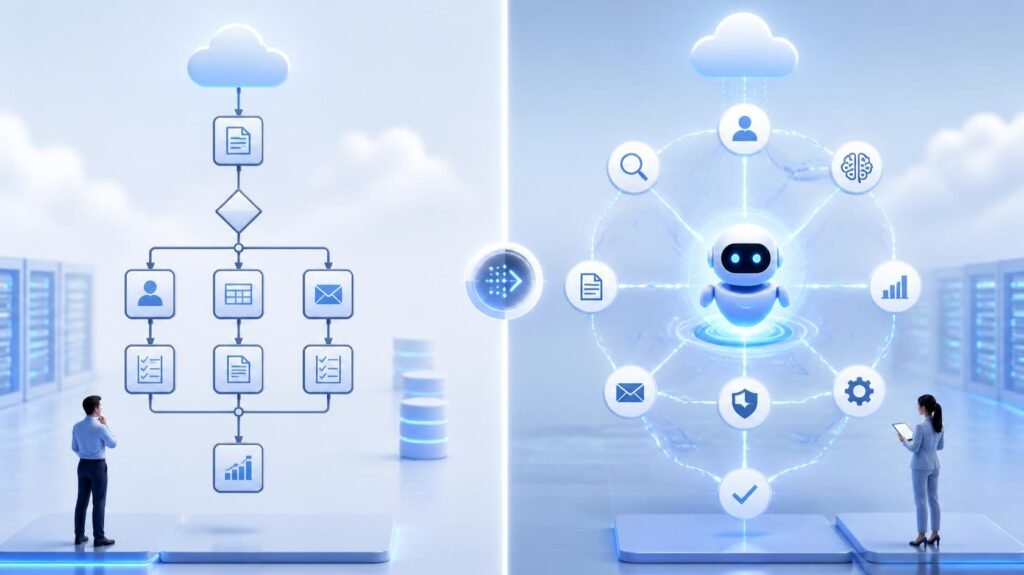
The traditional approach to workflow automation has been used for many years and is still one of the primary aspects of digital transformations. It includes the use of predefined rules, logical conditions, and workflows created by people. While being quite effective for repetitive tasks, it is ineffective in dealing with unexpected situations.
For instance, the conventional invoice approval workflow would route the invoices according to predefined limitations of expenditures. When it encounters any missing information or peculiar requests, the workflow will just stop functioning and wait for human intervention.
An AI agentic workflow will work in a much different manner. It would recognize the missing information, search for relevant documents in internal databases, contact the corresponding department in case of need to clarify something, check the compliance policies, and offer the correct approval path.
It becomes clear that the key feature of such workflows is the ability to adapt to changing conditions. Instead of asking “What should we do when this particular condition is present?”, an agentic workflow asks “How can we achieve this objective in this particular case?”
Such shift changes dramatically the range of business processes that organizations can automate.
The Evolution of Enterprise Automation
Enterprise automation has undergone many stages of development throughout the years.
The first ones involved basic task automation. Organizations were developing scripts and macros for automatic performing of routine actions like data entry, transfer files, generating reports. Such automation made processes more efficient, but it needed a lot of programming and was applicable only to structured processes.
The evolution of enterprise automation progressed through several important stages:
- Introduction of Robotic Process Automation (RPA): Marked the next major advancement by using software robots to automate repetitive, rule-based tasks.
- Business Process Management (BPM): Introduced graphical interfaces that made it easier to design, manage, and standardize business workflows across multiple enterprise applications.
- Improved Workflow Visibility: BPM systems provided organizations with better process transparency, monitoring, and governance.
- Enterprise Application Integration: Enabled seamless communication between different business systems, improving operational efficiency.
- Rule-Based Automation: Despite these improvements, BPM platforms still depended heavily on predefined rules and required manual updates whenever business requirements changed.
Finally, artificial intelligence made possible many new abilities like computer vision, natural language processing, predictive analytics and machine learning. With the help of these technologies, the systems could understand images, process documents and classify information and make predictions.
Core Characteristics of AI Agentic Workflows
There are some defining characteristics that make AI agentic workflows different from other automation technologies.
- Firstly, it is goal-oriented execution. While other automation technologies follow pre-programmed instructions, AI agents aim at delivering business outcomes. They choose what actions should be taken instead of using pre-defined workflows.
- Secondly, autonomous planning should be mentioned. AI agents break down business goals into sub-goals, prioritize actions, distribute resources, and change their execution plans depending on changing circumstances.
- Thirdly, context awareness makes AI agents able to take into account the history of interactions with users, organizational policies, preferences, current business data, and any external information when making decisions. Thus, the result becomes more accurate and personalized.
- Continuous reasoning is another characteristic of AI agentic workflows. During their execution, AI agents analyze the process, detect possible problems, find alternative solutions, and adapt their future actions based on their feedback.
- Fourthly, collaboration is one of the defining characteristics of AI agents. Several AI agents can collaborate in executing different parts of the workflow, exchanging information and coordinating their actions. It is also possible for human employees to take part in this process and review recommendations, approve sensitive actions or provide additional input if needed.
The Building Blocks of an AI Agentic Workflow
However, despite organizational diversity in terms of implementation of AI agentic workflows, there is a set of common elements that these workflows have.
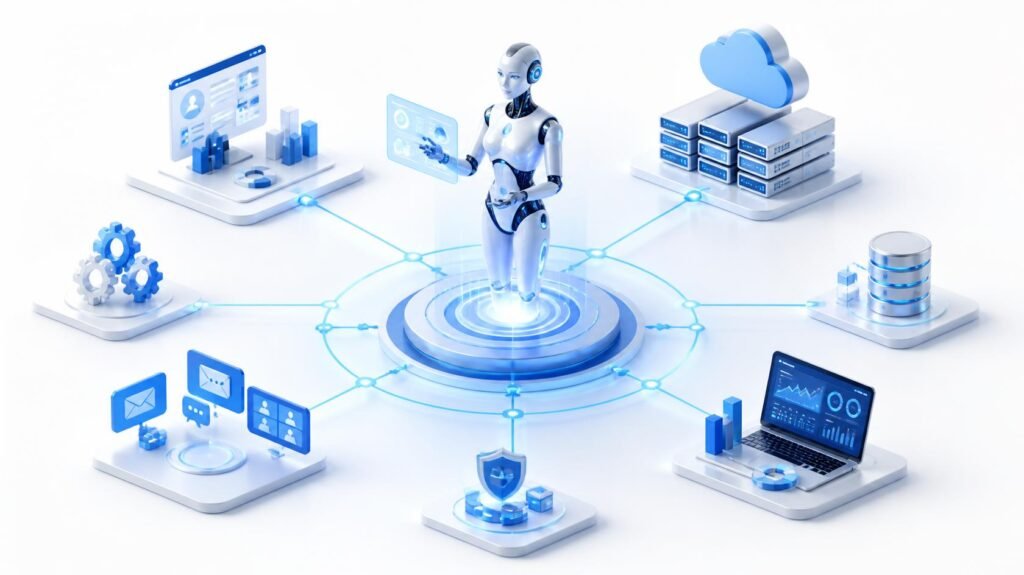
- The first one is an AI agent, which represents the intelligent decision-maker. An AI agent understands organizational goals, analyzes and reasons over the received information, makes plans, and executes actions across different systems.
- Large Language Models make it possible for AI agents to understand human instructions, analyze and reason over documents, generate content, and conduct conversations.
- Short- and long-term memories are crucial parts of the workflow. While short-term memory helps AI agents to keep the context throughout the process, long-term memory is where organizational experience is stored.
- The planning engine breaks the complex objectives into subtasks and adjusts priorities in accordance with the changes in the business environment.
- The tool integration layer includes integrations of AI agents with enterprise software such as CRM, ERP, cloud, databases, collaboration software, emails, APIs, and document management systems. These integrations help AI agents to collect information, update records, make transactions, and collaborate throughout the process.
The governance and security system ensures that every step of the workflow complies with organizational policies.
How AI Agents Think and Make Decisions
As opposed to typical software where instructions are executed, AI agents go through reasoning process that is similar to structured problem solving.
Once a new objective is provided, the agent first analyzes the request to understand what is expected. Relevant information is identified; context is collected; and resources are assessed.
The next step involves development of strategy when the objective is broken down into several small tasks. Dependencies among tasks are identified; action priorities are set; risks are assessed; and required tools or enterprise applications are chosen to execute them.
Once a task is completed, the agent constantly evaluates the results. In case of unexpected situations, agent reevaluates available information; changes the strategy; and chooses new actions without interrupting the workflow.
Reasoning, adaptability, and optimization throughout the execution make agentic workflows more flexible compared to conventional automation systems.
With the help of intelligent planning and execution, companies can automate business processes that could not be automated by conventional workflow management technologies due to their dynamism and unpredictability.
How AI Agentic Workflows Operate in Modern Enterprises
An AI agentic workflow operates differently from traditional automation because it focuses on achieving business outcomes instead of simply executing predefined instructions. Conventional workflows follow a fixed sequence of rules, meaning they stop whenever unexpected situations occur or when human judgment is required. AI agentic workflows, however, continuously analyze information, reason through multiple possibilities, adapt to changing conditions, and decide the best course of action to accomplish the assigned objective.
Common business objectives include:
- Managing IT security incidents and responding to potential threats.
- Resolving customer complaints quickly and accurately.
- Approving loan applications based on predefined policies and risk analysis.
- Automating new employee onboarding and account provisioning.
- Processing insurance claims with minimal manual intervention.
Using enterprise data, business policies, historical information, and real-time insights, the AI creates a plan, identifies dependencies, selects the necessary tools, and begins executing tasks. Throughout the workflow, it continuously evaluates results and modifies its approach whenever circumstances change.
This dynamic decision-making capability enables enterprises to automate complex operations that traditional automation technologies cannot efficiently manage.

How an AI Agentic Workflow Functions
Although implementations vary between organizations, most AI agentic workflows follow a structured sequence of intelligent actions.
Step 1: Understanding the Business Objective
Every workflow begins with a clearly defined goal. Rather than receiving hundreds of detailed instructions, the AI agent receives a high-level objective.
Examples include:
- Resolve a customer support request.
- Complete employee onboarding.
- Generate a quarterly financial report.
- Investigate a cybersecurity alert.
- Process an insurance claim.
- Schedule preventive equipment maintenance.
The AI first analyzes the request to understand what success looks like before taking any action.
Step 2: Gathering Relevant Information
Once the objective is understood, the AI agent collects information from multiple enterprise systems.
It may retrieve data from:
- Customer Relationship Management (CRM) platforms
- Enterprise Resource Planning (ERP) systems
- Cloud storage
- Internal knowledge bases
- Email platforms
- Business intelligence tools
- APIs
- External databases
- Collaboration platforms
Instead of relying on one application, the AI combines information from multiple sources to develop complete situational awareness.
Step 3: Planning the Workflow
After collecting sufficient context, the AI develops an execution strategy.
Rather than following predefined logic, it determines:
- Which tasks should be completed first
- Which departments should be involved
- Which enterprise systems need to be accessed
- Whether approvals are required
- Potential risks
- Alternative execution paths
This planning capability makes agentic workflows significantly more adaptable than conventional automation.
Step 4: Executing Tasks
The AI agent begins completing tasks using integrated enterprise applications.
Examples include:
- Updating customer records
- Creating support tickets
- Scheduling meetings
- Sending emails
- Generating reports
- Executing API requests
- Updating inventory
- Processing payments
- Monitoring infrastructure
Each completed task provides new information that influences subsequent decisions.
Step 5: Continuous Monitoring and Optimization
Unlike traditional workflows that stop after execution, AI agentic workflows continuously monitor progress.
The AI evaluates:
- Task completion status
- Business KPIs
- Customer responses
- System performance
- Workflow bottlenecks
- Security events
- Compliance requirements
If problems arise, the AI adjusts its strategy instead of waiting for manual intervention.
AI Agentic Workflow Lifecycle
The following table illustrates the typical lifecycle of an AI agentic workflow.
| Stage | AI Agent Activity | Enterprise Value |
|---|---|---|
| Goal Definition | Understands business objective | Aligns automation with outcomes |
| Data Collection | Retrieves information from multiple systems | Improves decision quality |
| Planning | Creates execution strategy | Reduces manual coordination |
| Task Execution | Completes business operations | Accelerates productivity |
| Monitoring | Tracks workflow progress | Detects issues early |
| Optimization | Learns from previous outcomes | Improves future performance |
Real-World Example: Customer Support Automation
Imagine that you are a company producing software for the whole world, and thousands of people reach out to you daily with their problems.
Instead of transferring each support request to a human agent, an AI agentic workflow solves most of the issues without any human involvement.
The process starts with receiving a request from a customer. In a matter of seconds, AI recognizes the issue, defines how urgent it is, and studies the customer’s history.
Then it looks through its internal documentation and support requests that have been processed before to define the best way of solving the problem.
If there is not enough data about the situation, the AI will ask some additional questions instead of sending the problem somewhere else.
As soon as there is something for the engineers to do, the workflow will create tickets for them, schedule follow-ups, and inform the customer about everything that goes on.
In case the problem can be solved right away, the AI will give the client personalized instructions.
Only difficult situations are sent to the support engineers.
Single-Agent vs Multi-Agent Workflows
Organizations can implement AI agentic workflows using one intelligent agent or multiple specialized AI agents working together.
The following comparison highlights the differences.
| Feature | Single-Agent Workflow | Multi-Agent Workflow |
|---|---|---|
| Complexity | Moderate | High |
| Decision Making | One AI agent | Multiple collaborating agents |
| Scalability | Good | Excellent |
| Coordination | Simple | Advanced |
| Enterprise Suitability | Small to medium workflows | Large enterprise operations |
A multi-agent workflow may include:
- A planning agent responsible for task allocation.
- A research agent that gathers enterprise information.
- A finance agent that validates costs.
- A compliance agent that checks regulations.
- A reporting agent that generates business insights.
Together, these specialized agents coordinate activities while sharing information in real time.
Benefits of AI Agentic Workflows
Organizations adopting AI agentic workflows experience improvements across nearly every business function.
Some of the most significant benefits include:
- Faster business process execution
- Reduced operational costs
- Improved decision-making accuracy
- Higher employee productivity
- Better customer experiences
- Continuous workflow optimization
- Reduced manual intervention
- Improved compliance monitoring
- Enhanced scalability
- Better utilization of enterprise data
Unlike conventional automation, AI agentic workflows continue improving as they process more business scenarios.
AI Agentic Workflow vs Traditional Workflow Automation
Many organizations already use workflow automation platforms. However, AI agentic workflows introduce capabilities that conventional automation cannot provide.
| Capability | Traditional Workflow | AI Agentic Workflow |
|---|---|---|
| Rule-based automation | Yes | Yes |
| Autonomous reasoning | No | Yes |
| Context awareness | Limited | Extensive |
| Learns from experience | No | Yes |
| Dynamic planning | No | Yes |
| Handles unstructured data | Limited | Excellent |
| Multi-system collaboration | Moderate | Excellent |
| Adapts to changing conditions | No | Yes |
Traditional automation is excellent for repetitive tasks.
AI agentic workflows are designed for complex decision-driven business processes.
AI Agentic Workflow vs Robotic Process Automation (RPA)
RoboRPA is still useful in case of routine, well-defined tasks. Yet the RPA bots need precise programming and do not have reasoning capabilities like the AI agents.
For instance, the RPA bot could move customer details from one application to another.
However, the AI agent can:
- Interpret customers’ emails
- Interpret customers’ intentions
- Search different knowledge bases
- Compare all possible solutions
- Produce individualized answers
- Update enterprise applications
- Only escalate when needed
That is why the AI agentic process is much more appropriate for enterprise environment when each business process deals with individual cases.
Why Enterprises Are Rapidly Adopting AI Agentic Workflows
Enterprise leaders are under increasing pressure to improve efficiency while delivering better improving customer experiences and minimizing cost of operation. The use of AI agentic workflows gives a realistic approach towards attaining these objectives without necessarily removing human experts from their roles. On the contrary, they allow workers to concentrate on innovation, strategic planning, and relationship management while leaving coordination and intelligent decision making to AI.
There are several business trends that are fueling the process:
- Faster development of Generative AI
- Increased investments towards digital transformation
- High demands towards automated workflow
- The need for accelerated decision making
- Increasing cloud-native enterprise applications
- Increasing focus on operational resilience
- Skill gaps amongst technical professionals
- Increased use of AI copilots and AI autonomous agents
In the course of technology stack modernization, AI agentic workflows have become a central element in any enterprise automation strategy.
Enterprise Use Cases of AI Agentic Workflows
The agentic workflows of AI are not experimental anymore and are utilized by the forward-looking startup companies alone. In today’s era, businesses from all sorts of industries are implementing smart agents of AI to automate complicated business processes and enhance decision making and operational efficiency. The reason behind this is that agentic workflows are capable of analyzing context and interacting with many enterprise systems.
Customer Service and Support
Customer support is another rapidly growing application of AI agents workflows. Chatbots usually operate based on scripted replies and cannot deal with more complicated problems of customers. But AI agents are able to detect the purpose of customers, find their accounts, search the company’s knowledge base, and give personalized recommendations.
For instance, if the customer calls with a complaint about the billing problem, AI agents will be able to check the transaction history of the client, find out what is wrong, and process a refund and even send an e-mail confirming the refund without any human input.
Advantages of using AI agents for customer support include:
- Faster response time
- Higher first contact resolution rate
- Personalized customer experience
- Lighter burden for support teams
- Around-the-clock customer support
Finance and Accounting
There are many repetitive and essential tasks that need accuracy and compliance in financial functions. AI agentic process streamlines the tasks through automation of invoice processing, expenses approval, financial reporting, and fraud detection.
A typical function of an AI agent would be to extract information from invoices, validate purchase orders, spot discrepancies, obtain approvals wherever needed, and update the ERP system automatically. It can also track transactions in real-time and identify any suspicious transactions to alert the finance team before anything escalates.
Some of the applications are:
- Invoice processing
- Accounts payable automation
- Budget forecasting
- Financial reporting
- Fraud detection
- Expense management
- Tax compliance
Human Resources
Human resource departments handle recruitment, onboarding, payroll, employee engagement, and compliance. Agentic AI processes make these tasks more efficient while enhancing the employee experience.
During the recruitment process, AI agents will be able to go through resumes, match the candidate’s qualifications with job descriptions, arrange interviews, interact with the candidate, and prepare reports for the hiring manager.
After recruiting, AI agents will also help in organizing onboarding by creating employee profiles, scheduling training programs, asking for necessary paperwork, and tracking onboarding.
IT Operations
Today’s IT systems produce thousands of alerts daily. Agentic systems in AI can aid IT experts in prioritizing the events, analyzing their root cause, and automating resolution processes.
For example, when a server’s performance becomes slow, the AI agent is capable of analyzing the system data, locating the relevant systems, starting the necessary services, providing more cloud computing resources, informing the system administrators, and documenting each step.
Healthcare
Healthcare organizations manage enormous volumes of patient data, appointments, insurance claims, and regulatory requirements.
AI agentic workflows support medical staff by:
- Scheduling appointments
- Verifying insurance coverage
- Summarizing clinical notes
- Coordinating patient referrals
- Processing medical claims
- Monitoring patient follow-ups
Although healthcare professionals remain responsible for clinical decisions, AI significantly reduces administrative workloads and improves operational efficiency.
Manufacturing
The manufacturing industry utilizes AI agentic workflows to improve production planning, monitor machinery, determine maintenance needs, and streamline supply chain management.
AI agents assess sensor data, production schedules, availability of suppliers, and inventories to suggest the best manufacturing approach.
This ensures that production is not delayed, while maintenance and inventory costs are kept at bay.
Sales and Marketing
Sales teams generate large volumes of customer data that require continuous analysis.
AI agentic workflows assist by:
- Qualifying leads
- Updating CRM records
- Scheduling follow-ups
- Creating personalized outreach emails
- Monitoring campaign performance
- Forecasting revenue
- Identifying cross-selling opportunities
Marketing departments use AI agents to optimize advertising campaigns, personalize customer journeys, generate content recommendations, and analyze campaign performance across multiple channels.
How to Implement AI Agentic Workflows Successfully
Implementing AI agentic workflows requires careful planning rather than simply deploying AI software. Organizations should begin with well-defined business objectives and gradually expand automation capabilities as they gain experience.
A structured implementation approach reduces risks while maximizing long-term business value.
Step 1: Identify Suitable Business Processes
Not every workflow should be automated immediately.
Organizations should prioritize processes that involve:
- High transaction volumes
- Repetitive manual work
- Multiple enterprise systems
- Frequent decision-making
- Significant operational costs
- Process bottlenecks
Starting with smaller workflows allows organizations to measure success before expanding AI across additional departments.
Step 2: Prepare High-Quality Data
AI agents rely on accurate and accessible information.
Organizations should ensure:
- Data accuracy
- Standardized formats
- Secure storage
- Updated documentation
- Well-maintained knowledge bases
- Consistent metadata
Poor-quality data often produces poor-quality AI decisions.
Step 3: Select Appropriate AI Models
Different workflows require different AI capabilities.
Organizations may choose models optimized for:
| Business Need | Recommended AI Capability |
|---|---|
| Customer support | Natural language understanding |
| Forecasting | Predictive analytics |
| Document processing | OCR and document AI |
| Decision-making | Large Language Models (LLMs) |
| Visual inspection | Computer vision |
Selecting the appropriate AI technology improves workflow accuracy and overall performance.
Step 4: Integrate Enterprise Systems
An AI agent becomes valuable only when it can interact with existing business applications.
Typical integrations include:
- CRM platforms
- ERP software
- Cloud infrastructure
- Email systems
- HR platforms
- Databases
- Collaboration tools
- Document management systems
- APIs
Seamless integration enables AI agents to access real-time information and execute business operations automatically.
Step 5: Monitor and Improve Performance
AI agentic workflows should continuously evolve.
Organizations should regularly measure:
| KPI | Why It Matters |
|---|---|
| Workflow completion rate | Measures automation success |
| Average processing time | Indicates efficiency improvements |
| Customer satisfaction | Evaluates service quality |
| Cost savings | Demonstrates business value |
| Error rate | Measures operational accuracy |
| Employee productivity | Tracks workforce efficiency |
Performance monitoring helps organizations identify improvement opportunities and refine AI strategies over time.
Best Practices for AI Agentic Workflow Adoption
Successful AI implementations share several common characteristics. Enterprises that follow these best practices generally achieve better results and reduce implementation risks.
Some important recommendations include:
- Start with one high-value workflow before scaling.
- Keep humans involved in critical decisions.
- Establish clear governance policies.
- Maintain detailed audit logs.
- Continuously monitor AI outputs.
- Train employees to work alongside AI agents.
- Protect sensitive enterprise data.
- Regularly update AI models and knowledge bases.
- Measure ROI using business KPIs.
- Encourage collaboration between IT and business teams.
Following these practices creates a strong foundation for long-term AI success.
Challenges of AI Agentic Workflows
Despite their many benefits, AI agentic workflows also present several challenges that organizations must address.
Data Privacy
AI systems often process confidential customer and business information. Organizations must implement strong encryption, access controls, and privacy policies to protect sensitive data.
Security Risks
AI agents connected to multiple enterprise applications may become attractive targets for cyberattacks.
Security measures should include:
- Identity verification
- Role-based access control
- API security
- Continuous monitoring
- Threat detection
- Zero Trust architecture
Regulatory Compliance
Industries such as healthcare, finance, and government operate under strict regulations.
Organizations must ensure AI workflows comply with standards such as:
- GDPR
- HIPAA
- PCI DSS
- SOC 2
- ISO 27001
Maintaining compliance protects organizations from legal and financial risks.
Bias and Decision Accuracy
AI systems learn from existing data. If training data contains bias, AI recommendations may also become biased.
Organizations should:
- Regularly evaluate AI decisions
- Test models using diverse datasets
- Monitor fairness metrics
- Include human oversight
Responsible AI governance remains essential for maintaining trust.
Employee Adoption
Employees may initially view AI as a replacement rather than a productivity tool.
Successful organizations address this challenge through:
- Training programs
- Transparent communication
- Change management initiatives
- Employee involvement in AI projects
When employees understand how AI supports their work, adoption rates improve significantly.
The Future of AI Agentic Workflows
AI agentic workflows are expected to become increasingly intelligent as advancements in large Research and development in language models, reasoners, and autonomous AI are ongoing. In the future, enterprise workflows will be characterized by cooperation among various AI agents within different departments, decision-making by those AI agents independently according to governance rules, and optimization of operations continuously with regard to real-world business conditions.
Some of the future trends related to agentic workflows include:
- Collaboration among various AI agents across enterprise systems
- AI-driven orchestration platforms for workflows
- Autonomous agents that can learn from their experience and get better
- Better integration with enterprise software as a service (SaaS) applications
- Predictive decision-making in real time
- Better AI governance and compliance solutions
- Use of multimodal AI in text, images, audio, and videos
- Edge AI for decision-making at the local level
- Industry-specific AI agents
- Better collaboration between humans and AI
With time, such advancements in technology will make AI agents more capable of taking on operational tasks.
Conclusion
AI agentic workflows constitute a great step forward in enterprise automation because they involve three key components – artificial intelligence, autonomous decision-making and workflow orchestration – into one intelligent process. In contrast to conventional automated solutions that depend on pre-defined rules, AI agents understand goals, adjust to the changes in business environment, work together with corporate applications and constantly get better due to their continuous learning capability.
Companies from various sectors are already applying such workflows to innovate their customer service, financial, healthcare, manufacturing, human resource, IT operations and sales processes. AI agentic workflows help companies automate processes faster, reduce manual involvement and provide customers and employees with superior experiences.
In a time when the world of enterprise AI is getting more mature, companies that will implement such workflows securely and properly managed will have a chance to stay ahead of others in the business.
Frequently Asked Questions
What is an AI agentic workflow?
An AI agentic workflow is an intelligent automation process in which AI agents autonomously plan, execute, monitor, and optimize business tasks to achieve specific goals with minimal human intervention.
How is an AI agentic workflow different from traditional automation?
Traditional automation follows predefined rules and workflows, while AI agentic workflows use reasoning, contextual understanding, and adaptive decision-making to handle dynamic business situations.
What industries benefit the most from AI agentic workflows?
Industries such as healthcare, finance, manufacturing, retail, IT, telecommunications, logistics, and customer service benefit significantly from AI agentic workflows due to their complex operational processes.
Do AI agentic workflows replace employees?
No. They are designed to automate repetitive and data-intensive tasks, allowing employees to focus on strategic, creative, and customer-facing responsibilities.
What technologies power AI agentic workflows?
They typically combine large language models (LLMs), machine learning, natural language processing, workflow orchestration, APIs, enterprise software integrations, and data analytics to automate business processes intelligently.