


The field of artificial intelligence has seen a swift evolution from basic rule-based approaches to sophisticated large language models (LLMs) able to produce human-like text, write code, analyze documents, and automate complex business processes. Although prompt engineering has been instrumental in creating better responses, modern AI requires much more than just good prompts. With the integration of AI agents, RAG, multi-agent approaches, and autonomous workflow, a new field Context Engineering has been established.
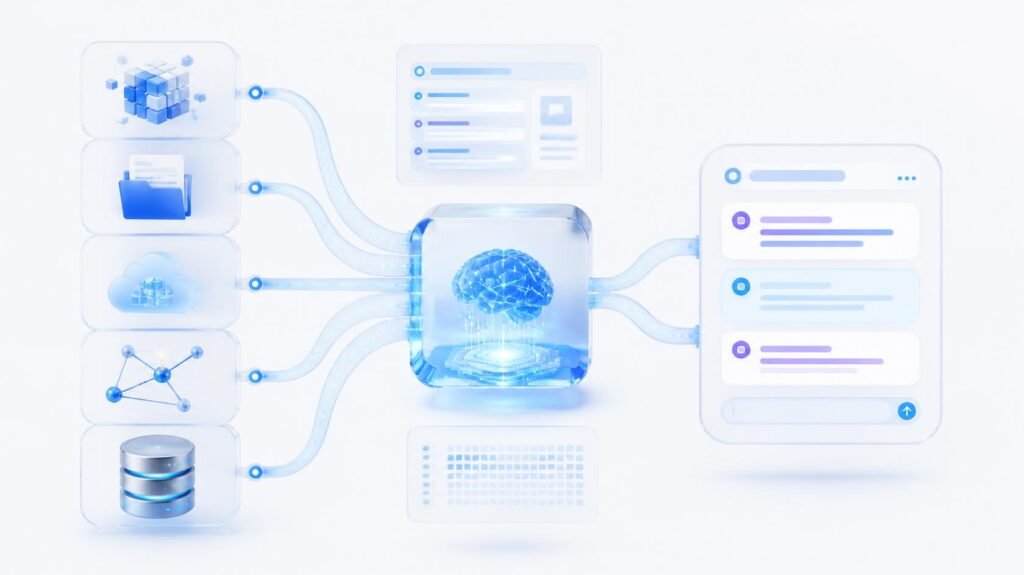
Context engineering is an approach that deals with designing, structuring, and providing the appropriate information to the AI model at the right moment in order to help it to produce accurate and reliable responses. Instead of using only prompts, context engineering helps to make sure that the AI has all necessary business data, user data, documentation, tools, APIs, memory, and other inputs that would enable better decision-making.
For those companies that build enterprise AI solutions, context engineering has become one of the most important aspects impacting the work of their AI systems. The most advanced language model will not be able to produce useful output if it does not have the necessary context. At the same time, proper context pipeline helps the AI system to understand business
As AI becomes integrated into customer support, software development, healthcare, finance, cybersecurity, manufacturing, and marketing, businesses are realizing that context not prompts is the real competitive advantage.
This comprehensive guide explains Context Engineering, why it matters, how it differs from prompt engineering, its architecture, core components, benefits, challenges, enterprise use cases, and best practices for building intelligent AI systems.
What Is Context Engineering?
Context Engineering is the process of collecting, organizing, filtering, and delivering all relevant information that an AI model needs before generating a response.
Instead of sending only a question to an AI model, context engineering enriches the request with additional information such as:
- User preferences
- Previous conversations
- Company knowledge base
- Internal documentation
- Business policies
- API responses
- Database records
- Retrieved documents
- Tool outputs
- External knowledge sources
- Long-term memory
- Workflow state
The AI model uses this contextual information to understand the situation more accurately and generate responses that align with business objectives.
For example, imagine a customer asks an AI assistant:
“Where is my order?”
Without context, the AI has no idea which order the customer is referring to.
With context engineering, the AI automatically receives:
- Customer ID
- Recent purchases
- Shipping information
- Order tracking details
- Delivery status
- Customer communication history
Instead of asking unnecessary follow-up questions, the AI can immediately respond:
“Your order #45231 was shipped yesterday and is expected to arrive on Friday.”
This illustrates how context engineering transforms generic AI responses into intelligent, personalized interactions.
Why Context Engineering Matters
As more advanced applications of AI become widespread, so too does the information needed for making correct decisions increase. Large language models are excellent reasoners; however, they do not know anything about the inner workings of a company, its customers, policies, and current workflow status. Context engineering is an important step that provides the model with the right context prior to inference.
Key reasons why context engineering is essential include:
Improves AI Accuracy
Answers will be as accurate as the data that you provide. With the help of recent and accurate context, organizations ensure that their answers are not wrong.
Eliminates Hallucinations
Hallucinations happen when AI models create something that seems to be very believable but turns out to be fabricated information.
With context engineering, organizations can avoid these problems by using accurate data from the enterprise context, retrieved documents, databases, and knowledge base.
Personalized Experiences
All customers interact in a different way with your organization.
Context engineering makes it possible for AI assistants to personalize their experiences based on:
- Behavior
- Purchases
- Preferences
- Subscription
- Conversations
Supports Enterprise Decision-Making
Business AI systems often require access to operational data from multiple departments.
For example:
- Sales CRM
- Inventory management
- Finance systems
- HR databases
- IT monitoring tools
Context engineering enables AI to combine these data sources before generating recommendations.
Enhances AI Agent Performance
Modern AI agents perform multiple tasks rather than simply answering questions.
An AI agent may:
- Search documents
- Call APIs
- Execute software
- Update databases
- Generate reports
- Communicate with other AI agents
Each task requires dynamic context.
Without context engineering, these autonomous workflows become unreliable.

The Evolution from Prompt Engineering to Context Engineering
Prompt engineering was one of the most useful skills when generative AI was first gaining popularity. Developers figured out how to create prompts which could make AI models generate better outputs.
Though prompt engineering is still essential, there are certain shortcomings of this practice.
With just a prompt, you won’t be able to get:
- The customer’s history
- Real-time inventory
- Company’s documentation
- API response
- Logs of the software
- Security policies
- Workflow memory
- External databases
As AI systems got more and more complicated, developers understood that prompts are just a small part of intelligent AI systems.
Nowadays, AI systems use several layers of contextual data simultaneously.
This development has led to a shift in enterprise AI developement from writing better prompts to building better context pipelines.
Modern AI applications typically include:
- Retrieval-Augmented Generation (RAG)
- Vector databases
- Long-term memory
- Knowledge graphs
- Enterprise search
- API integrations
- Tool calling
- AI agents
- Model Context Protocol (MCP)
- Context orchestration
These technologies collectively define modern context engineering.
Context Engineering vs Prompt Engineering
Although the terms are often used interchangeably, they represent different concepts.
| Prompt Engineering | Context Engineering |
|---|---|
| Focuses on writing effective prompts | Focuses on delivering complete contextual information |
| Primarily text-based instructions | Combines prompts, memory, data, tools, APIs, and retrieved knowledge |
| Optimizes wording | Optimizes the entire AI workflow |
| Static input | Dynamic information pipeline |
| Best for simple AI tasks | Essential for enterprise AI systems |
| Limited personalization | Highly personalized responses |
| Minimal external data | Extensive integration with enterprise systems |
Prompt engineering asks:
“How should I ask the AI?”
Context engineering asks:
“What information does the AI need before answering?”
This shift represents one of the most significant advancements in enterprise AI architecture.
Organizations that invest in context engineering are building AI systems capable of reasoning over company knowledge, interacting with business tools, and adapting responses based on real-time information.
Core Components of Context Engineering
Effective context engineering combines multiple information sources into a unified context that supports intelligent decision-making.
Some of the most important components include:
System Instructions
These define the AI’s overall behavior, responsibilities, limitations, and communication style.
For example, an enterprise customer support assistant may be instructed to:
- Follow company policies.
- Never disclose confidential information.
- Escalate complex issues to human agents.
- Maintain a professional tone.
- Reference only approved knowledge sources.
System instructions establish consistent behavior across all interactions.
User Context
User context includes information specific to the individual interacting with the AI.
Examples include:
- User profile
- Account information
- Purchase history
- Location
- Language preferences
- Previous conversations
- Subscription plan
- Recent activities
Providing user context enables the AI to deliver highly relevant and personalized responses.
Business Knowledge
Enterprise AI systems often need access to internal information such as:
- Employee handbooks
- Product documentation
- Company policies
- Technical manuals
- Standard operating procedures
- Internal FAQs
- Compliance requirements
Rather than relying on outdated training data, context engineering retrieves this information in real time, ensuring responses reflect the latest organizational knowledge.
Real-Time Data Integration
One of the most valuable aspects of Context Engineering is its ability to provide AI models with real-time information instead of relying solely on pre-trained knowledge. Large language models have a knowledge cutoff and cannot automatically access the latest business information. Context engineering solves this limitation by integrating live data sources before every AI interaction.
Real-time context may include:
- Current inventory levels
- Customer support tickets
- Sales opportunities
- Financial transactions
- Shipping status
- CRM records
- IoT sensor data
- Network monitoring alerts
- Security logs
- Cloud infrastructure metrics
For example, an enterprise sales assistant can instantly retrieve the latest customer interactions from a CRM system before generating an email or recommending the next action. This ensures that every response is based on current business information rather than outdated assumptions.
Real-time context dramatically improves AI reliability and allows organizations to automate decisions with greater confidence.
Long-Term Memory in Context Engineering
Conventional AI dialogues are usually restricted to one dialogue session only. After that, all data will be forgotten by the model, unless previous dialogues were stored by the application itself.
Context engineering is bringing the long-term memory feature that enables AI apps to store valuable information for more than one dialogue.
Long-term memory could include:
- Customer preferences
- Common workflows
- Company goals
- Project history
- Feedback from users
- Previous support cases
- Meeting agendas
- Documents created by the team
Let us think about AI-based project management assistant that knows all about previous sprints, assigned tasks, deadlines, and feedback received from stakeholders. No need to remind anything each time, the assistant can continue its work while keeping the context intact. It brings significant benefits.

Retrieval-Augmented Generation (RAG) and Context Engineering
One of the most important technologies supporting context engineering is Retrieval-Augmented Generation (RAG).
Rather than expecting an AI model to memorize millions of documents, RAG retrieves the most relevant information from trusted knowledge sources before generating a response.
The process typically follows these steps:
- The user submits a query.
- The application searches a vector database or enterprise knowledge base.
- Relevant documents are retrieved.
- Retrieved information becomes part of the model’s context.
- The AI generates an answer using both the prompt and retrieved knowledge.
For example, an employee asks:
“What is our organization’s remote work reimbursement policy?”
Instead of generating a generic answer, the AI retrieves the latest HR policy document and answers based on official company guidelines.
This approach offers several advantages:
- Improved factual accuracy
- Reduced hallucinations
- Easy knowledge updates
- No need for frequent model retraining
- Better regulatory compliance
- More trustworthy AI responses
RAG has become one of the foundational technologies behind modern enterprise AI systems because it ensures responses are grounded in reliable and current information.
Vector Databases and Context Engineering
Effective context engineering requires rapid access to the relevant data, which is where vector databases come into play.
Whereas conventional databases look for specific keywords, vector databases perform searches based on semantics. They transform textual data into numeric vectors called embeddings, allowing AI to recognize similar data even if different words are used.
The following enterprise-level applications can be distinguished:
- Enterprise-level document search
- Search in customer support knowledge base
- Recommendation engines for products
- Legal document analysis
- Medical record search
- Technical documentation search
- Code search
- Research assistance
In case the user asks a question, the system looks through the vector database for the most relevant documents and adds them to the context of the AI model.
It helps the AI to answer complicated questions based on the reliable enterprise knowledge without bombarding the model with extra information.
Knowledge Graphs in Context Engineering
Many organizations store information across disconnected systems. Context engineering can unify this information using knowledge graphs.
A knowledge graph connects related entities and relationships, enabling AI models to understand how information is linked.
For example:
Customer → Purchased Product → Warranty → Support Ticket → Technician → Resolution
Instead of treating each piece of information independently, the AI understands the relationships between them.
Knowledge graphs are widely used in:
- Financial services
- Healthcare
- Manufacturing
- Supply chain management
- Cybersecurity
- Scientific research
- Enterprise search
They enable AI to perform deeper reasoning and provide more comprehensive answers.
Tool Calling and API Integration
Modern AI applications are no longer limited to generating text. They can interact with external tools through APIs, making context engineering far more powerful.
Examples of AI tool usage include:
- Booking meetings
- Sending emails
- Updating CRM records
- Creating invoices
- Running SQL queries
- Searching internal databases
- Accessing cloud resources
- Deploying applications
- Creating reports
- Executing automation workflows
Consider an AI sales assistant responding to a request:
“Schedule a product demo with our highest-value lead next week.”
The AI may:
- Retrieve CRM data
- Identify the highest-value prospect
- Check calendar availability
- Schedule the meeting
- Send invitations
- Update the CRM
- Notify the sales manager
Each step requires different contextual information, which is orchestrated through context engineering.
AI Agents Depend on Context Engineering
The rise of AI agents has made context engineering even more important.
Unlike chatbots that simply answer questions, AI agents complete objectives through planning, reasoning, and action.
A typical enterprise AI agent may:
- Understand a business request
- Break the task into subtasks
- Search internal documents
- Call external APIs
- Execute software tools
- Evaluate results
- Continue planning
- Deliver the final outcome
Every stage requires accurate contextual information.
For example, an IT support agent resolving a server outage might need:
- Monitoring dashboards
- Infrastructure logs
- Previous incidents
- Cloud configurations
- Security alerts
- Service-level agreements
- Internal troubleshooting guides
Without context engineering, the AI agent would lack the information required to diagnose and resolve issues effectively.
Enterprise Architecture for Context Engineering
A typical enterprise context engineering architecture consists of several interconnected components.
User Interface
Users interact with the AI through web applications, mobile apps, chat platforms, or internal enterprise portals.
Authentication Layer
This layer verifies user identity and determines which information the user is authorized to access.
Context Orchestrator
The context orchestrator is the central component of the system. It gathers information from multiple sources, filters irrelevant data, prioritizes important details, and constructs the final context sent to the AI model.
Enterprise Data Sources
Context may be collected from:
- CRM platforms
- ERP systems
- HR software
- Knowledge bases
- Document management systems
- Cloud storage
- Databases
- APIs
- Monitoring platforms
- Business intelligence tools
Retrieval Layer
The retrieval layer searches vector databases, enterprise search engines, and document repositories to find the most relevant information for each request.
AI Model
The AI model processes the enriched context and generates an intelligent response.
Action Layer
After generating a response, the AI may trigger business actions such as updating records, creating tickets, sending notifications, or executing workflows.
Together, these layers create an intelligent ecosystem where AI can reason, retrieve information, and take action based on enterprise context rather than isolated prompts.
Benefits of Context Engineering
Organizations implementing context engineering experience measurable improvements across AI initiatives.
Higher Response Accuracy
Providing relevant context significantly improves answer quality and reduces ambiguity.
Better Personalization
AI can tailor responses based on user roles, preferences, history, and business requirements.
Reduced Hallucinations
Grounding AI with verified enterprise information minimizes fabricated or misleading responses.
Faster Decision-Making
Employees spend less time searching for information because AI delivers contextual answers immediately.
Improved Productivity
AI assistants equipped with contextual knowledge automate repetitive tasks and streamline workflows, enabling teams to focus on higher-value work.
Stronger Compliance
Organizations can ensure AI references approved policies, regulations, and documentation, helping maintain consistency and meet compliance requirements.
Challenges of Context Engineering
While Context Engineering significantly improves AI performance, implementing it within enterprise environments presents several technical and operational challenges. Organizations must design scalable, secure, and efficient systems that deliver relevant context without overwhelming the AI model.
Managing Large Volumes of Data
Modern enterprises generate massive amounts of structured and unstructured data across departments.
Common data sources include:
- CRM systems
- ERP platforms
- Emails
- Internal documentation
- Knowledge bases
- Cloud storage
- Customer support tickets
- Source code repositories
- Analytics platforms
The challenge is identifying which information is relevant for a specific AI request. Supplying too much data can exceed the model’s context window, while providing too little may result in incomplete or inaccurate responses.
Maintaining Context Quality
Not all enterprise data is accurate, current, or useful. Outdated documents, duplicate records, and conflicting information can negatively impact AI performance.
Organizations should establish governance practices that include:
- Regular content reviews
- Duplicate content removal
- Version control
- Knowledge validation
- Metadata management
- Document lifecycle policies
High-quality context consistently produces more reliable AI outputs.
Context Window Limitations
Although modern large language models support larger context windows than earlier generations, they still have limits.
Organizations cannot simply send every document to the model. Instead, they must intelligently prioritize the most relevant information.
Effective strategies include:
- Semantic search
- Context ranking
- Document summarization
- Chunking large documents
- Relevance scoring
- Dynamic retrieval
These techniques maximize the value of available context while staying within model limitations.
Security and Privacy
Enterprise AI systems often process sensitive information.
Examples include:
- Customer records
- Financial data
- Intellectual property
- Medical information
- Employee records
- Legal documents
- Confidential business strategies
Context engineering must enforce strict security controls, including:
- Role-based access control (RBAC)
- Data encryption
- Authentication
- Authorization
- Audit logging
- Data masking
- Compliance monitoring
AI should never access information beyond a user’s permissions.
Integration Complexity
Enterprise environments typically include dozens of software platforms from different vendors.
Integrating AI with:
- CRM systems
- ERP software
- Cloud platforms
- Identity providers
- Analytics tools
- Databases
- Communication platforms
requires APIs, connectors, middleware, and orchestration frameworks.
Successful context engineering depends on seamless integration across these systems.
Best Practices for Context Engineering
Organizations that successfully deploy enterprise AI follow several proven best practices.
Focus on Relevant Context
More information does not always produce better AI responses.
Instead of overwhelming the model, provide only the information directly related to the user’s request.
Effective filtering improves both speed and accuracy.
Build a Centralized Knowledge Base
Maintain an organized repository for:
- Policies
- Product documentation
- Technical manuals
- FAQs
- Process documentation
- Training materials
- Internal procedures
A centralized knowledge base simplifies retrieval and ensures consistent responses.
Keep Information Updated
Enterprise knowledge changes constantly.
Schedule regular updates for:
- Documentation
- Policies
- Product information
- Pricing
- Compliance requirements
- Technical specifications
Current information reduces outdated or misleading responses.
Implement Retrieval-Augmented Generation
Rather than embedding all enterprise knowledge into the model itself, retrieve relevant information dynamically at runtime.
This approach enables organizations to:
- Scale efficiently
- Reduce maintenance
- Improve factual accuracy
- Update knowledge instantly
Use Vector Databases
Vector databases improve semantic search by retrieving information based on meaning rather than exact keywords.
This significantly enhances context relevance and search quality.
Maintain User Memory Carefully
Long-term memory improves personalization, but organizations should store only information that provides genuine value.
Memory should be:
- Secure
- Permission-aware
- Transparent
- Easy to update
- Easy to delete when required
Responsible memory management strengthens user trust.
Monitor AI Performance
Measure key performance indicators such as:
- Response accuracy
- Retrieval quality
- Hallucination rate
- User satisfaction
- Resolution time
- Task completion rate
Continuous monitoring allows teams to refine context engineering strategies over time.
Real-World Applications of Context Engineering
Context engineering is transforming industries by enabling AI systems to deliver more accurate, personalized, and actionable insights.
Customer Support
AI-powered support assistants retrieve:
- Order history
- Product documentation
- Previous conversations
- Warranty details
- Troubleshooting guides
As a result, customers receive faster and more accurate assistance without repeating information.
Healthcare
Healthcare AI systems combine context from:
- Electronic health records
- Medical history
- Lab results
- Clinical guidelines
- Prescription data
This helps healthcare professionals access relevant information quickly while supporting informed decision-making.
Financial Services
Banks and financial institutions use context engineering for:
- Fraud detection
- Risk assessment
- Customer service
- Loan processing
- Compliance monitoring
- Investment research
AI can evaluate multiple sources simultaneously to generate more reliable recommendations.
Software Development
Development teams use AI coding assistants that retrieve:
- Project documentation
- Source code
- API references
- Coding standards
- Bug reports
- Pull requests
Developers receive suggestions that align with the project’s existing architecture and coding practices.
Cybersecurity
Security teams benefit from AI systems that analyze:
- Threat intelligence
- Security logs
- Network activity
- Vulnerability databases
- Incident reports
- Compliance policies
This contextual awareness improves threat detection and accelerates incident response.
Human Resources
HR departments use AI assistants to answer employee questions about:
- Leave policies
- Payroll
- Benefits
- Training programs
- Recruitment
- Performance management
Because responses are grounded in current HR documentation, employees receive consistent and accurate information.
Sales and Marketing
Sales teams leverage context engineering to retrieve:
- Customer profiles
- Purchase history
- CRM notes
- Marketing interactions
- Product catalogs
- Competitive intelligence
This enables highly personalized sales conversations and more effective lead nurturing.
Manufacturing
Manufacturers use AI systems to monitor:
- Equipment performance
- Maintenance schedules
- Production metrics
- Inventory
- Supply chain data
- Quality inspections
Context-aware AI helps reduce downtime, optimize operations, and improve production efficiency.
The Future of Context Engineering
As enterprise AI continues to evolve, context engineering will become even more sophisticated. Several emerging trends are shaping its future.
Autonomous AI Agents
Future AI agents will independently collect, evaluate, and update context while completing complex business objectives with minimal human intervention.
Multimodal Context
AI systems will combine multiple forms of information, including:
- Text
- Images
- Audio
- Video
- Sensor data
- Documents
This richer understanding will enable more intelligent decision-making.
Enterprise AI Operating Systems
Organizations are moving toward centralized AI platforms that manage context, security, workflows, memory, governance, and orchestration from a single environment.
Context-Aware Collaboration
Multiple AI agents will collaborate by sharing structured context, allowing them to solve complex business problems more efficiently.
Smarter Personalization
Future AI assistants will adapt dynamically based on user behavior, preferences, responsibilities, and organizational goals while respecting privacy and security requirements.
Standardized Context Protocols
As enterprise AI ecosystems mature, standardized protocols for exchanging contextual information between AI models, tools, and applications are expected to become more common, improving interoperability and reducing integration complexity.
These advancements will make context engineering a foundational capability for enterprise AI, enabling organizations to build intelligent, scalable, and trustworthy AI solutions.
Conclusion
However, AI has evolved to an age when good prompting will not suffice for developing enterprise AI applications. The quality of context is now the main driver behind AI performance as companies begin implementing it in their customer service, software development, cybersecurity, finance, health care, and operational processes.
Context Engineering solves the problem of feeding AI models with the appropriate data. Besides training the model and crafting great prompts, companies augment AI with real-time business data, retrieval systems, long-term memory, API calls, enterprise knowledge bases, and workflow state. As a result, the system can provide accurate, relevant, personalized, and actionable responses.
The emergence and development of RAG, vector databases, AI agents, knowledge graphs, and the Model Context Protocol prove that in the future enterprise AI will be all about intelligent context management and not just larger models. Companies that invest in context engineering today will be able to develop scalable AI with reduced hallucinations and outstanding user experience.
With further advancements in AI technology, context engineering is going to emerge as one of the key practices alongside software engineering, cloud engineering, and data engineering. Companies that build strong context pipelines, have quality enterprise knowledge, and adopt security-based governance will have a distinct edge in the fast-growing AI ecosystem.
If you are developing an AI chatbot, AI coding assistant, autonomous AI, or enterprise search solutions, context engineering is going to lay the groundwork for designing AI solutions that can make a difference in the business world.
Frequently Asked Questions (FAQs)
1. What is Context Engineering?
Context Engineering is the process of collecting, organizing, and delivering relevant information—such as user data, enterprise knowledge, memory, retrieved documents, APIs, and business rules—to an AI model before it generates a response. This helps improve the accuracy, relevance, and reliability of AI outputs.
2. How is Context Engineering different from Prompt Engineering?
Prompt Engineering focuses on writing effective instructions or prompts for AI models. Context Engineering takes a broader approach by supplying the AI with all the relevant information it needs, including retrieved knowledge, user history, real-time data, memory, and tool outputs, resulting in more accurate and personalized responses.
3. Why is Context Engineering important for enterprise AI?
Enterprise AI systems need access to company-specific information, customer records, business policies, and real-time data. Context Engineering enables AI to use this information securely, improving decision-making, reducing hallucinations, and increasing productivity across business operations.
4. What technologies support Context Engineering?
Several technologies work together to enable effective Context Engineering, including:
- Retrieval-Augmented Generation (RAG)
- Vector databases
- Knowledge graphs
- AI agents
- Long-term memory systems
- Enterprise search
- APIs and tool calling
- Model Context Protocol (MCP)
- Context orchestration platforms
5. Can Context Engineering reduce AI hallucinations?
Yes. By grounding AI responses in trusted enterprise knowledge, current documents, and real-time data, Context Engineering significantly reduces the likelihood of hallucinations and improves factual accuracy.