


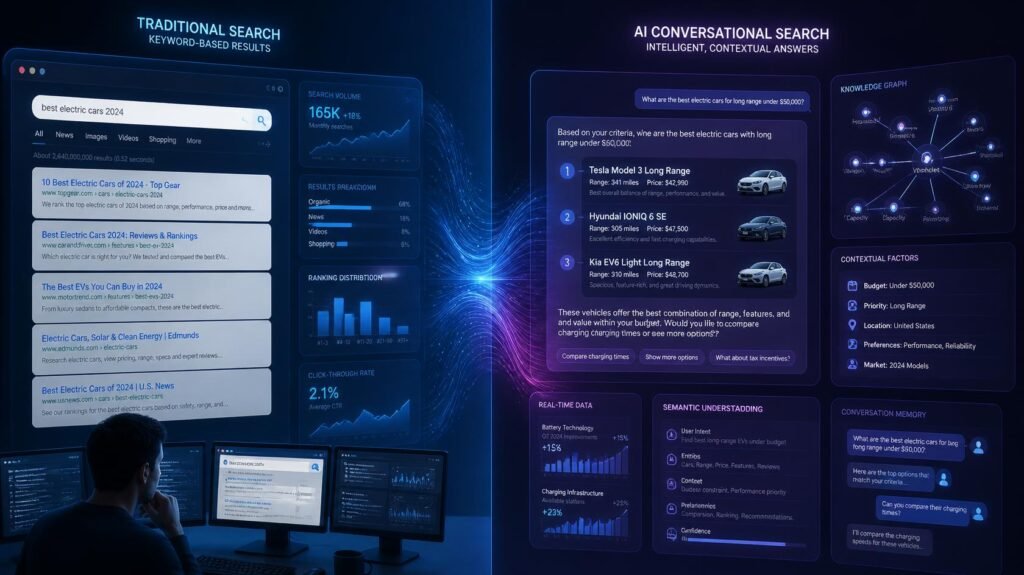
Search behavior is no longer the same as it was just a couple of years ago. People no longer browse through various search engine results pages. Instead, they use AI-based platforms such as ChatGPT, Google AI Overviews, Gemini, Claude, and Perplexity to get instant conversational answers. These platforms collect information from various reliable sources and provide comprehensive answers, which may save users the effort to visit many different websites.
Such transformation created a whole new discipline called AI Search Optimization (AISO) or Generative Engine Optimization (GEO). Unlike traditional SEO that aims to get better ranking positions in search engine result pages, AI Search Optimization tries to create content that will be easily understandable, trustworthy, and useful enough to use in responses generated by AI platforms.
While many companies invest much money into content marketing, they do not update it according to the requirements of the new search behavior. In such a way, while their websites may still receive traffic from search engines due to old search algorithms, they will be almost invisible in AI-driven answers.
Whether you are a digital marketer, SEO specialist, business owner, publisher, or content strategist, understanding these common mistakes can help you improve both search visibility and long-term authority.
By the end of this guide, you will know how to avoid the biggest AI Search Optimization mistakes and create content that performs well across both traditional search engines and AI-powered search experiences.

What Is AI Search Optimization?
AI Search Optimization refers to the development of content that will enable AI-driven search platforms to comprehend and refer to it when developing responses.
In contrast to regular SEO, which mostly focuses on search engine rankings, AI Search Optimization focuses on content quality, semantic comprehension, topical authority, entity relationships, and trustworthiness.
Rather than just focusing on keywords and backlinks on your pages to rank them higher, AI systems analyze whether your content answers user queries accurately and reliably.
Traditional SEO vs AI Search Optimization
| Traditional SEO | AI Search Optimization |
|---|---|
| Focuses on SERP rankings | Focuses on AI citations and visibility |
| Keyword-focused | Entity and context-focused |
| Measures clicks | Measures visibility and citations |
| Optimizes for search engines | Optimizes for AI understanding |
| Ranking-centric | Knowledge-centric |
Why AI Search Optimization Matters
AI-driven search is redefining information discovery for the digital world. Companies focusing only on conventional SEO will slowly begin to fade from visibility due to the increasing dependence on AI-driven answers by people.
Optimization of AI search helps you ensure your content becomes:
- Easy for AI search algorithms to read
- More likely to get featured in AI-driven answers
- Trustworthy for users
- Structured for knowledge extraction
- Competitive for future searches
1: Writing for Algorithms Instead of Humans
One of the frequent errors companies do is writing content not for their target audience but for search engine algorithms. As a result, the material looks redundant and filled with keywords and does not add any value for users.
Although this strategy might work at first glance, contemporary AI-based systems consider different factors evaluating the content’s quality. Namely, these are its clarity, usefulness, uniqueness, and context, but not just the amount of keywords used.
Think about looking for information on AI Search Optimization and reading an article which uses the same phrase in each paragraph while offering almost no useful tips. Although it is full of the target phrase, it cannot help the user solve his problem. The AI platform understands it and refers to this content less frequently.
Signs You’re Making This Mistake
- Repeating the same keyword unnaturally
- Writing long paragraphs filled with filler text
- Prioritizing keyword density over readability
- Publishing generic advice available on hundreds of websites
- Creating content solely to satisfy search algorithms
Why This Hurts Your AI Visibility
AI systems are designed to recommend the most helpful information available. They evaluate whether your content demonstrates expertise, provides complete answers, and solves real problems.
If your article feels robotic or repetitive, it signals low value and reduces the likelihood of being cited.
Example
Instead of writing:
AI Search Optimization helps improve AI Search Optimization because AI Search Optimization increases AI Search Optimization rankings.
Write:
AI Search Optimization improves your website’s visibility by making content easier for AI-powered platforms to understand, trust, and reference in their responses.
The second version is more informative, natural, and reader-friendly.
How to Fix It
Focus on answering users’ questions instead of simply targeting keywords.
Best practices include:
- Write naturally.
- Use conversational language.
- Explain concepts thoroughly.
- Include practical examples.
- Add original insights.
- Prioritize readability.
Expert Tip
Before publishing any article, ask yourself:
“Would this article genuinely help someone solve their problem if search engines didn’t exist?”
If the answer is yes, you are already aligning with how AI systems evaluate high-quality content.
Common Problems and Solutions
| Problem | Solution |
|---|---|
| Keyword stuffing | Use semantic keywords naturally |
| Robotic writing | Write conversationally |
| Thin explanations | Add practical examples |
| Low originality | Include expert insights |
| Poor readability | Use shorter paragraphs and headings |
2: Ignoring Search Intent
Search intent is one of the strongest indicators of content quality. Many websites choose a keyword without understanding what users actually expect to find.
For example, someone searching for “AI Search Optimization Checklist” wants a practical checklist they can follow immediately. If your article instead provides only a general overview of AI Search Optimization, readers are unlikely to find it useful.
Similarly, a user searching “Why isn’t ChatGPT citing my website?” expects troubleshooting advice, not a basic explanation of AI search.
Matching your content to the user’s intent improves engagement, satisfaction, and the likelihood that AI systems will consider your article a reliable source.
Types of Search Intent
| Intent | Example Query |
|---|---|
| Informational | What is AI Search Optimization? |
| Navigational | OpenAI documentation |
| Commercial | Best AI SEO tools |
| Transactional | Buy AI SEO software |
How to Align Content with Search Intent
Start by identifying the primary question behind your target keyword.
Then:
- Answer the question early in the article.
- Expand with practical guidance.
- Include examples and comparisons.
- Address related questions naturally.
- Finish with actionable recommendations.
Example
If the keyword is AI Search Optimization Mistakes, readers expect:
- Common mistakes
- Reasons those mistakes matter
- Real-world examples
- Practical fixes
- Actionable recommendations
Delivering exactly what users expect increases both engagement and the potential for AI-powered platforms to reference your content.

3: Publishing Thin Content Instead of Comprehensive Resources
One of the most critical aspects as to why sites do not get mentioned in AI-driven searches is because they produce content which is shallow in relation to the topics covered. An article that is short will be able to give an answer to one question but not much more; AI-driven searches will rather opt to use content that gives a thorough explanation on the topic.
People usually make use of AI platforms in order to receive a response to their questions, rather than searching for various pages. In that case, the content must be complete, well-structured, and valuable.
Take for instance a 700-word long article giving just the definition of AI Search Optimization and compare it to a guide which covers all of the relevant topics such as benefits, ranking factors, steps, mistakes, tools, FAQs, etc.
It makes sense to create comprehensive resources in order to be considered a good source for both users and AI platforms.
Signs of Thin Content
Many websites unknowingly publish thin content because they focus on quantity rather than quality.
Common indicators include:
- Articles shorter than necessary for the topic
- Missing practical examples
- No actionable recommendations
- Lack of statistics or supporting data
- Few or no tables
- No FAQs
- Weak internal linking
- Repetitive information without adding value
Thin Content vs Comprehensive Content
| Thin Content | Comprehensive Content |
|---|---|
| Covers only one aspect of the topic | Covers the topic from multiple perspectives |
| Few headings | Logical H2 and H3 structure |
| Minimal examples | Includes real-world examples and use cases |
| Limited value | Offers practical guidance and insights |
| Few supporting resources | References related concepts and trusted sources |
Why Thin Content Performs Poorly in AI Search
The purpose of using an AI is to provide a complete answer to user questions. When your article fails to give answers to crucial questions, the AI uses information gathered from various websites rather than relying on your site.
A complete piece of work shows that you are an expert in the subject matter. Your article can be used by the AI when it gives a complete answer to questions related to the topic.
How to Fix It
Rather than writing multiple short articles about similar topics, invest time in creating one high-quality resource.
Your content should include:
- Clear definitions
- Benefits
- Challenges
- Step-by-step implementation
- Best practices
- Practical examples
- Common mistakes
- Frequently asked questions
- Comparison tables
- Actionable recommendations
The objective is to ensure that readers can find everything they need without leaving your page.
Expert Tip
Before publishing, ask yourself:
“If I were a beginner, would this article answer every major question I have about this topic?”
If the answer is no, continue improving it until it becomes a complete resource.
Quick Checklist for Comprehensive Content
| Content Element | Included |
|---|---|
| Introduction | ✔ |
| Definitions | ✔ |
| Benefits | ✔ |
| Examples | ✔ |
| Best Practices | ✔ |
| Tables | ✔ |
| FAQs | ✔ |
| Conclusion | ✔ |
4: Ignoring Topical Authority
Having high-quality content on the website is very significant, but one single high-quality article won’t help you to build authority. The AI-based search engines check how frequently the website provides content on a specific topic.
It is called topical authority.
One website that has one single article on AI search optimization can be viewed as relevant. A website that has thirty articles on AI search optimization, AI SEO, Google AI overviews, AI citations, structured data, topical authority, prompt engineering, and content optimization will be considered much more authoritative.
What Is Topical Authority?
Topical authority refers to the level of expertise your website demonstrates within a specific subject area.
Instead of publishing unrelated articles, successful websites organize their content around a central theme.
For example, if your niche is AI Search Optimization, your content ecosystem might include:
- AI Search Optimization Guide
- AI SEO Checklist
- AI Search Ranking Factors
- ChatGPT SEO
- Google AI Overviews
- Generative Engine Optimization
- AI Citation Optimization
- AI Search Analytics
- Structured Data for AI Search
- Common AI Search Optimization Mistakes
Together, these articles strengthen your website’s credibility.
Example Topic Cluster
| Pillar Article | Supporting Articles |
|---|---|
| AI Search Optimization Guide | What Is GEO? |
| AI Search Optimization Guide | AI SEO Checklist |
| AI Search Optimization Guide | AI Citation Optimization |
| AI Search Optimization Guide | Google AI Overviews Explained |
| AI Search Optimization Guide | ChatGPT SEO Best Practices |
| AI Search Optimization Guide | AI Search Ranking Factors |
| AI Search Optimization Guide | AI Search Analytics |
| AI Search Optimization Guide | AI Search Optimization Mistakes |
Benefits of Building Topical Authority
There are a number of benefits associated with topical authority development in the long run.
- Boosts website credibility
- Creates opportunities for interlinking
- Encourages prolonged browsing sessions
- Helps form semantic connections
- Ensures easier understanding of content by AI programs
- Makes your content more visible in various search queries
Best practices
In order to establish topical authority:
- Develop pillar pages
- Publish supporting content consistently
- Form links between related posts
- Update old posts
- Provide consistent quality
Sites which gain recognition for their comprehensive coverage of a certain topic are more likely to gain credibility among both visitors and AI-based search engines.
5: Poor Content Structure
Even exceptional content can underperform if it is difficult to read.
Many websites publish articles filled with long paragraphs, inconsistent headings, and poor organization. While users may lose interest quickly, AI systems can also struggle to identify the most important information.
Clear formatting improves readability and makes it easier for AI platforms to extract accurate answers.
Characteristics of Poor Structure
Common structural issues include:
- Very long paragraphs
- Missing headings
- No bullet points
- Lack of comparison tables
- Mixed topics in one section
- No summaries
Poor Structure vs AI-Friendly Structure
| Poor Structure | AI-Friendly Structure |
|---|---|
| Large text blocks | Short paragraphs |
| Random headings | Logical H2 and H3 hierarchy |
| Few lists | Bullet points and numbered lists |
| Limited tables | Comparison tables where appropriate |
| No summaries | Key takeaways after major sections |
Why Structure Matters
Good structure helps readers scan your article quickly.
It also enables AI systems to identify:
- Definitions
- Lists
- Comparisons
- Procedures
- Key recommendations
The easier your information is to interpret, the more useful it becomes for AI-generated responses.
Structure Best Practices
When writing your next article:
- Begin with a strong introduction.
- Use descriptive headings.
- Keep paragraphs between two and four lines.
- Add tables to explain comparisons.
- Include summaries after major sections.
- End with actionable conclusions.
These simple improvements significantly enhance readability and user experience.
6: Ignoring Entities and Context
Traditional SEO often focused on repeating keywords.
AI Search Optimization focuses on understanding concepts and relationships.
This means AI systems analyze the entities mentioned in your content rather than simply counting keywords.
Entities include:
- Companies
- Products
- Technologies
- Organizations
- People
- Frameworks
- Locations
- Standards
When your article naturally connects relevant entities, it provides richer context.
For example, an article discussing AI Search Optimization should naturally reference technologies and concepts such as:
- ChatGPT
- Google AI Overviews
- Gemini
- Claude
- Perplexity
- Large Language Models (LLMs)
- Retrieval-Augmented Generation (RAG)
- Structured Data
- Schema Markup
- Knowledge Graphs
- EEAT
These references help AI systems understand the broader subject.
Example of Poor Optimization
“AI Search Optimization helps AI Search Optimization rankings using AI Search Optimization strategies.”
This sentence repeats the keyword but provides almost no context.
Better Example
“AI Search Optimization improves content visibility across ChatGPT, Google AI Overviews, Gemini, Claude, and Perplexity by combining strong topical authority, structured information, trusted sources, and user-focused content.”
This version is far more informative and meaningful.
Relevant Entities for AI Search Content
| Category | Examples |
|---|---|
| AI Platforms | ChatGPT, Gemini, Claude, Perplexity |
| Search Engines | Google, Bing |
| SEO Concepts | EEAT, Structured Data, Schema Markup |
| AI Technologies | LLMs, RAG, Knowledge Graphs |
| Organizations | OpenAI, Google, Microsoft |
How to Optimize for Entities
- Mention important concepts naturally.
- Explain relationships between technologies.
- Define technical terminology.
- Use semantic keywords.
- Avoid repetitive keyword usage.
Entity-rich writing improves context, helping AI systems understand your content more accurately.
7: Ignoring EEAT Signals
One of the most significant distinctions between SEO and AI Search Optimization is the importance of credibility. The search platforms driven by AI technology are designed to offer the users only reliable and accurate information. Therefore, the more authoritative the information is, the higher are its chances of getting mentioned in AI-driven results.
The idea of EEAT was brought up by Google, where EEAT stands for Experience, Expertise, Authoritativeness, and Trustworthiness. Even though different AI systems might have various ways of assessing the content, their main idea is always the same – only trustworthy content will be surfaced.
The majority of web sites offer articles that do not provide any proof of the author’s expertise whatsoever. The articles do not have practical examples, they do not offer any valuable information and are not backed up by credible sources and the author’s real-life experience.
Understanding EEAT
| EEAT Component | Meaning | How to Improve |
|---|---|---|
| Experience | Demonstrates first-hand knowledge | Share practical examples, case studies, and lessons learned |
| Expertise | Shows deep subject knowledge | Publish accurate, well-researched, and comprehensive content |
| Authoritativeness | Builds recognition in your niche | Develop topical authority and earn quality backlinks |
| Trustworthiness | Establishes credibility | Use reliable sources, maintain transparency, and keep content updated |
Why EEAT Matters for AI Search
Imagine two websites that write on the same subject.
The first piece consists of general information copied from other sources, but the second one consists of tips for implementation, research, industry cases, and reputable sources.
Which one will be more often used by an AI assistant?
The second piece of work shows real expertise and brings more value. After all, the goal of AI is to provide the most reliable information to users.
Signs Your Content Lacks EEAT
You may need to improve your content if it has any of the following characteristics:
- No author information
- Generic advice without supporting evidence
- No examples or case studies
- Outdated statistics
- Poor grammar or inconsistent formatting
- Unsupported claims
- No references to trusted resources
Practical Ways to Strengthen EEAT
Improving EEAT doesn’t require complicated strategies. Focus on consistently producing high-quality, trustworthy content.
Consider the following best practices:
- Share practical experiences whenever possible.
- Include original research or observations.
- Reference reputable industry publications.
- Keep articles updated.
- Explain complex concepts clearly.
- Use accurate terminology.
- Build a consistent publishing schedule.
EEAT Implementation Checklist
| Task | Completed |
|---|---|
| Added original insights | ✔ |
| Included practical examples | ✔ |
| Referenced authoritative sources | ✔ |
| Updated outdated information | ✔ |
| Improved readability | ✔ |
| Demonstrated expertise | ✔ |
8: Weak Internal Linking Strategy
Many businesses underestimate the importance of internal linking. They either add only a few random links or neglect internal links entirely.
However, internal linking plays a critical role in helping AI systems understand your website’s structure and topical relationships.
Every internal link acts as a connection between related pieces of content. These connections help establish expertise while improving navigation for users.
Imagine your website as a city.
Each blog post represents a building, and internal links are the roads connecting them. Without roads, visitors and AI systems have difficulty discovering how everything fits together.
Benefits of Internal Linking
An effective internal linking strategy offers several advantages.
- Helps search engines discover content.
- Improves user navigation.
- Builds topical authority.
- Increases page views.
- Reduces bounce rate.
- Distributes page authority.
- Provides additional context for AI systems.
Poor vs Effective Internal Linking
| Poor Internal Linking | Effective Internal Linking |
|---|---|
| Random anchor text | Descriptive anchor text |
| Few related articles | Connected topic clusters |
| Broken links | Regularly maintained links |
| Isolated pages | Well-connected content ecosystem |
| No content hierarchy | Clear pillar-and-cluster model |
Internal Linking Best Practices
To maximize the value of internal links:
- Link naturally within paragraphs.
- Use descriptive anchor text instead of generic phrases like “click here.”
- Connect related articles.
- Update old content with links to new resources.
- Prioritize links that genuinely help readers.
For example, if you’re writing about AI Search Optimization Mistakes, you can naturally link to related articles such as:
- Complete AI Search Optimization Guide
- How to Rank in ChatGPT
- AI Citation Optimization
- Google AI Overviews Explained
- Building Topical Authority
- Schema Markup Best Practices
This creates a logical content network that benefits both users and AI search engines.
9: Publishing Content Once and Never Updating It
Search technology evolves rapidly. AI models, user expectations, and search algorithms continue to change, making it essential to keep your content current.
Many businesses publish an article and never revisit it. Over time, statistics become outdated, screenshots no longer match the latest interfaces, links break, and recommendations lose relevance.
AI systems generally prefer content that reflects the latest information available.
Why Content Updates Matter
Regular updates help maintain accuracy and improve the long-term performance of your articles.
Benefits include:
- Improved content quality
- Increased trust
- Better user experience
- More relevant information
- Stronger search visibility
- Higher chances of AI citations
What Should You Update?
Review the following elements periodically:
| Content Element | Recommended Update |
|---|---|
| Statistics | Replace with recent data |
| Examples | Add current examples |
| Screenshots | Update outdated visuals |
| Internal Links | Connect to new articles |
| External Links | Replace broken references |
| FAQs | Add questions based on recent trends |
| Best Practices | Revise according to industry changes |
How Often Should You Refresh Content?
The ideal update frequency depends on your industry.
| Content Type | Suggested Review Frequency |
|---|---|
| AI & Technology | Every 3–6 months |
| Digital Marketing | Every 6 months |
| Evergreen Guides | Every 6–12 months |
| Product Reviews | Every 3 months |
| Industry Statistics | Whenever new data is available |
A simple content audit every quarter can significantly improve the long-term value of your website.
Content Refresh Workflow
A structured update process makes maintenance easier.
- Review website analytics.
- Identify articles with declining traffic.
- Update outdated information.
- Add new examples and practical insights.
- Improve headings and readability.
- Expand FAQs.
- Add internal links to newer content.
- Republish the updated article if appropriate.
Long-Term Best Practices for AI Search Success
AI Search Optimization is not about quick fixes. It requires a long-term commitment to producing valuable, trustworthy, and well-organized content.
Focus on these practices consistently:
- Publish comprehensive, user-focused articles.
- Build topical authority through content clusters.
- Optimize for search intent.
- Use descriptive headings and structured formatting.
- Demonstrate expertise with original insights.
- Maintain strong internal linking.
- Keep content fresh through regular updates.
- Monitor performance and refine your strategy over time.
Common Mistakes to Avoid
| Mistake | Why It Hurts |
|---|---|
| Publishing generic content | Offers little unique value |
| Ignoring EEAT | Reduces trust and authority |
| Weak internal linking | Limits topical connections |
| Outdated information | Lowers credibility |
| Keyword stuffing | Makes content difficult to read |
| Inconsistent publishing | Slows authority growth |
10: Not Measuring AI Search Performance
One of the most frequently ignored issues related to the implementation of AI Search Optimization is assessing whether the measures taken have any positive impact on the visibility of your content. Indeed, companies may spend lots of effort on making the content more suitable for AI systems but do not measure the results. In contrast to standard SEO techniques, where ranking and clicking are the key signals, for AI Search Optimization, one needs to pay attention to a much wider range of indicators which show how your content gets discovered, referred to, and consumed.
At the moment, none of the leading AI systems such as ChatGPT, Gemini, Claude, and Perplexity offers dashboards indicating how many times it cites your website; however, there are some indirect signals that show the effectiveness of your strategy.
Metrics to Track
| Metric | Why It Matters | Suggested Tool |
|---|---|---|
| Organic Traffic | Measures overall search visibility | Google Analytics |
| Search Impressions | Indicates how often pages appear in search | Google Search Console |
| Click-Through Rate (CTR) | Evaluates title and meta description performance | Google Search Console |
| Indexed Pages | Confirms that pages are discoverable | Google Search Console |
| Referral Traffic | Identifies visitors from AI and other external sources | Google Analytics |
| Engagement Rate | Reflects content quality | Google Analytics |
| Average Engagement Time | Shows how users interact with content | Google Analytics |
| Backlinks | Builds authority and trust | Ahrefs, Semrush, Moz |
| Brand Mentions | Indicates growing online authority | Brand monitoring tools |
| Content Updates | Keeps information relevant | Content audit tools |
Monitoring these metrics regularly helps you identify which topics perform well and where improvements are needed.
Conclusion
AI Search Optimization is becoming one of the critical elements of digital marketing strategy. As AI-driven search platforms keep changing the way users find information online, organizations that can afford to create credible, consistent, and comprehensive content will have more chances to build visibility in the long term.
It’s not only about ranking higher on search engine results pages. It’s also about making sure your content is recognized as credible enough for use in conversational responses by AI systems. In order to make that happen, you need a combination of classic SEO fundamentals and entity optimization, topical authority, structured content, and EEAT factors.
This list of ten mistakes provides you with the knowledge of what to avoid in order to optimize your website for AI search visibility. If you don’t try to stuff your content with keywords, consider the search intent, publish credible and comprehensive resources, organize them properly, build topical authority, keep the right structure of internal links, update existing articles, and monitor your website, then you build the base for sustainable development.
AI search keeps evolving but there is one thing that is unlikely to change. The most important content is the one that really helps people.
Frequently Asked Questions
1. What is AI Search Optimization?
AI Search Optimization is the practice of creating content that AI-powered search platforms can easily understand, trust, and reference when generating responses.
2. How does AI Search Optimization differ from traditional SEO?
Traditional SEO focuses on improving rankings in search engine results, while AI Search Optimization emphasizes content quality, entities, context, and trust so that AI systems can confidently use it as a source.
3. Why isn’t my website appearing in ChatGPT or Google AI Overviews?
Common reasons include weak topical authority, poor content structure, lack of EEAT signals, thin content, and content that doesn’t match user search intent.
4. Is keyword optimization still important?
Yes. Keywords remain valuable, but they should be used naturally alongside semantic keywords, entities, and comprehensive topic coverage.
5. Does structured content improve AI visibility?
Yes. Clear headings, concise paragraphs, bullet points, tables, and logical organization make content easier for AI systems to understand and summarize.
6. How often should I update my content?
Review important articles every three to six months or sooner if significant industry changes occur.
7. What is topical authority?
Topical authority is the expertise your website demonstrates by publishing multiple interconnected articles around a specific subject.
8. Are backlinks still important for AI Search Optimization?
Yes. High-quality backlinks continue to strengthen website authority and can improve overall search visibility.
9. Can AI-generated content rank well?
Yes, provided it is thoroughly edited, fact-checked, enriched with original insights, and aligned with user intent and EEAT principles.
10. What is the biggest AI Search Optimization mistake?
The biggest mistake is creating content solely for search engines instead of producing helpful, trustworthy resources that genuinely answer users’ questions.