


With the emergence of digital-first companies, customers expect software that provides them with fast, secure, and reliable interaction. From eCommerce platforms that conduct thousands of operations per minute to banking applications and portals providing access to personal health information everything is done using software products. Organizations need to respond to constantly changing customer demands and market competition with the provision of innovative features of high quality and reliability without delays and risks.
Traditional approaches to software development were characterized by the isolation of development and operations. Developers worked on code, while operations team was responsible for infrastructure, deployment, and maintenance. Such isolation led to communication problems and difficulties with deployment. The adoption of cloud computing only intensified the problem since it presupposes the necessity of continuous scaling and automation.
DevOps in the Cloud provides developers with the opportunity to combine development, operation, automation, and cloud technologies in one process. Using this technique, organizations have an opportunity to develop, test, deploy, and continuously monitor applications at a much higher speed while enjoying the scalability and flexibility provided by cloud computing. Instead of deploying software every few months, it is possible to release daily or even multiple updates per day.

What Is DevOps in the Cloud?
Cloud DevOps is the term used to describe the application of DevOps practices using cloud technology infrastructure. In other words, it encompasses automation, collaboration, CI/CD, IaC, and cloud monitoring to deliver a faster and more reliable software delivery system.
While in on-premises environments, it could take days or even weeks to provision the infrastructure, cloud technology enables the developers and ops teams to provision servers, storage, network, and security in a matter of minutes. Therefore, this increases development agility while decreasing the operational complexity.
Cloud DevOps seeks to automate the software delivery pipeline from the stage of coding to the deployment stage. Unlike the conventional deployment of applications or server provisioning, in Cloud DevOps practices, the development and deployment of applications are fully automated through automation tools.
Why DevOps and Cloud Computing Work Together
The cloud offers the platform, whereas DevOps offers the process. It is through their collaboration that software development, testing, deployment, and scaling become efficient.
Cloud platforms offer on-demand resources that can be set up automatically. In turn, it makes it easier to develop DevOps automation because without cloud computing, it becomes harder and more costly to implement continuous integration, testing, and deployments.
Some of the reasons why cloud computing and DevOps are compatible include:
On-Demand Infrastructure
The ability to provision development, test, stage, and production environments at any time is provided by cloud service providers. Instead of buying hardware equipment, companies may instantly create virtual machines, containers, databases, and networking capabilities. That makes possible to save money on infrastructure and accelerate the development process.
Scalability
The cloud infrastructure allows scaling of resources based on the application requirements. In case of peak traffic loads, additional computing power may be allocated. When the traffic drops, unused resources will be automatically turned off and released, which will optimize the expenses.
Automation
Automation is the core concept behind both DevOps and cloud computing. Such processes as infrastructure provisioning, application deployment, testing, monitoring, backups, and security upgrades may be automated with cloud services and DevOps tools.
Faster Deployment
With cloud infrastructure, long-lasting procedures of hardware purchase and servers preparation become obsolete. New applications may be deployed within minutes rather than weeks needed to prepare infrastructure.
Higher Reliability
Big cloud providers have high availability, disaster recovery, global data centers, and automatic backup capabilities. Along with DevOps monitoring and automation tools, that makes applications highly available and fault-tolerant.
Core Principles of DevOps in the Cloud
Successful Cloud DevOps implementation relies on several fundamental principles that help organizations deliver software efficiently.
Collaboration
Cloud DevOps encourages developers, operations engineers, security teams, quality assurance professionals, and business stakeholders to work together throughout the software lifecycle. Instead of operating in isolated departments, everyone shares responsibility for software quality and performance. Improved collaboration reduces misunderstandings and accelerates problem-solving.
Continuous Integration
Continuous Integration (CI) allows developers to frequently merge code into a shared repository.
Every code change automatically triggers:
- Source code validation
- Automated builds
- Unit testing
- Code quality checks
- Security scanning
Early detection of issues reduces debugging efforts and prevents defects from reaching production.
Continuous Delivery and Continuous Deployment
Continuous Delivery ensures that software remains deployment-ready at all times. Continuous Deployment goes a step further by automatically releasing validated changes into production without manual intervention.
These practices enable organizations to deliver software updates quickly while maintaining high quality standards.
Infrastructure as Code (IaC)
Infrastructure as Code allows teams to define cloud infrastructure using configuration files rather than manual setup.
Instead of clicking through cloud management consoles, infrastructure is created programmatically using tools such as Terraform, AWS CloudFormation, or Azure Resource Manager.
Benefits include:
- Consistent infrastructure
- Version control
- Easy rollback
- Automated provisioning
- Faster environment creation
Automation
Automation eliminates repetitive manual work throughout the development lifecycle.
Automated processes include:
- Code compilation
- Software testing
- Infrastructure provisioning
- Application deployment
- Monitoring
- Scaling
- Security updates
- Backup management
Automation improves accuracy while reducing deployment times.
Continuous Monitoring
Applications require constant monitoring after deployment.
Cloud DevOps teams collect metrics related to:
- CPU utilization
- Memory usage
- Network traffic
- Error rates
- Response time
- Application availability
- User experience
Real-time monitoring enables teams to identify issues before they impact customers.
Core Components of Cloud DevOps:
| Component | Purpose |
|---|---|
| Version Control | Stores and manages source code |
| Continuous Integration | Automatically builds and tests code |
| Continuous Delivery | Automates software deployment |
| Infrastructure as Code | Creates cloud infrastructure using code |
| Containers | Packages applications consistently |
| Kubernetes | Orchestrates containers |
| Monitoring | Tracks application health |
| Security | Protects applications and infrastructure |
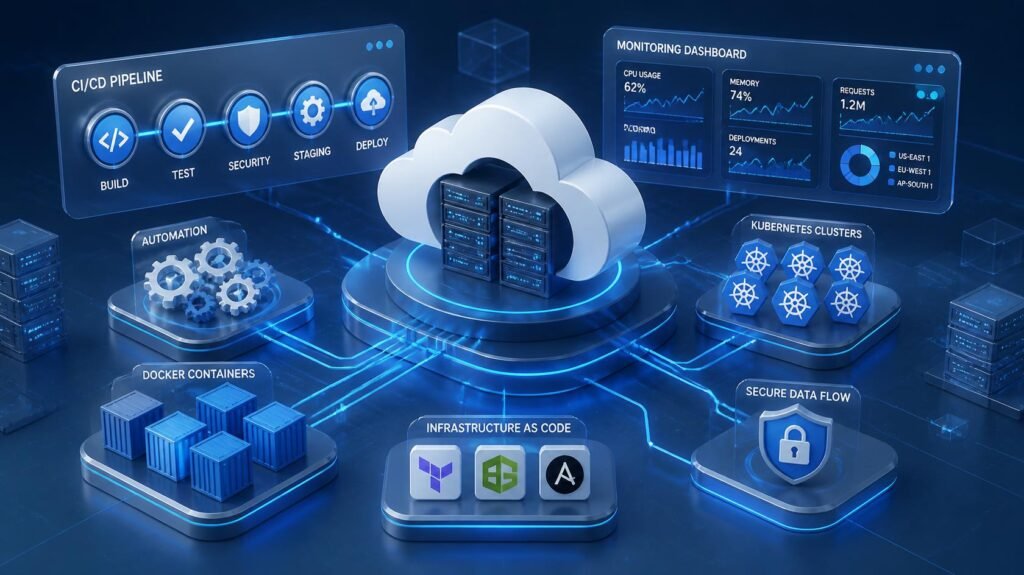
The Evolution of DevOps in the Cloud
Software development has undergone significant transformation over the last two decades.
Traditional IT Operations
Earlier software projects followed a waterfall model. Development, testing, deployment, and maintenance occurred as separate phases. Infrastructure was managed manually using physical servers. Release cycles often lasted several months. This approach created bottlenecks and delayed product releases.
Virtualization Era
Virtual machines improved resource utilization. Organizations could create multiple servers on a single physical machine. Although virtualization improved efficiency, infrastructure management remained largely manual.
Cloud Computing Revolution
Cloud computing transformed IT infrastructure.
Instead of maintaining data centers, organizations began using cloud providers that offered:
- Compute services
- Databases
- Storage
- Networking
- Security
- AI services
- Analytics
Resources became instantly available through APIs.
Rise of DevOps
As cloud adoption increased, organizations needed faster deployment methods. DevOps emerged as a culture emphasizing automation, collaboration, and continuous improvement. The combination of cloud computing and DevOps dramatically shortened release cycles while improving software quality.
Cloud-Native DevOps
Today, organizations increasingly adopt cloud-native technologies including:
- Containers
- Kubernetes
- Serverless computing
- Microservices
- GitOps
- AI-powered automation
These technologies further accelerate software delivery while improving scalability and resilience.
Benefits of DevOps in the Cloud
Organizations adopting DevOps in the Cloud gain both technical and business advantages.
Faster Software Delivery
Automation reduces delays across development, testing, and deployment. Teams release updates more frequently without sacrificing quality. This allows businesses to respond quickly to customer needs and market changes.
Improved Collaboration
Developers, operations teams, and security professionals work together using shared tools and processes. This reduces communication barriers and speeds up issue resolution.
Better Scalability
Cloud environments automatically scale based on workload. Applications maintain consistent performance during traffic spikes without requiring manual intervention.
Reduced Operational Costs
Cloud DevOps helps organizations pay only for the resources they use. Automation also minimizes manual effort, lowering infrastructure management costs while improving efficiency.

Cloud DevOps Architecture
The design of a Cloud DevOps architecture allows for efficient application creation, testing, deployment, and management while ensuring security, scalability, and reliability of applications. Even though each organization might use its own implementation, most Cloud DevOps architectures share a common flow where automation is applied in each step of the software development lifecycle.
This process starts with the creation of a source code by developers and committing this code to a version control system, like Git. After that, once the code is committed, the continuous integration process takes place automatically. The CI process compiles the application, runs tests, analyzes the quality of code, and checks for any security vulnerabilities. If the code satisfies all the validation requirements, then it goes to the continuous delivery pipeline where it is built and delivered to test, staging, or production environment.
The whole process becomes extremely efficient because cloud platforms allow automating infrastructure provisioning, network configuration, workload scaling, and application monitoring. Infrastructure is managed using code, which means that both development and operations teams can replicate the same environment at any time.
A modern Cloud DevOps architecture generally includes:
- Source Code Repository
- Continuous Integration Pipeline
- Artifact Repository
- Infrastructure as Code
- Container Platform
- Orchestration Layer
- Continuous Delivery Pipeline
- Monitoring and Logging
- Security and Compliance Tools
- Cloud Infrastructure Services
Every component communicates through automation, allowing applications to move seamlessly from development to production.
Continuous Integration (CI) in Cloud DevOps
Continuous Integration is one of the most important practices in DevOps. Instead of waiting until the end of a project to merge code, developers integrate their changes into a shared repository several times a day.
Whenever new code is committed, automated workflows immediately begin verifying the quality of the application.
A typical Continuous Integration pipeline performs tasks such as:
- Compiling source code
- Running unit tests
- Executing integration tests
- Static code analysis
- Dependency validation
- Security scanning
- Code formatting checks
- Build generation
Early validation prevents bugs from accumulating and significantly reduces the cost of fixing software defects.
Cloud-based CI services provide scalable build environments, allowing multiple builds to run simultaneously without maintaining dedicated build servers.
Benefits of Continuous Integration include:
- Faster development cycles
- Early bug detection
- Improved collaboration
- Better software quality
- Reduced deployment risks
- Automated testing
- Consistent build process
Continuous Delivery and Continuous Deployment
After code successfully passes Continuous Integration, it enters the Continuous Delivery pipeline. Continuous Delivery ensures every application version is production-ready. Deployment becomes a predictable, repeatable process instead of a stressful manual operation.
The Continuous Delivery pipeline generally includes:
- Build packaging
- Artifact storage
- Environment provisioning
- Configuration management
- Integration testing
- Performance testing
- User acceptance testing
- Approval workflows
- Production deployment
Some organizations choose Continuous Deployment, where validated code is automatically released into production without requiring manual approval.
This enables multiple software releases every day while maintaining stability.
Advantages include:
- Faster feature delivery
- Reduced deployment failures
- Lower operational costs
- Faster customer feedback
- Improved release confidence
Infrastructure as Code (IaC)
Infrastructure management has traditionally been one of the most time-consuming aspects of IT operations.
Cloud DevOps replaces manual configuration with Infrastructure as Code (IaC).
Instead of logging into cloud consoles and manually creating resources, engineers write configuration files that define the entire infrastructure.
These files describe:
- Virtual machines
- Storage
- Databases
- Load balancers
- Networking
- Firewalls
- Security groups
- DNS settings
Once executed, the infrastructure is automatically created exactly as specified.
Popular Infrastructure as Code tools include:
- Terraform
- AWS CloudFormation
- Azure Resource Manager (ARM)
- Pulumi
- OpenTofu
Benefits of Infrastructure as Code
Consistency
Every environment is identical, reducing deployment errors.
Version Control
Infrastructure changes are tracked just like application code.
Rapid Provisioning
Entire cloud environments can be created within minutes.
Disaster Recovery
Infrastructure can be recreated quickly after failures.
Reduced Human Error
Automation eliminates manual configuration mistakes.
Configuration Management
Infrastructure provisioning alone is not enough. Applications also require consistent software configuration.
Configuration management tools automatically install software, configure operating systems, update packages, and manage application settings.
Popular tools include:
- Ansible
- Puppet
- Chef
- SaltStack
These tools ensure every server follows the same configuration standards, improving reliability and reducing troubleshooting time.
Containers in Cloud DevOps
Containers have transformed application deployment.
Instead of installing software directly on virtual machines, developers package applications together with their dependencies into lightweight containers.
Containers provide several advantages:
- Portable across environments
- Faster startup
- Lower resource consumption
- Simplified deployment
- Consistent runtime environment
Applications behave the same regardless of whether they run on a developer’s laptop, a testing server, or a cloud production environment. One of the most widely adopted container platforms is Docker. Docker packages applications into isolated containers that can run consistently across different cloud providers.
Benefits include:
- Faster deployments
- Easy scaling
- Improved resource utilization
- Simplified application management
- Better developer productivity
Kubernetes and Container Orchestration
Managing a few containers manually is relatively simple. Managing thousands of containers across multiple cloud regions requires orchestration. Kubernetes has become the industry standard for container orchestration.
It automatically manages:
- Container scheduling
- Load balancing
- Auto-scaling
- Self-healing
- Rolling updates
- Service discovery
- Storage management
If a container crashes, Kubernetes automatically replaces it. If application traffic increases, Kubernetes launches additional containers. If traffic decreases, unnecessary containers are removed automatically.
This automation dramatically improves application availability. Major cloud providers offer managed Kubernetes services, reducing operational complexity while maintaining enterprise-grade scalability.
Microservices Architecture
Modern Cloud DevOps environments commonly use microservices instead of monolithic applications. A monolithic application combines every feature into a single codebase. Any modification often requires redeploying the entire application. Microservices divide applications into smaller independent services. Each service performs a specific business function.
Examples include:
- Authentication Service
- Payment Service
- Notification Service
- Inventory Service
- User Management
- Recommendation Engine
Advantages of microservices include:
- Independent deployments
- Faster development
- Better fault isolation
- Improved scalability
- Technology flexibility
- Easier maintenance
Each service can be updated without affecting the rest of the application.
Cloud Automation
Automation forms the foundation of DevOps in the Cloud. Organizations automate virtually every repetitive operational task.
Common automation examples include:
- Infrastructure provisioning
- Application deployment
- Security scanning
- Database backups
- Scaling resources
- Certificate renewal
- Patch management
- Log collection
- Performance monitoring
Automation reduces manual effort while improving operational efficiency. It also enables teams to focus on innovation instead of routine maintenance.
Monitoring and Observability
Deployment is not the end of the software lifecycle. Applications must be continuously monitored to ensure reliability. Cloud DevOps monitoring focuses on collecting operational data in real time.
Teams monitor:
- CPU usage
- Memory utilization
- Disk performance
- Network latency
- Error rates
- Response time
- User sessions
- API performance
- Service availability
Modern observability platforms combine metrics, logs, and traces to provide complete visibility into application health. Instead of merely identifying that a problem exists, observability helps engineers understand why it occurred.
Logging and Centralized Log Management
Every application generates logs containing valuable operational information. Cloud DevOps centralizes these logs for easier analysis.
Logs typically include:
- System events
- User activity
- Application errors
- Security alerts
- Performance metrics
- API requests
Centralized logging enables faster troubleshooting, security investigations, and compliance reporting.
Cloud Security in DevOps
Security is integrated throughout the Cloud DevOps lifecycle rather than being treated as a final step before deployment. Modern organizations adopt DevSecOps practices, ensuring that security is embedded into every phase of software development.
Security measures include:
- Identity and Access Management (IAM)
- Multi-factor authentication
- Encryption at rest and in transit
- Secret management
- Vulnerability scanning
- Dependency scanning
- Container image scanning
- Runtime security monitoring
- Compliance automation
Automated security testing helps detect vulnerabilities before software reaches production.
This proactive approach reduces security risks while supporting regulatory compliance.
Serverless DevOps
Serverless computing is another important evolution in Cloud DevOps. Instead of managing virtual machines or containers, developers deploy individual functions that execute only when triggered.
Cloud providers automatically manage:
- Infrastructure
- Scaling
- Availability
- Operating system updates
- Resource allocation
Benefits of serverless DevOps include:
- Lower infrastructure costs
- Faster deployment
- Automatic scaling
- Reduced operational overhead
- Improved developer productivity
Serverless architectures are especially useful for APIs, event-driven applications, data processing, and automation workflows. In a Cloud DevOps environment, serverless services can seamlessly integrate into CI/CD pipelines, allowing teams to deliver features rapidly without managing the underlying infrastructure.

Top Cloud DevOps Tools Every Organization Should Know
Selecting the right set of tools is critical for building a successful Cloud DevOps strategy. While no single tool can handle every stage of the software delivery lifecycle, combining the right technologies enables teams to automate workflows, improve collaboration, and accelerate deployments.
Below are some of the most widely used Cloud DevOps tools categorized by their primary function.
Version Control
Version control systems allow developers to track changes, collaborate on code, and maintain a complete history of software development.
Popular tools include:
- Git
- GitHub
- GitLab
- Bitbucket
These platforms support collaborative development, pull requests, branching strategies, and code reviews.
Continuous Integration and Continuous Delivery (CI/CD)
CI/CD platforms automate building, testing, and deploying applications.
Popular options include:
- Jenkins
- GitHub Actions
- GitLab CI/CD
- Azure DevOps Pipelines
- CircleCI
- Bamboo
These tools reduce manual intervention and help deliver software updates faster.
Infrastructure as Code
Infrastructure provisioning becomes more reliable when managed through code.
Leading IaC tools include:
- Terraform
- AWS CloudFormation
- Azure Resource Manager
- Pulumi
- OpenTofu
They help create consistent and repeatable cloud environments.
Containerization
Containers package applications with all required dependencies.
Common container technologies include:
- Docker
- Podman
- Buildah
Containers simplify deployment across different cloud environments.
Container Orchestration
Managing hundreds or thousands of containers requires orchestration platforms.
Popular choices include:
- Kubernetes
- Amazon Elastic Kubernetes Service (EKS)
- Azure Kubernetes Service (AKS)
- Google Kubernetes Engine (GKE)
- Red Hat OpenShift
These platforms automate scaling, recovery, and deployment.
Configuration Management
Configuration management ensures servers remain consistent throughout development and production.
Popular tools include:
- Ansible
- Chef
- Puppet
- SaltStack
These tools automate software installation, system configuration, and updates.
Monitoring and Observability
Monitoring solutions help organizations maintain application health and quickly detect performance issues.
Frequently used platforms include:
- Prometheus
- Grafana
- Datadog
- New Relic
- Dynatrace
- Elastic Stack
They provide dashboards, alerts, metrics, logs, and distributed tracing.
Security
Security is integrated into every stage of DevOps.
Widely adopted security tools include:
- Snyk
- Trivy
- Checkov
- SonarQube
- Aqua Security
- Prisma Cloud
These platforms scan source code, containers, dependencies, and cloud infrastructure for vulnerabilities.
Cloud Providers Supporting DevOps
Major cloud platforms provide native DevOps services that reduce operational complexity and integrate seamlessly with development workflows.
Amazon Web Services (AWS)
AWS offers a comprehensive suite of DevOps services that support the entire software delivery lifecycle.
Popular AWS services include:
- CodeCommit
- CodeBuild
- CodeDeploy
- CodePipeline
- CloudFormation
- CloudWatch
- Elastic Kubernetes Service (EKS)
- Lambda
These services help organizations automate application delivery while maintaining high scalability and reliability.
Microsoft Azure
Azure provides enterprise-grade DevOps capabilities suitable for organizations already using Microsoft’s ecosystem.
Key Azure services include:
- Azure DevOps
- Azure Pipelines
- Azure Repos
- Azure Monitor
- Azure Kubernetes Service
- Azure Resource Manager
- Azure Functions
Azure integrates well with Windows-based development environments and enterprise applications.
Google Cloud Platform (GCP)
Google Cloud focuses heavily on cloud-native development and Kubernetes.
Popular Google Cloud DevOps services include:
- Cloud Build
- Cloud Deploy
- Cloud Source Repositories
- Google Kubernetes Engine
- Cloud Operations Suite
- Cloud Run
Google’s expertise in containers and Kubernetes makes it a preferred choice for cloud-native applications.
| Feature | AWS | Microsoft Azure | Google Cloud |
|---|---|---|---|
| CI/CD Service | CodePipeline | Azure Pipelines | Cloud Build |
| Kubernetes | Amazon EKS | Azure AKS | Google GKE |
| Infrastructure as Code | CloudFormation | ARM Templates | Deployment Manager |
| Monitoring | CloudWatch | Azure Monitor | Cloud Monitoring |
| Serverless | AWS Lambda | Azure Functions | Cloud Functions |
| Best For | Enterprise & Startups | Microsoft Ecosystem | Cloud-Native Applications |
How to Implement DevOps in the Cloud
Implementing Cloud DevOps is more than adopting new tools. It requires changes in culture, processes, automation, and collaboration.
A structured implementation roadmap helps organizations reduce risks while maximizing business value.
Step 1: Assess Current Processes
Begin by evaluating your existing software development workflow.
Identify:
- Manual processes
- Deployment bottlenecks
- Communication gaps
- Infrastructure challenges
- Security risks
Understanding current pain points makes it easier to prioritize improvements.
Step 2: Build a Collaborative Culture
Successful DevOps begins with people.
Developers, operations engineers, QA professionals, and security teams should work together rather than in isolated departments.
Encourage shared ownership of software quality and operational performance.
Step 3: Adopt Version Control
Store application code, infrastructure configurations, documentation, and deployment scripts in centralized version control repositories.
This improves collaboration and enables rollback when necessary.
Step 4: Automate Testing
Automated testing ensures software quality without slowing releases.
Implement:
- Unit testing
- Integration testing
- Functional testing
- Security testing
- Performance testing
Automation allows developers to identify issues early in the development lifecycle.
Step 5: Build CI/CD Pipelines
Create automated pipelines that handle:
- Code compilation
- Testing
- Packaging
- Deployment
- Validation
- Rollback
CI/CD pipelines significantly reduce release times while improving reliability.
Step 6: Manage Infrastructure as Code
Replace manual infrastructure provisioning with Infrastructure as Code.
Store infrastructure configurations alongside application code.
This ensures consistency across development, staging, and production environments.
Step 7: Implement Monitoring
Monitor applications continuously after deployment.
Track:
- Performance
- Availability
- Security
- Resource utilization
- Customer experience
Real-time visibility enables faster incident response.
Step 8: Continuously Improve
DevOps is an ongoing journey rather than a one-time implementation.
Regularly review deployment metrics, customer feedback, and operational performance to identify opportunities for optimization.
Best Practices for DevOps in the Cloud
Organizations that successfully adopt Cloud DevOps typically follow several proven practices.
Automate Everything Possible
Automation reduces errors, improves consistency, and accelerates delivery.
Automate:
- Testing
- Infrastructure provisioning
- Deployments
- Monitoring
- Security scanning
- Scaling
- Backups
Keep Infrastructure Version Controlled
Infrastructures must be treated like the application code. All infrastructure changes must be reviewed, tested, and versioned.
Shift-Left Security Approach
Introduce security into the development process. Do an automated scan of the vulnerabilities during development and not in production.
Go for Small, Frequent Deploys
Small deploys minimize risks and make things easier to debug. The continuous delivery process provides faster feedback from customers.
Monitor It All
Metrics must be captured from apps, servers, containers, databases, and cloud providers. Observability allows for proactive problem solving.
Embrace Continuous Learning
The technology changes fast. Training keeps everyone up-to-date about cloud service usage and automation and security approaches.
Common Challenges in Cloud DevOps
Despite the numerous advantages that Cloud DevOps offers, businesses still face some challenges when implementing it.
Cultural Resistance
Traditional working processes make employees reluctant to embrace DevOps principles. Support from leaders and training will alleviate cultural resistance.
Skills Gap
Using cloud computing technologies requires specific skills. Employees need constant education and certification to develop their competencies.
Management of Multi-cloud Systems
Multiple cloud service providers are frequently used by organizations. Management of various systems may complicate the processes of an organization. Automation will help to ensure consistency.
Security Threats
Quick deployments may pose security threats to applications if security practices are neglected. DevSecOps includes integration of automated security measures throughout the development process.
Cost Control
Resource usage can escalate quickly without proper management. Businesses need to monitor their cloud resource usage and optimize workload.
Benefits of DevOps in the Cloud
| Benefit | Business Impact |
|---|---|
| Faster Deployment | Reduced time to market |
| Automation | Less manual effort |
| Scalability | Handles growing workloads |
| Collaboration | Better team productivity |
| Security | Continuous security testing |
| Cost Optimization | Reduced infrastructure expenses |
| Reliability | Improved uptime |
| Faster Recovery | Quick incident response |
Real-World Use Cases of Cloud DevOps
Cloud DevOps is extensively used by various industries due to the following advantages, which include increased innovation and operational efficiency.
E-commerce
E-commerce businesses utilize Cloud DevOps to manage seasonal rushes, launch new features and remain available throughout special sales periods.
Banking and Financial Services
Banks depend on automated tests, secure CI/CD pipelines, and monitoring for delivering reliable banking services to customers and complying with regulatory requirements.
Healthcare
Healthcare organizations deploy Cloud DevOps for launching patient portals, telemedicine solutions and analytical systems in a secure manner.
Software as a Service (SaaS)
SaaS companies regularly launch new versions of their products without disturbing client activity using automated deployment pipelines and cloud-based infrastructure.
Media and Entertainment
Media companies process vast amounts of data and user requests. Cloud DevOps makes it possible to scale rapidly and launch features continuously for millions of simultaneous users.
Artificial Intelligence in Cloud DevOps
Artificial Intelligence is transforming how DevOps teams manage cloud operations. AI-powered tools can analyze logs, predict failures, identify anomalies, optimize cloud resources, and automate routine operational tasks.
Emerging AI capabilities include:
- Intelligent incident detection
- Automated root cause analysis
- Predictive scaling
- AI-assisted code reviews
- Automated security recommendations
- Infrastructure optimization
- Smart deployment validation
These capabilities reduce manual effort while improving system reliability.
Future Trends in DevOps in the Cloud
The future DevOps in the cloud will be influenced by the development of automation, AI, and cloud-native technologies.
Main trends are:
- AI-driven DevOps (AIOps), which is aimed at providing predictive monitoring and automated problem resolution.
- More use of GitOps, which makes Git the single source of truth for infrastructure and deployments.
- Development of Platform Engineering, which means offering standardized self-service developer platforms.
- Usage of serverless computing for event-based applications.
- Focusing on sustainability through improving the use of cloud resources and saving energy.
- Combining DevOps and DevSecOps, thus ensuring that security is included into each step of software delivery process.
- Development of edge computing, so DevOps becomes required for management of distributed applications.
The companies using these trends will have more chances to deliver software faster and provide their customers with better experiences.
Conclusion
DevOps in the Cloud has now been adopted as one of the most crucial approaches in modern software development. This strategy makes it possible for organizations to be responsive to ever-changing market demands, facilitates teamwork between different teams, and enables development of quality applications at fast pace and reliably. With the help of cloud-based infrastructure, automation, CI/CD, Infrastructure as Code, containerization, Kubernetes and monitoring, businesses can make their processes easier and accelerate innovation.
In addition to making technical aspects better, DevOps in the Cloud generates valuable business benefits. Shorter release cycles ensure faster introduction of innovations, automated workflows decrease operational expenses, scalability of cloud-based infrastructure ensures the performance of applications even under the load of high demand. Security built into DevOps ensures that software development is protected from the very beginning and not just a part of its final phase.
Deploying DevOps in the Cloud is not just about doing it once and for all; it is an endless cycle of constant optimization. The first thing businesses need to do is assess their development processes, automate them where possible, create stable CI/CD pipelines, practice infrastructure as code and invest in monitoring and observability. Another essential step would be to develop a culture of cooperation, accountability, and continuous learning.
In the future, the combination of AI, cloud native, GitOps, DevSecOps, and Platform Engineering will change the way software development and operations take place. Companies that use these technologies will be able to deploy apps quickly and better, provide a more enjoyable experience for customers and increase the level of security.
Frequently Asked Questions
What is DevOps in the Cloud?
DevOps in the Cloud is the practice of combining DevOps methodologies with cloud computing services to automate software development, testing, deployment, monitoring, and infrastructure management. It enables organizations to deliver applications faster, improve collaboration between development and operations teams, and leverage the scalability and flexibility of cloud platforms.
How is DevOps in the Cloud different from traditional DevOps?
Traditional DevOps often relies on on-premises infrastructure that requires manual provisioning and maintenance. DevOps in the Cloud uses cloud services to automate infrastructure management, scale resources on demand, and accelerate software delivery through cloud-native tools and platforms.
Which cloud platform is best for DevOps?
The right platform depends on your organization’s requirements.
- AWS is ideal for organizations seeking a broad range of cloud services and global infrastructure.
- Microsoft Azure is well suited for businesses already invested in Microsoft technologies.
- Google Cloud Platform (GCP) excels in Kubernetes, containers, and cloud-native application development.
All three platforms provide mature DevOps capabilities, CI/CD services, managed Kubernetes, monitoring, and automation tools.
Is DevOps only for large enterprises?
No. Businesses of all sizes can benefit from Cloud DevOps. Startups use DevOps to accelerate product development, while small and medium-sized businesses use it to automate deployments, improve software quality, and reduce operational overhead. Large enterprises rely on DevOps to manage complex applications and large-scale cloud environments efficiently.
Is Kubernetes required for Cloud DevOps?
Not necessarily. Kubernetes is widely used for container orchestration, but it is not mandatory for every DevOps implementation. Organizations running traditional virtual machines, serverless applications, or simpler workloads can still successfully implement DevOps without Kubernetes. However, for large-scale containerized applications, Kubernetes provides significant advantages in scalability, resilience, and automation.
How does Infrastructure as Code improve Cloud DevOps?
Infrastructure as Code (IaC) allows teams to define and manage cloud infrastructure using configuration files instead of manual processes. This ensures consistent environments, simplifies provisioning, reduces human error, enables version control, and accelerates disaster recovery.