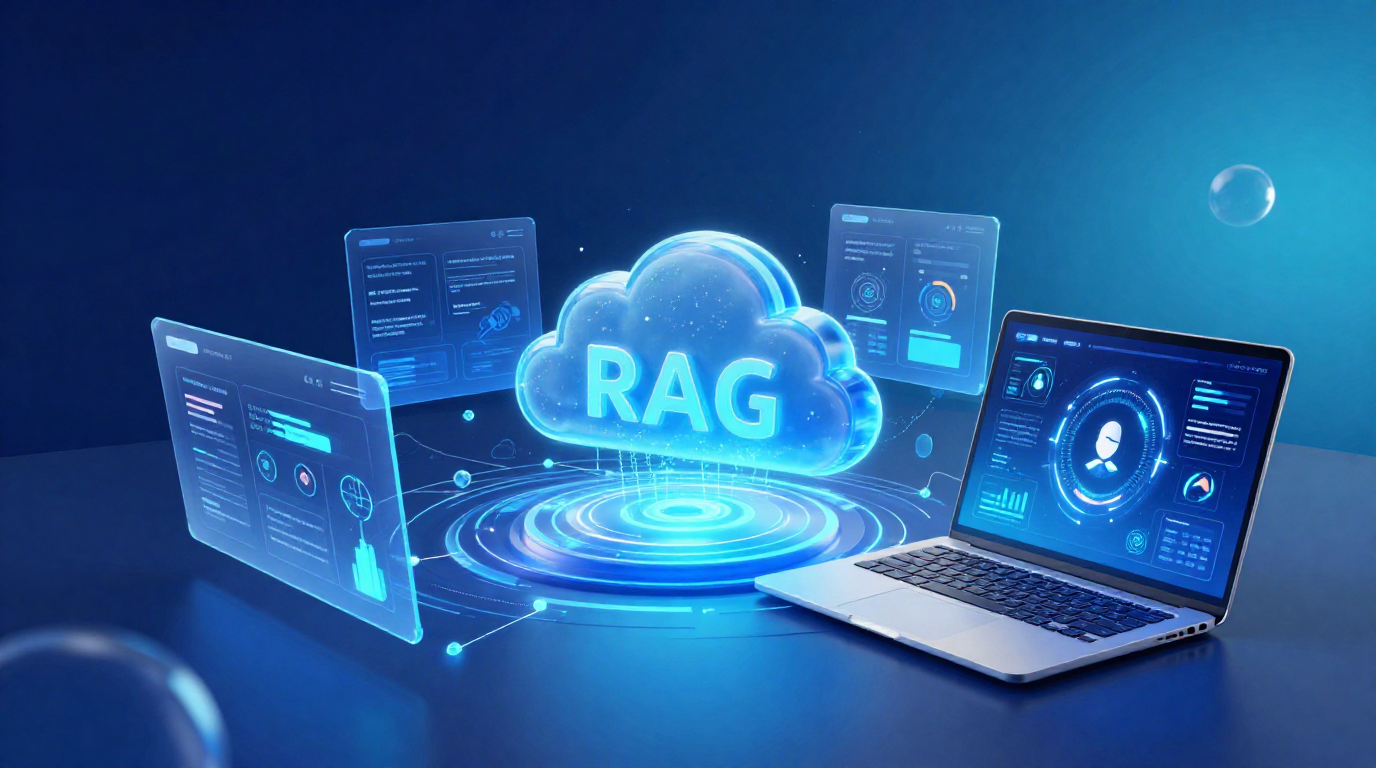
Artificial intelligence is revolutionizing software applications. Chatbots and intelligent search solutions enabled with AI can be found anywhere these days. Businesses are utilizing these AI solutions for improving user experience, automating processes, and making informed decisions. One of the recent technologies driving innovation in AI-powered software is RAG in SaaS applications.
Retrieval Augmented Generation (RAG) is emerging as an effective solution for building AI-driven platforms that offer precise, intelligent, and context-aware responses. While conventional AI models lack timely information and suffer from information hallucination issues and business knowledge limitations, RAG addresses these problems by combining information retrieval with generative AI.
Currently, many SaaS applications are leveraging RAG technology to offer smarter customer support services, personalize user experience, build more sophisticated search capabilities, and automate work processes. Whatever industry your business belongs to, RAG is being deployed in SaaS solutions from CRM platforms to healthcare and fintech software.
What is RAG in SaaS Applications?
The RAG (Retrieval Augmented Generation) framework is a machine learning methodology that utilizes two core concepts:
- Information Retrieval
- Generative AI Algorithms
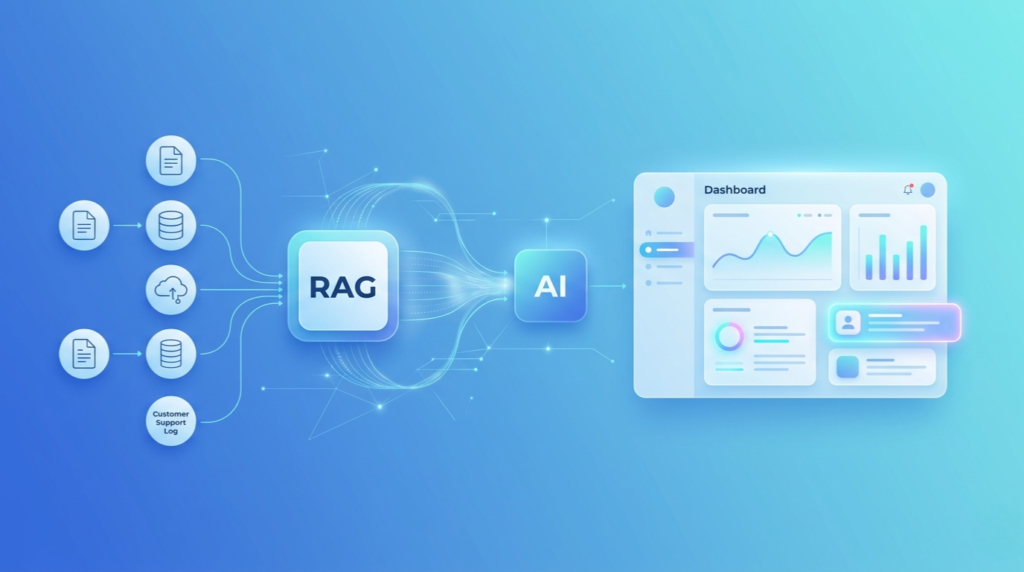
Instead of relying solely on the pre-built intelligence of the AI model, RAG searches for information from external sources such as databases, documents, APIs, or organizational knowledge banks prior to responding.
Through this method, SaaS applications can offer:
- Accurate answers
- Timely information
- Contextual responses
- Fewer cases of AI hallucination
- Increased personalization
As an illustration, let us say we have a SaaS application used by a company for customer service and support. Rather than providing standard answers generated by AI, the platform will first seek out the necessary information from the company’s recent documentation, FAQs, and support tickets before responding.
Importance of RAG in Modern SaaS Platforms
Although conventional AI-based chatbots appear knowledgeable, they might give erroneous or outdated results. For any SaaS organizations, such errors could mean losses as they affect their reputation and business process.
This is where RAG in SaaS applications comes into play.
Using RAG, software applications can obtain relevant data at any point in time from the organization’s database. Unlike traditional AI chatbots that depend on outdated data only, the current RAG system can leverage new data during interaction with the users.
This improves:
| Benefit | Impact on SaaS Platforms |
|---|---|
| Better Accuracy | Reduces incorrect AI responses |
| Real-Time Knowledge | Uses updated company data |
| Personalized Responses | Understands customer context |
| Improved Automation | Handles tasks intelligently |
| Faster Customer Support | Resolves issues quickly |
| Higher User Satisfaction | Creates better user experiences |
Because of these advantages, RAG is becoming a core technology in AI-powered SaaS ecosystems.
How RAG in SaaS Applications Works
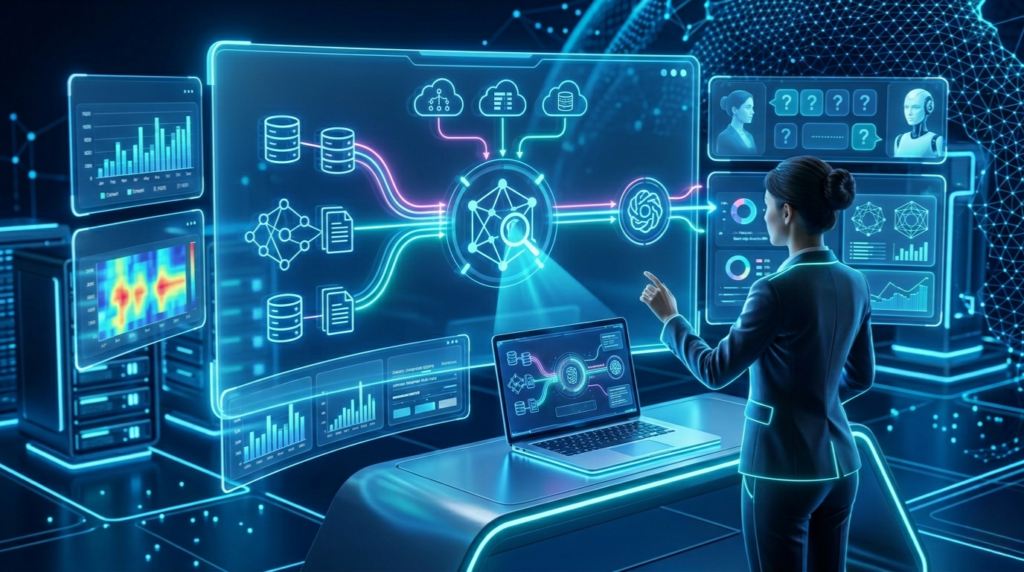
The workflow of RAG may sound technical, but the process is actually simple when broken down step-by-step.
Step 1: User Submits a Query
The process starts when a user asks a question or requests information inside the SaaS application.
Example:
“How can I upgrade my subscription plan?”
The AI system receives this query.
Step 2: Retrieval System Searches Relevant Data
Instead of immediately generating an answer, the RAG system searches multiple data sources such as:
- Internal documentation
- Knowledge bases
- PDFs
- CRM records
- Product manuals
- Customer history
- Databases
- APIs
The retrieval engine identifies the most relevant information connected to the query.
Step 3: Relevant Data is Sent to the AI Model
After retrieving useful information, the system sends that data to the Large Language Model (LLM).
The AI model now has context-specific knowledge instead of relying only on general training data.
Step 4: AI Generates a Smart Response
The generative AI creates a human-like response using the retrieved information.
Because the response is based on actual company data, it becomes:
- More accurate
- More relevant
- More trustworthy
- More contextual
Simple Workflow Table
| Stage | What Happens |
|---|---|
| User Query | Customer asks a question |
| Data Retrieval | System searches relevant sources |
| Context Injection | Retrieved data is passed to AI |
| AI Generation | AI creates an informed response |
| Final Output | User receives accurate answer |
Core Components of RAG in SaaS Applications
To understand the technology better, let us look at the major components behind RAG systems.
1. Large Language Model (LLM)
The LLM is responsible for generating human-like responses.
Popular LLMs include:
- GPT models
- Claude
- Gemini
- Llama
These models understand language patterns and generate conversational outputs.
2. Retrieval Engine
The retrieval engine searches relevant information from connected data sources.
It uses:
- Semantic search
- Vector databases
- Embeddings
- Search indexing
This helps find the most contextually relevant data.
3. Knowledge Base
The knowledge base stores information that the AI can access.
Examples include:
- Internal company documents
- Product information
- Customer records
- FAQs
- Support content
4. Vector Database
Vector databases store embeddings used for semantic similarity search.
Popular vector databases include:
| Vector Database | Common Use |
|---|---|
| Pinecone | AI search systems |
| Weaviate | Semantic data retrieval |
| Chroma | Lightweight AI retrieval |
| FAISS | High-speed similarity search |
Advantages of RAG for SaaS Applications
RAG for SaaS applications is becoming increasingly popular due to its ability to overcome numerous issues faced by conventional AI programs.
- The adoption of RAG technology is increasing because it provides several important advantages for businesses and users.
- One of the biggest benefits is improved response accuracy. Since the AI retrieves verified information before answering, the chances of incorrect or misleading responses become much lower.
- Another major advantage is real-time knowledge access. SaaS companies continuously update their products, pricing, policies, and workflows. Traditional AI models may not know these updates, but RAG systems can retrieve them instantly.
- This makes RAG highly useful for industries where information changes frequently.
- Customer support also improves significantly with RAG-powered systems. AI support agents can provide faster and more accurate assistance while reducing dependency on human agents.
- Businesses can also use RAG for advanced personalization. By accessing customer history and preferences, AI systems can deliver highly customized recommendations and experiences.
- Another important advantage is reduced AI hallucinations. Generative AI models sometimes create false information confidently. RAG minimizes this risk because responses are grounded in trusted company data.
Applications of RAG in SaaS Applications in Real-World Scenarios
The applications of RAG technology have grown into several industries.
- One industry that has widely adopted this technology is customer support platforms. Using RAG, chatbots can immediately recall troubleshooting guides, manuals, and past conversations before answering customers.
- Also, CRM firms are applying RAG to enable their sales teams to examine consumer behavior and give personalized recommendations.
- HR SaaS applications incorporate RAG systems to offer assistance to employees when it comes to onboarding, finding policies, and accessing internal documents.
- RAG applications in Healthcare SaaS firms include assisting healthcare practitioners in decision-making by accessing patient information, conducting medical research, and obtaining treatment documentation.
- Moreover, Financial SaaS firms apply RAG in fraud prevention, automated customer support, and financial analysis.
Finally, eCommerce SaaS platforms utilize RAG systems for providing intelligent recommendations, personalization of shoppers’ experience, and conversational search systems.
It is evident that RAG in SaaS Applications has versatile applications.
Challenges of Implementing RAG in SaaS Applications
Although RAG offers powerful capabilities, implementation can still be challenging. One major issue is data quality. If the connected knowledge base contains outdated or inaccurate information, the AI responses may also become unreliable.
Infrastructure complexity is another challenge. Businesses need vector databases, retrieval pipelines, AI orchestration systems, and scalable cloud environments to build effective RAG architectures. Security and compliance are also critical concerns. SaaS platforms often manage sensitive customer information, so businesses must implement strict access controls and encryption methods.
Operational costs may increase as well because retrieval systems and AI models require computing resources and cloud infrastructure. Despite these challenges, the long-term benefits of RAG often outweigh the implementation costs for growing SaaS businesses.
Best Practices for RAG Implementation
- Businesses should follow strategic practices to maximize the effectiveness of RAG systems. Keeping the knowledge base updated is extremely important. Fresh and well-structured data improves response accuracy significantly.
- Companies should also focus on semantic search optimization to improve retrieval relevance. Proper data chunking is another important practice. Large documents should be divided into meaningful sections to improve retrieval precision. Security should remain a top priority. Businesses must ensure that sensitive company data is accessible only to authorized users.
Continuous monitoring and testing are also necessary to maintain AI performance and response quality over time.
Future of RAG in SaaS Applications
The future of SaaS platforms is becoming increasingly AI-driven, and RAG is expected to play a central role in this transformation. As AI technology evolves, future RAG systems will become more autonomous, multimodal, and intelligent.
Businesses may soon use RAG systems capable of processing not only text but also images, videos, audio, and structured business data. AI agents powered by RAG may automate complete workflows without requiring human intervention.
Hyper-personalization will also improve as AI systems gain deeper understanding of user behavior and business context. Enterprise search capabilities will become smarter and more conversational, allowing employees and customers to access information more efficiently. These advancements will make RAG in SaaS Applications one of the most influential technologies shaping the future of cloud software.
Conclusion
Retrieval-Augmented Generation is changing how AI-powered SaaS platforms operate. Instead of relying only on static AI training data, RAG combines intelligent retrieval with generative AI to create more accurate, contextual, and personalized experiences. From customer support and CRM platforms to healthcare and finance software, businesses are using RAG in SaaS Applications to improve automation, reduce misinformation, and enhance user satisfaction.
Although implementation requires proper infrastructure and data management, the long-term advantages are substantial. Companies adopting RAG today are positioning themselves for the next generation of intelligent software systems.
As AI continues to evolve, Retrieval-Augmented Generation will likely become a standard feature across modern SaaS ecosystems, powering smarter applications and transforming how businesses interact with users.
FAQs
What is RAG in SaaS Applications?
RAG in SaaS Applications refers to Retrieval-Augmented Generation technology that combines information retrieval systems with generative AI to provide accurate, context-aware, and real-time responses.
Why is RAG important for modern SaaS platforms?
RAG helps SaaS platforms improve AI accuracy, reduce hallucinations, deliver personalized experiences, and provide real-time access to updated business information.
How does RAG improve customer support?
RAG-powered systems retrieve relevant support documents, FAQs, and customer data before generating responses, helping businesses provide faster and more accurate customer assistance.
What are the main components of a RAG system?
The core components include Large Language Models (LLMs), retrieval engines, vector databases, embeddings, and knowledge bases.
Which industries use RAG in SaaS Applications?
Industries such as healthcare, finance, HR, cybersecurity, eCommerce, and customer support widely use RAG-powered SaaS solutions.
How does RAG reduce AI hallucinations?
RAG reduces hallucinations by grounding AI responses in verified and retrieved information instead of relying only on static training data.
What are vector databases in RAG systems?
Vector databases store embeddings used for semantic search, helping AI systems retrieve contextually relevant information quickly.
Is RAG suitable for enterprise SaaS applications?
Yes, RAG is highly suitable for enterprise SaaS platforms because it improves scalability, automation, search capabilities, and data-driven decision-making.
Can RAG provide real-time information?
Yes, RAG systems can retrieve updated information from connected databases and knowledge sources in real time.