

The software development process has undergone more changes within a decade than during the previous two decades. In the past, companies considered software development to be a technical function carried out by a group of developers isolated from others, developing codes and fixing bugs at intervals of several months. That is no longer viable.
Modern enterprises rely entirely on software for almost all their activities. Bank solutions, hospital software, eCommerce websites, logistics, marketing, customer service, and even enterprise collaborations largely depend on software development. With growing reliance on technology, software development has taken on a whole new meaning – one that is not only dependent on coding but also on operations, scalability, security, compliance, and customer experience.
All these changes have affected how developers are considered in an organization. Apart from looking at their coding skills, developers are now rated according to their ability to keep systems up and running, respond to incidents, deploy software quickly, ensure software reliability, and maintain high levels of customer satisfaction.
The Evolution of Software Development
To comprehend why software development is turning operational, it is essential to comprehend the evolution of software engineering through time.
During the early years of technology, software programs were quite basic. Organizations developed software programs that carried out certain functions and served only a few individuals. The process was lengthy, updates occurred rarely, and managing infrastructure was relatively easy.
The majority of programs used actual servers situated within office buildings or data centers. Programmers and operations specialists had distinct jobs. The programmers developed the application, while the operations team handled its deployment, maintenance, and infrastructure management.
These differences established firm boundaries.
The programming team was responsible for developing the program.
The operations team was responsible for overseeing the infrastructure.
But as businesses began transforming digitally, software solutions grew increasingly complex. Companies began introducing web applications, mobile applications, cloud platforms, and real-time solutions that necessitated constant upgrades.
Today, software development involves:
- Continuous deployment
- Infrastructure automation
- Real-time monitoring
- Cloud scalability
- Security integration
- Performance optimization
- Incident management
- Compliance monitoring
- Data reliability
- Customer experience tracking
As a result, software development is no longer just engineering work. It is deeply connected to operational management.
Why Modern Software Is More Operational Than Ever
Modern applications are highly dynamic. Unlike software systems developed decades ago and relatively stable for years, today’s applications are dynamic. New updates are released daily. APIs change often. Cloud environments scale dynamically. Traffic changes all the time. Threats arise every hour. Such dynamic changes result in complexities within operations.
For example, an eCommerce application that was easy to build a few decades ago might include:
- Frontend applications
- Backend microservices
- Payment gateways
- Recommendation engines
- Inventory systems
All of these components depend on each other.
If there is an issue in any of these parts, then the overall customer experience will be impacted.
As you see, building such an interconnected application requires operational thinking from the very beginning.
Software developers cannot concentrate on functionality alone. They should pay attention to:
The Rise of DevOps Changed Everything
Probably one of the most notable developments in the software sector is the advent of DevOps.
DevOps is not only a methodology but rather a whole cultural shift wherein software development and IT operations are combined.
Before, developers and ops teams used to work in silos leading to various issues in communications.
There were conflicts because developers needed fast deployment while ops required stable environments.
DevOps sought to resolve these problems through cooperation and automation among other factors.
Today, in most companies, the developer teams must be able to:
- deploy their code themselves;
- monitor applications;
- react to incidents;
- manage cloud infrastructure;
- optimize performance;
- and participate in security reviews.
This indicates that developers are accountable for operation.
In DevOps, enterprises should automate processes like infrastructure deployment, continuous delivery, monitoring services, and testing frameworks.
This implies that software development teams are accountable for operations.
Cloud Computing Turned Infrastructure Into Software
In traditional IT environments, infrastructure management was a completely separate responsibility that involved physical hardware setup, manual server configurations, and dedicated operations teams handling maintenance and deployment tasks.
Developers mainly focused on writing code while infrastructure teams managed the operational side of systems. However, the rise of cloud computing has completely transformed this model. Today, cloud platforms allow businesses to provision servers, databases, storage systems, and networking resources instantly, making infrastructure far more flexible and scalable than before.
A modern developer is no longer responsible only for building applications but may also need to configure cloud resources, optimize container orchestration, monitor serverless functions, manage scaling rules, configure networking policies, handle failover systems, and even reduce infrastructure costs. Cloud-native development therefore requires strong operational thinking from the beginning of the development process. The traditional boundary between development and operations continues to disappear as organizations increasingly expect software engineers to understand operational environments deeply.
Continuous Deployment Increased Operational Pressure

The practice of continuous deployment has greatly added to the complexity of operations in software delivery. Previously, software updates were launched a few times each year, allowing for adequate time for testing, preparing for deployment, and observing the process. These days, software updates are being launched several times each day, and major tech companies may even be updating their software up to thousands of times each day. While such an approach provides for higher levels of agility, it creates the risk of problems such as system crashes, security issues, malfunctioning, etc.
Frequent updates increase the chances of:
- Production failures
- Security vulnerabilities
- Service disruptions
- Configuration errors
- Dependency conflicts
- Performance degradation
As a result, software development teams must constantly monitor production systems.
Reliability Has Become More Important Than Features
| Traditional Software Development Focus | Modern Operational Software Development Focus |
|---|---|
| Businesses mainly focused on adding new features quickly. | Reliability is considered just as important as innovation. |
| Occasional downtime was often tolerated. | Even a few minutes of downtime can damage trust and revenue. |
| Software releases were prioritized over system stability. | Operational stability is now a major priority. |
| Success was measured mainly by feature delivery. | Teams are evaluated using operational metrics and performance indicators. |
| Limited monitoring and operational accountability. | Continuous monitoring and operational excellence are essential. |
Cybersecurity Is Now Part of Software Development
Cybersecurity threats are increasing rapidly across industries.
Ransomware attacks, API vulnerabilities, data breaches, phishing campaigns, and cloud misconfigurations have made security a top business concern.
Earlier, security teams often reviewed applications near the end of development.
Today, that approach is too slow.
Organizations now integrate security directly into software development workflows.
This practice is commonly called DevSecOps.
Developers are now expected to:
- Write secure code
- Monitor vulnerabilities
- Apply dependency patches
- Follow compliance standards
- Manage identity access systems
- Configure secure cloud environments
- Prevent data leaks
Security has become an operational responsibility embedded within software development.
A single security mistake can create massive operational disruptions.
Because of this, software development teams must think continuously about risk management, monitoring, and compliance.
Operational awareness is no longer optional.
Customer Expectations Are Driving Operational Demands
Modern customers expect fast, seamless, and personalized digital experiences.
Users no longer tolerate slow applications, broken interfaces, or long downtimes.
If an application performs poorly, customers quickly switch to competitors.
This creates enormous operational pressure on software teams.
Software development today involves optimizing:
- Performance
- Availability
- User experience
- Real-time responsiveness
- Personalization
- Scalability
For example, streaming services must handle millions of concurrent users.
Ride-sharing platforms must update locations instantly.
Food delivery apps must manage live order tracking.
Banking apps must support secure transactions without delays.
Meeting these expectations requires strong operational systems.
As a result, software development has evolved into a continuous operational process rather than a one-time engineering project.
Microservices Increased Operational Complexity
Most companies today implement microservices architecture in order to increase their scalability and flexibility.
Rather than creating one huge application, companies break down their applications into various small services.
Although microservices offer better flexibility to applications, it does come with operational difficulties.
For example, a single application might consist of a huge number of inter-related services.
Such a system will need:
- Discovery of services
- Management of APIs
- Distributed monitoring
- Network Optimization
- Fault handling
- Data synchronization
- Orchestration of containers
It is imperative that software developers know the working of these systems.
Visibility of operations is key here.
When one service fails, others services can also be affected.
Hence, software development itself will require operational skills from developers.
AI and Automation Are Changing Software Operations
Artificial intelligence is transforming software development rapidly. While AI improves productivity, it also increases operational complexity. AI-driven applications often require continuous retraining and monitoring. This creates ongoing operational responsibilities.
Software development teams are now expected to manage both application logic and intelligent automation systems. This further strengthens the connection between software engineering and operations.
| AI and Automation in Software Operations | Impact on Modern Software Development |
|---|---|
| Code Generation | AI tools help developers write code faster and improve productivity. |
| Testing Automation | Automated testing reduces manual effort and speeds up software delivery. |
| Bug Detection | AI identifies coding issues and vulnerabilities more efficiently. |
| Infrastructure Monitoring | AI systems monitor servers, applications, and cloud environments in real time. |
| Security Analysis | AI helps detect threats, suspicious activity, and security risks quickly. |
| Incident Prediction | Predictive systems identify potential failures before they occur. |
| Performance Optimization | AI improves application speed, scalability, and operational efficiency. |
Remote Work Increased Operational Challenges
Also, the emergence of remote and hybrid working models has had an impact on software operations.
These include:
- Collaboration tools
- Remote access security
- Cloud architecture
- Communication
- Monitoring
Working with globally distributed software development teams brings about operational coordination problems.
Companies have come to rely on cloud-native software development pipelines and automation tools to enable remote software development.
Such operational reliance has led to rapid digital transformation.
Modern software development is heavily reliant on operational coordination processes.
Cost Optimization Is Becoming a Development Responsibility
Now, cloud infrastructure costs are posing significant issues for companies.
In the past, the cost of the infrastructure was seldom considered by the developers.
In today’s world, poorly designed software can lead to enormous costs of operation.
Now, developers need to focus on optimizing the following:
- Cloud use
- Computing
- Databases
- Storage
- Networking
Companies want the developers to be aware of the costs associated.
This approach is usually referred to as FinOps.
FinOps entails the fusion of finance management and cloud management.
In many cases, developers are involved in the decision-making regarding costs optimization.
The Growing Importance of Platform Engineering
Platform engineering is rapidly gaining significance as firms attempt to navigate the rising complexities associated with contemporary software architectures. The current rapid pace of the digital world is such that many developers waste considerable time working on infrastructure management, deployments, security setups, and other operational activities rather than software creation. Platform engineering addresses this issue through the construction of internal platforms and standardized tools that streamline software development processes.
These platforms offer developers pre-built environments, automated deployment chains, monitoring tools, security measures, and infrastructure blueprints. Thus, software development teams become more productive while ensuring uniformity of operations within the firm. Other benefits include increased scalability, fewer operational mistakes, improved teamwork, and accelerated software delivery. With increasing adoption of cloud-native technology and distributed architecture, platform engineering will be integral to software development and operation practices.
Data Systems Require Continuous Operations
Modern applications rely heavily on data.
Organizations collect massive amounts of customer, operational, and transactional information.
Managing data pipelines requires ongoing operational oversight.
Software development teams must ensure:
- Data accuracy
- Real-time synchronization
- Backup reliability
- Data security
- Analytics performance
- Database scalability
Data engineering and software development now overlap significantly.
Operational reliability is essential because poor data quality can disrupt entire business operations.
This is especially important in industries like finance, healthcare, and eCommerce.
Software Development Teams Are Becoming Business Operations Teams
One of the most important shifts happening today is that software development teams are increasingly influencing business operations directly.
Digital products are now central to revenue generation.
If software systems fail, businesses may lose:
- Customers
- Revenue
- Brand reputation
- Operational continuity
Because software impacts nearly every business process, development teams are becoming strategic operational partners.
Executives now expect engineering teams to contribute to:
- Operational efficiency
- Customer retention
- Revenue growth
- Risk reduction
- Innovation speed
This transformation changes how organizations structure technology teams.
Software development is no longer isolated from business operations.
It is becoming a core operational function.
How Companies Are Adapting to Operational Software Development
Companies are rapidly adapting to operational software development by shifting from traditional development models toward AI-driven, automation-focused, and platform-centric operations. The modern software environment now demands continuous deployment, real-time monitoring, faster delivery cycles, and stronger collaboration between development and operations teams.
One of the biggest changes is the rise of AI-powered development workflows. Organizations are increasingly using AI for code generation, automated testing, incident prediction, bug detection, and infrastructure management. This allows engineering teams to release software faster while reducing manual operational workloads. Major companies such as GitLab and Freshworks are restructuring their engineering organizations around AI-assisted software delivery models.
Cross-Functional Teams
Enterprises are forming cross-functional teams with software developers, operations engineers, security personnel, and product managers collaborating in a unified effort. It will help facilitate better communication and faster decision-making processes.
Automation Efforts
Enterprises are employing automation to deal with redundant procedures and processes, such as testing, deployment, monitoring, and infrastructure management. The use of automation will ensure less human error and increased productivity.
Cloud-Native Technologies
There is increasing reliance on cloud-native technologies, including containerization, microservices architecture, and Kubernetes orchestration platforms. The adoption of cloud-native technologies will result in improved scalability and reliability.
Improving Observability
Enterprises are using sophisticated monitoring and log analysis tools for gaining real-time visibility into how systems operate. Observability will help in detecting problems and maintaining uptime.
Engineering Culture
An emphasis is being placed on building engineering culture within organizations. It involves fostering collaboration and experimentation among team members.
The Human Side of Operational Software Development
The operational transformation of software development also affects workplace culture.
Developers today experience more responsibility than ever before.
They are expected to:
- Write efficient code
- Maintain uptime
- Resolve incidents
- Ensure security
- Optimize costs
- Improve customer experience
This creates pressure.
Many organizations now focus on developer experience to reduce operational stress.
Internal tooling, automation, documentation, and better workflows help improve productivity.
Companies also recognize the importance of work-life balance because operational incidents can lead to burnout.
Healthy engineering cultures are becoming critical for long-term success.
The Future of Software Development
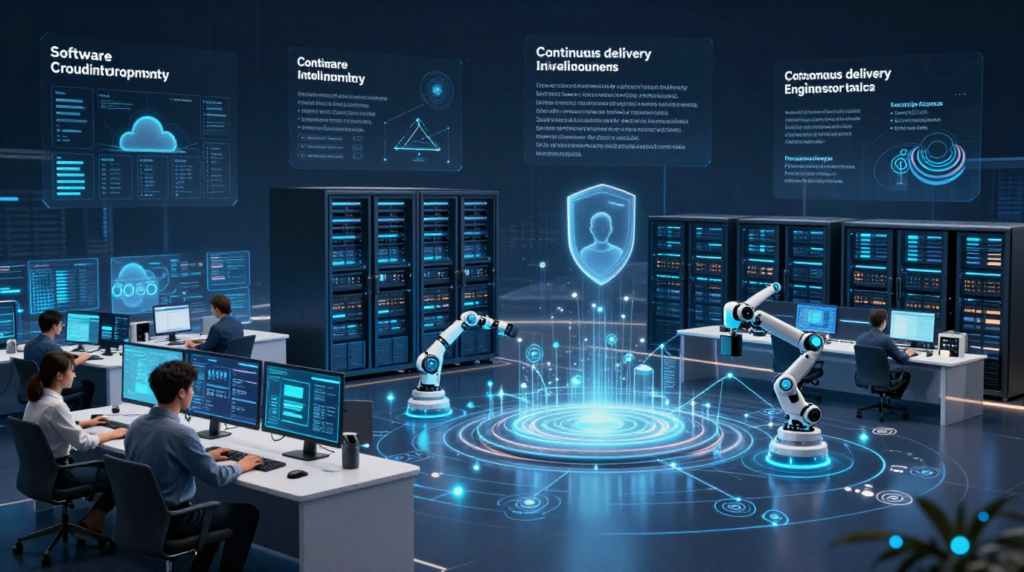
The future of software development will likely become even more operational.
Several trends will continue shaping the industry:
AI-Driven Operations
Artificial intelligence will automate many operational tasks such as monitoring, debugging, and performance optimization.
Autonomous Infrastructure
Cloud platforms will increasingly manage scaling, recovery, and optimization automatically.
Stronger Security Integration
Security will become even more embedded within software development workflows.
Real-Time Engineering
Organizations will prioritize real-time responsiveness and continuous delivery.
Platform-Centric Development
Internal developer platforms will simplify operational management.
Greater Focus on Reliability
Reliability engineering will become central to software development strategies.
The line between software engineering and operations may eventually disappear entirely.
Future developers will likely be expected to understand coding, infrastructure, security, monitoring, automation, and business operations together.
Why This Shift Matters for Businesses
Businesses that fail to adapt to operational software development may struggle to compete.
Modern customers expect seamless digital experiences.
Organizations need reliable, secure, scalable, and continuously evolving applications.
This requires strong operational capabilities.
Companies that successfully integrate operations into software development gain several advantages:
- Faster innovation
- Better customer experience
- Higher reliability
- Improved scalability
- Stronger security
- Reduced downtime
- Greater operational efficiency
Technology is no longer a support function.
It is now a core business driver.
Software development therefore becomes a strategic operational priority.
The Business Impact of Operational Failures
Operational failures can have severe business consequences.
A single outage may result in:
- Lost revenue
- Customer churn
- Regulatory penalties
- Brand damage
- Security breaches
This is why businesses invest heavily in operational resilience.
Software development teams are now critical guardians of business continuity.
Operational excellence is no longer optional.
It directly affects organizational success.
The Importance of Automation in Modern Software Developmen
Automation is one of the most important solutions for operational complexity.
Without automation, managing modern systems becomes nearly impossible.
Organizations use automation for:
- Code testing
- Infrastructure setup
- Security checks
- Incident response
- Performance monitoring
- Backup management
Automation reduces manual effort and improves reliability.
It also allows software development teams to focus more on innovation.
As operational demands continue increasing, automation will become even more important.
Conclusion
Software development is no longer solely a coding effort. It has become an ongoing operational function encompassing infrastructure, security, monitoring, scaling, compliance, automation, and the user experience.
Contemporary applications have become integral parts of the business ecosystem, where application problems impact the bottom line, reputation, and performance. This has made software development teams accountable for operational results.
Companies that take advantage of this shift can create more reliable, scalable, and innovative solutions.
However, businesses that overlook operational challenges might face technical difficulties, inefficiencies, security threats, and limited growth opportunities.
The companies that recognize the intimate connection between software development and operations will dominate the industry in the coming years.
In the coming years, the boundary between developers and operations staff might vanish entirely.