

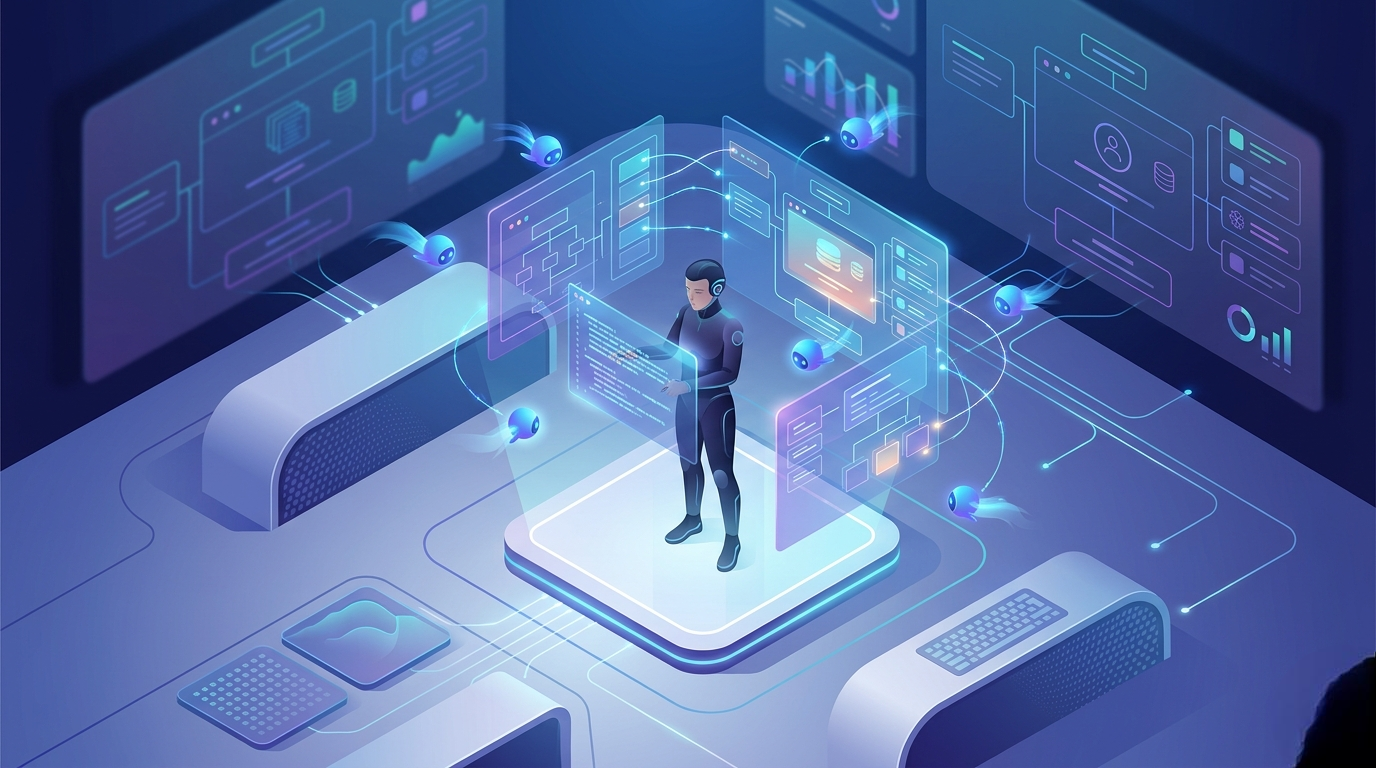
AI has already revolutionized software engineering through code generation, bug detection, automated testing, and project management support. But there is a revolutionary wave of AI that is becoming increasingly popular within the tech industry: Agentic AI.
Whereas classical AI only reacts to prompts, Agentic AI can generate a plan, reason about actions, make decisions, take actions, and then learn from the results. Within software engineering, this is causing profound changes to application design, development, testing, deployment, and maintenance.
As companies try to increase their productivity, shorten time-to-market, and implement more advanced automation, Agentic AI represents a disruptive technology that goes above and beyond simple support to become an active participant in the development process.
This article delves into what it is, how it applies to software engineering, its advantages, difficulties, use cases, and future implications for development teams.
Understanding Agentic AI
Agentic AI is defined as AI which possesses the capability to act independently for achieving certain goals with minimum human interference. Unlike traditional AI that is able to do one particular task according to direct instructions, it is able to:
- Understand goals
- Break down complex goals into smaller tasks
- Develop action plan
- Do multiple actions
- Analyze outcomes
- Change its strategy if needed
- Continue doing until the goal is achieved
Regarding software engineering, AI works more like a partner rather than a coding aid.
How Agentic AI Differs from Traditional AI
| Traditional AI | Agentic AI |
|---|---|
| Responds to prompts | Pursues goals autonomously |
| Performs isolated tasks | Manages multi-step workflows |
| Requires frequent human input | Operates with minimal supervision |
| Focuses on execution | Focuses on planning and execution |
| Limited memory and context | Maintains ongoing context |
| Reactive behavior | Proactive decision-making |
For example:
Traditional AI may generate a code snippet when requested.
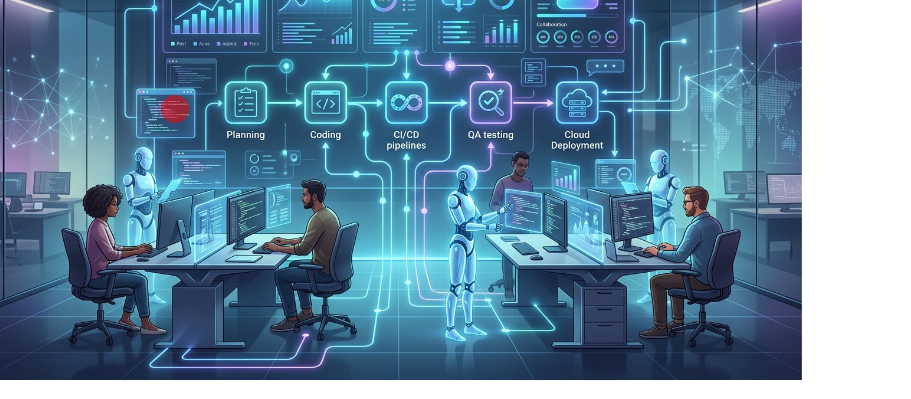
- Analyze project requirements
- Create a development plan
- Generate code modules
- Run tests
- Identify errors
- Apply fixes
- Document changes
- Deploy updates
all within a coordinated workflow.
Core Components of Agentic AI
Goal-Based Planning
A goal-based planning approach enables an agentic intelligent system to take a predetermined goal and devise a well-thought-out strategy for accomplishing it. The process does not rely on sequential instructions but involves breaking the objective down into smaller sub-tasks and finding the best possible way to move forward. When used in software engineering, goal-based planning may include requirements analysis, architecture design, task prioritization, and resource management.
Reasoning Abilities
The reasoning feature is the ability of Agentic AI to consider several options before making choices. By analyzing all possible solutions, the AI is able to select the most appropriate one considering the circumstances. This way, reasoning helps it choose among algorithms, evaluate software engineering frameworks, find the most optimal architecture, and suggest testing techniques.
Context and Memory Storage
While standard AI systems usually treat each communication individually can preserve context over time. Thus, it will be able to recall previous actions and decisions, track project progress, learn the history of the codebase, and store relevant information for future use.
Memory and Context Management
Unlike traditional AI interactions, maintains long-term context.
This allows the system to:
- Remember previous decisions
- Track project progress
- Understand codebase history
- Learn from earlier outcomes
Tool Utilization
An AI can access various external resources for completing specific tasks. For instance, besides providing recommendations, it can utilize development-related sources such as repositories for source codes, CI/CD pipelines, cloud infrastructure services, monitoring software, and project management tools.
Self-Correction
One of the most valuable capabilities that Agentic AI has is the capacity for self-correction. Namely, if errors happen or some unintended results are achieved, an AI will be able to identify a problem, investigate its cause, make alterations in how to approach it and try implementing a new strategy.
The Importance of Agentic AI in Modern Software Engineering
Current software engineering practices encompass far more than just programming itself. Besides the task of coding, engineers need to consider planning, development, testing, deployment, security issues, documentation, and other aspects of software life cycle. All of these factors make the work of a developer more complicated and require considerable amounts of time to complete successfully.
Developers must manage:
- Requirements gathering
- System design
- Testing
- Security reviews
- Documentation
- Deployment
- Maintenance
Applications of Agentic AI in Software Engineering
1. Automated Code Generation
Using agentic artificial intelligence, it is possible to develop not fragments but full software components by creating functional code which is consistent through the entire application and understanding project requirements.
Main abilities include:
- Creation of APIs and backend services
- Development of user interfaces
- Database schema creation
- Implementation of business logic
- Observance of coding conventions in different projects
2. Intelligent Software Testing
Testing a product usually requires time and resources. IT automates many operations related to testing, thus enabling early discovery of problems and improving software quality.
3. Bug Detection and Resolution
Apart from detecting bugs, agentic AI can conduct research related to the detected problem, find its root cause and suggest solutions.
Main abilities include:
- Software defect identification
- Detection of affected code
- Effective solutions suggestions
- Implementation of fix
- Validation test execution
4. DevOps & Deployment Automation
Agentic AI enables organizations to improve their DevOps process by automating various deployment processes and the management of the underlying infrastructure. This increases the reliability of operations and boosts efficiency.
5. Software Maintenance
Maintenance of legacy software can be highly resource-consuming. Agentic AI can help businesses optimize their software maintenance processes through automation.
Capabilities include:
- Technical debt detection
- Modernization recommendations
- Code refactoring
- Dependency updates
- Documentation improvement
6. Security Management
With evolving threats to cyber-security, Agentic AI provides solutions to continuously increase application security.
Capabilities include:
- Source-code scanning
- Suspicious activity identification
- Applying security patches
- Monitoring security compliance regulations
- Automation of security testing processes
Benefits of Agentic AI in Software Development

Increased Productivity
Developers spend less time on repetitive tasks and more time solving business problems. Teams can complete projects faster while maintaining quality standards.
Faster Time to Market
By automating planning, coding, testing, and deployment activities, organizations can accelerate release cycles. Products reach customers sooner.
Improved Software Quality
Continuous monitoring, testing, and self-correction reduce defects and improve application reliability.
Better Resource Utilization
Agentic AI allows organizations to optimize engineering resources and focus human expertise on high-value activities.
Enhanced Collaboration
AI agents can coordinate across teams, tools, and workflows, improving communication and project visibility.
Challenges with Agentic AI in Software Engineering
While having numerous benefits, Agentic AI has certain challenges as well.
Trustworthiness and Reliability Issues
It is critical that the decisions made by the AI technology would be trustworthy and accurate. Errors made by autonomous systems could result in potential risks.
Security Risks
AI technologies operating within development environments would need enhanced security measures. Failure to govern agents properly might result in security vulnerabilities.
Governance Challenges
A major challenge with implementing AI-based software solutions relates to who will take responsibility for actions taken by them and the consequences thereof.
Integration Difficulties
Given the current situation at many enterprises where multiple software and systems are used, integrating Agentic AI would pose certain difficulties.
Human Oversight Requirements
Although Agentic AI is autonomous, human supervision remains necessary for:
- Strategic decisions
- Compliance requirements
- Ethical considerations
- Critical production changes
Agentic AI vs AI Coding Assistants
Many people confuse with coding assistants.
However, the two serve different purposes.
| AI Coding Assistant | Agentic AI |
|---|---|
| Generates code when prompted | Completes end-to-end workflows |
| Limited task scope | Multi-step goal execution |
| Requires frequent instructions | Operates independently |
| Assists developers | Acts as a digital teammate |
| Reactive responses | Proactive actions |
Coding assistants help developers write code.
Agentic AI helps manage and execute software development objectives.
Future of Agentic AI in Software Engineering
The future of software engineering is likely to involve collaboration between human engineers and intelligent AI agents.
Emerging capabilities may include:
- Fully autonomous testing environments
- AI-managed software releases
- Self-healing applications
- Autonomous security operations
- Intelligent architecture optimization
- Continuous performance improvement
Rather than replacing software engineers will augment their capabilities and enable them to focus on innovation, strategy, and complex problem-solving.
Organizations that successfully adopt Agentic AI may gain significant competitive advantages through faster development cycles, improved software quality, and increased operational efficiency.
Best Practices for Implementing Agentic AI
For successful integration of Agentic AI into the workflows of software engineers, some best practices can be recommended to strike the right balance between automation and control, security, and accountability.
Low-Risk Activities First
An organization may want to start using AI in relatively harmless activities, which do not cause serious damage when something goes wrong. Examples include testing, writing documentation, performing code reviews, and even monitoring systems for anomalies. This way, organizations will get enough experience to expand their use of the technology.
Human Oversight Must Be in Place
While Agentic AI is capable of independent operation, there are still tasks that should be handled only by people. For instance, human developers and managers must oversee key decisions made by Agentic AI and ensure that it can make any changes in production.
Governance Policies
Effective governance policies are crucial for establishing rules for Agentic AI within an organization. There should be clear regulations on who should be responsible for each action, decision-making processes, what kind of permission and authorization are required from humans, and other aspects of the process.
Securely Protect Data
As Agentic AI systems interact with code repositories, clouds, and deployments, security needs to be considered a top priority. It is vital to create stringent access control, authentication, activity tracking, and security audit measures in order to prevent any malicious behavior or potential data breaches.
Monitor the AI’s Performance
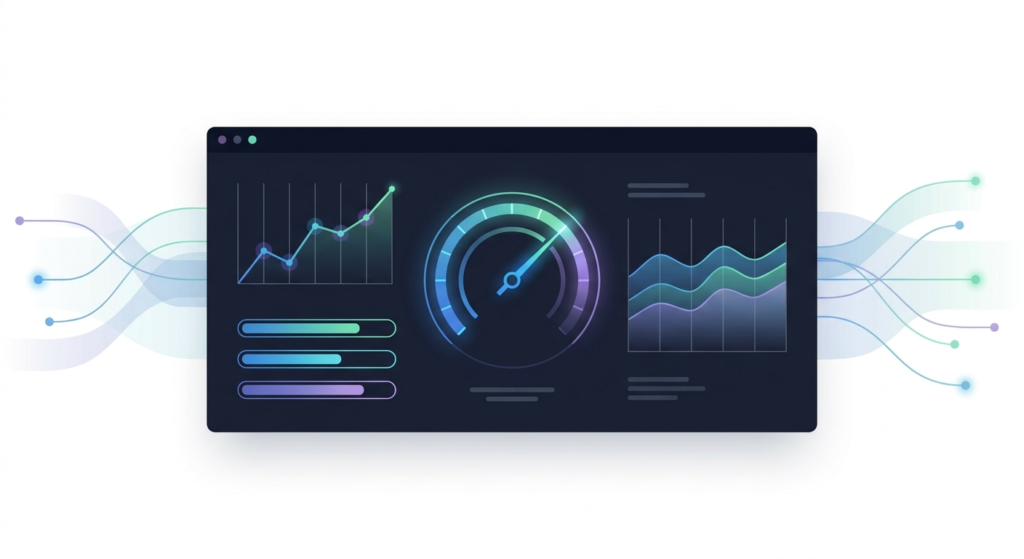
Agentic AI systems need to be monitored continuously in terms of their overall performance. Metrics like the AI’s accuracy, increase in productivity, improvement in software development, savings achieved, and results realized by the organization should be constantly measured.
Conclusion
Artificial intelligence is becoming the next major advancement in software engineering. Unlike traditional AI systems that primarily respond to user prompts, modern intelligent systems can plan, reason, execute tasks, and adapt their actions to achieve software development goals with greater autonomy.
From code generation and software testing to deployment, maintenance, and security management, these advanced AI capabilities have the potential to transform every stage of the software development lifecycle. While challenges related to governance, trust, and security still need to be addressed, the benefits including increased productivity, faster development cycles, and improved software quality are driving widespread adoption.
As software development continues to evolve, the future will likely be defined by closer collaboration between human expertise and intelligent AI-driven systems. Together, they will enable engineering teams to build more reliable, innovative, and high-quality software in less time.
Frequently Asked Questions (FAQs)
- What is Agentic AI in software engineering?
Agentic AI is an AI technology that is capable of planning, reasoning, making decisions, and performing tasks to attain pre-defined software development objectives without the need for extensive human interference.
- In what way is Agentic AI different from traditional AI?
While traditional AI systems only respond to certain commands and complete particular tasks, Agentic AI creates its own strategies to carry out multi-step actions to attain a predefined objective.
- Is Agentic AI capable of writing software code?
Yes, Agentic AI is able to create different components of an application ranging from APIs to UIs, databases to business rules, and adheres to coding conventions.
- How can Agentic AI be used for software testing?
Using Agentic AI software engineers are able to generate test cases, perform testing, analyze failure occurrences, recommend corrective measures, and extend their scope of testing.
- Can Agentic AI fix software bugs on its own?
Yes, in most scenarios, Agentic AI software is able to detect the existence of bugs, identify affected codes, analyze the root cause, suggest solutions, fix problems, and perform verification tests.
- How can Agentic AI assist in DevOps?
Agentic AI can automate various DevOps activities, including infrastructure provisioning, configuration management, deployment monitoring, performance optimization, and rollback management, helping teams achieve faster and more reliable releases.