


In the current world of fast-changing digital economy, Data Science in Business has been identified as an extremely significant driving force for innovation, growth, and competitive edge. Various firms have embraced the application of data science in their operations to help them gain insight, make sound decisions, and drive digital transformation efforts. The need to exploit available data in modern businesses has emerged as one key factor for success in the dynamic environment today.
Unlike previous years when organizations used guesswork and intuition in making important decisions, nowadays there is a reliance on various advanced tools such as big data analysis, artificial intelligence, and machine learning to make data-driven strategic decisions that help firms achieve extraordinary value from the data available.
What Is Data Science in Business?
Data Science in Business refers to the use of statistical analysis, machine learning, artificial intelligence, and data analytics techniques to extract meaningful insights from business data. These insights help organizations make informed decisions, identify opportunities, reduce risks, and improve overall performance.
Businesses collect data from various sources, including customer interactions, sales transactions, social media platforms, websites, mobile applications, and connected devices. Data science transforms this raw information into actionable intelligence that supports business objectives and drives innovation.
As organizations continue their digital transformation journeys, data science has become a critical component of modern business strategies.
The Growing Importance of Digital Transformation

Digital transformation refers to the adoption of digital technologies in all aspects of organizational operations. Digital transformation radically changes the way an organization conducts its operations, offers value to its customers, and competes in the market.
The success of digital transformation projects lies in data science, which involves analyzing vast amounts of data and using it to uncover inefficiencies, customer behavior patterns, and innovations.
Organizations that implement digital transformation and data science tend to benefit from:
- Rapid decision-making
- Efficient operations
- Superior customer experience
- Business agility
- Revenue generation opportunities
- Competitive advantages
As technology develops, organizations that focus on data-driven digital transformation are able to react to changing market and customer dynamics.
How Data Science Improves Business Decision-Making
A key benefit associated with the use of Data Science for Business lies in its impact on decision-making. Previously, business decisions were usually made through a process of trial and error, using incomplete knowledge, assumptions, and even intuition. Data science ensures that all decisions made by the company are evidence-based, relying on accurate data insights.
By analyzing data and applying predictive models, organizations can discover patterns in data, assess risks associated with specific business decisions, and even forecast future outcomes.
Thus, retail companies are able to estimate future demand by analyzing purchase history, and banks can better manage risks due to understanding customer behavior.
Data Science and Customer Experience Personalization
Customer expectations have changed drastically in recent times. Customers desire a more personalized experience according to their tastes and preferences.
The use of data science can enable companies to offer more customized customer experiences using customer analytics. Customer data analysis will help companies gain insight into customer purchasing behavior, browsing behavior, and engagement.
Machine learning algorithms can be used to develop personalized recommendation engines, more customized marketing campaigns, and communication strategies to make customers happier and loyal.
The benefits of customer personalization include:
- Higher levels of customer engagement
- Increased conversion rates
- Increased customer retention
- Increased brand loyalty
- Customer lifetime value
Organizations that effectively use data science to personalize customer experiences gain a significant advantage in today’s competitive marketplace.
| Data Science Capability | How It Personalizes Customer Experience | Business Benefit |
|---|---|---|
| Customer Analytics | Analyzes customer behavior, preferences, and purchase history. | Improves customer understanding and engagement. |
| Recommendation Engines | Suggests products or services based on past interactions and interests. | Increases conversions and sales. |
| Predictive Analytics | Predicts future customer needs and purchasing behavior. | Enables proactive customer engagement. |
| Customer Segmentation | Groups customers based on demographics, behavior, and preferences. | Supports targeted marketing campaigns. |
| AI-Powered Chatbots | Provides personalized assistance and instant support. | Enhances customer satisfaction and reduces response times. |
| Sentiment Analysis | Evaluates customer feedback, reviews, and social media interactions. | Helps improve products and customer service. |
| Personalized Marketing | Delivers customized content, emails, and offers to individual customers. | Increases engagement and marketing ROI |
Predictive Analytics: Unlocking Future Opportunities

Perhaps one of the most important uses of data science is predictive analytics. Predictive analytics relies on historical data, statistical algorithms, and machine learning methods to predict future occurrences.
Some of the uses of predictive analytics in business include:
- Predicting sales performance
- Understanding customer behavior
- Determining possible risks
- Optimizing stock management
- Improving demand planning
- Improving financial forecasting
Instead of simply responding to what happens, companies will be able to make plans for possible future scenarios and take advantage of new opportunities.
With further improvements in predictive analytics technology, businesses will be able to see more clearly into future trends in the market.
Machine Learning in Business Operations
Machine Learning in Business is transforming operational efficiency across industries. Machine lEarning algorithms have the capability of processing massive amounts of data and detecting trends in them to automate processes without requiring much human involvement.
The following applications can be achieved using machine learning in businesses:
- Automation of routine activities
- Fraud detection and anomaly detection
- Supply chain optimization
- Pricing optimization
- Customer support
- Forecasting
Machine learning-based automation saves on operational expenses while increasing efficiency.
Business organizations incorporating machine learning into their processes tend to become more efficient in terms of productivity..
Business Intelligence and Real-Time Analytics
Modern organizations require timely access to information in order to remain competitive. Traditional reporting mechanisms usually offer revelations when the window of opportunity is already closed.
When Business Intelligence is integrated with real-time analytics, the firm can track performance indicators while things happen. This ensures that the decision-makers are always up to date with the current situation in order to take the appropriate measures.
The use of real-time analytics will allow the following activities to be undertaken:
- Performance evaluation
- Optimization of operations
- Tracking customers’ behavior
- Financial assessment
- Risk management
- Strategic planning
| Aspect | Business Intelligence (BI) | Real-Time Analytics |
|---|---|---|
| Definition | Analyzes historical and current business data to support strategic decisions. | Processes and analyzes data instantly as it is generated. |
| Data Processing | Batch processing and scheduled reporting. | Continuous data processing with instant updates. |
| Decision-Making Speed | Supports medium- to long-term planning. | Enables immediate decision-making and rapid response. |
| Primary Goal | Understand past performance and identify trends. | Monitor live activities and react to events in real time. |
| Data Sources | Data warehouses, CRM systems, ERP platforms, and historical databases. | IoT devices, websites, mobile apps, transactions, and live streams. |
| Use Cases | Sales reporting, financial analysis, KPI tracking, and business performance reviews. | Fraud detection, dynamic pricing, predictive maintenance, and real-time customer insights. |
Data Science and Risk Management
Risk management plays an important role in achieving business success. There are various kinds of risks faced by companies that include financial risks, cybersecurity threats, and others.
Through the implementation of data science tools, businesses can better identify, measure, and manage risks.
Banks use models powered by machine learning algorithms to calculate credit risks and prevent fraud cases. The cybersecurity department of a company employs data science methods to detect any strange behavior that could pose a threat to the company’s operations.
The proper management of risks helps businesses preserve their resources and retain their customers’ trust.
Driving Innovation Through Data-Driven Strategies
Innovation is critical for business growth and sustainability. Data science empowers organizations to deDevelop data-based approaches that facilitate continuous innovation.
By using customer insights, market trends, and data analysis, firms can determine new possibilities for developing innovative products or services.
Innovation through data science can assist firms in:
- Identifying new market trends
- Understanding customer preferences
- Improving features of products
- Creating enhanced user experience
- Reducing time to develop products
Companies that employ data science to innovate will introduce superior products to the market ahead of their competitors.
The Role of Artificial Intelligence in Data Science
TThe use of AI and Data Science is opening up new opportunities for enterprises across the globe. The use of artificial intelligence helps data science by enabling machines to learn from the data and make intelligent decisions.
Some business processes that can be automated using AI are:
- Automating customer service
- Predictive maintenance
- Fraud detection
- Optimizing marketing
- Predicting sales
- Process automation
With the advancement of AI, enterprises will become more dependent on intelligent machines to optimize operations.
Challenges of Implementing Data Science in Business
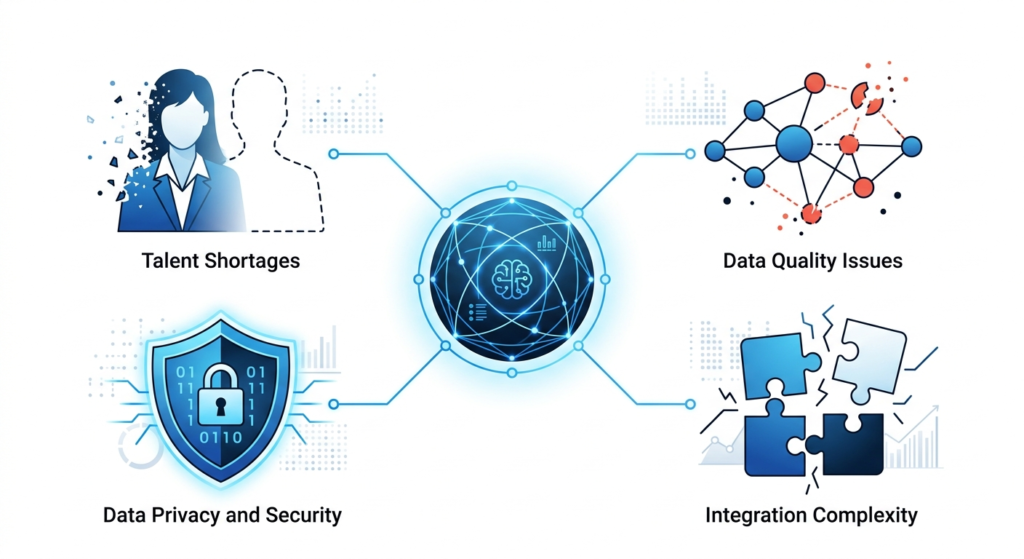
While the benefits of data science are substantial, organizations may encounter challenges during implementation.
Common challenges include:
Data Quality Issues
Poor-quality data can lead to inaccurate insights and ineffective decision-making. Businesses must establish strong data governance practices to maintain data accuracy and consistency.
Talent Shortages
The demand for skilled data scientists and analytics professionals continues to grow. Organizations often face difficulties recruiting and retaining qualified talent.
Data Privacy and Security
As businesses collect more customer data, protecting sensitive information becomes increasingly important. Organizations must comply with privacy regulations and implement robust security measures.
Integration Complexity
Integrating data science solutions with existing systems can be complex and require significant organizational change.
Despite these challenges, the long-term benefits of data science far outweigh the initial implementation obstacles.
The Future of Data Science in Business
The future of Data Science in Business is closely linked to advancements in artificial intelligence, technologies for automation, and digital transformation.
Trends on the horizon:
- Automated Machine Learning (AutoML)
- Explainable AI
- Predictive Analytics in Real-Time
- Edge Computing
- Intelligent Automation
- Advanced Customer Analytics
Such developments will allow businesses to obtain even more value from their data assets while increasing efficiency.
Companies that leverage new data science technologies will have a competitive advantage in the future.
Conclusion
Data Science in Business has emerged as an essential component of any contemporary digital transformation project. By harnessing the power of data analytics, predictive analytics, business intelligence, machine learning in business, and AI and data science, companies can make better decisions and achieve a competitive edge.
Since companies are continuously collecting and analyzing large quantities of data, data science will continue to play a significant role in innovation and maintaining a competitive edge. Companies that embrace data-driven decision-making and incorporate advanced analytics in their strategy will be able to create unprecedented business value in the digital era.
FAQ’s
- What is Data Science in Business?
Data Science in Business refers to the use of data analytics, machine learning, artificial intelligence, and other statistical methods to obtain valuable information from business data. The obtained insights can be applied in business practices.
- How does Data Science assist businesses in digital transformation?
By employing data science, businesses are able to work with large amounts of information, automate various processes, improve decision-making skills, and provide their customers with personalized experiences.
- What are the key benefits of applying Data Science in business?
The key advantages include more efficient decision-making, customer experience improvement, process optimization, improved risk management, forecasting, and competitive advantage.
- How can companies leverage predictive analytics?
Predictive analytics relies on machine learning models and historical information to predict future events. Predictive analytics can be used for demand forecasting, behavior prediction, risk assessment, inventory management, and other purposes.
- What is the role of machine learning in businesses?
Machine learning algorithms help businesses automate repetitive actions, find instances of fraud, streamline processes, personalize marketing campaigns, forecast events, and optimize customer support activities.