

Modern businesses today have the pressure to develop products digitally quickly, with efficiency and seamlessness, especially when it comes to deployment on multiple channels. This includes everything from web applications and mobile applications to Internet of Things devices and AI-driven applications. Here, the role of API First Development becomes critical.
As opposed to using APIs as supplementary components, which were developed as secondary parts of applications, API First Development emphasizes developing APIs first and considering them an integral part of application development.
What Is API-First Development?
“API First Development” is an approach in software engineering where APIs are designed and built in advance of application programming code.
In the conventional software development approach, programmers tend to develop applications and then develop APIs for exposing features. However, API First Development starts with planning the communication between the systems. The development team develops API agreements which act as blueprints for all parties, including front-end programmers, back-end programmers, partners, and third parties.
This way, consistency among systems and development constraints can be avoided.
Why API-First Development Matters
Digital ecosystems have become increasingly interconnected. Businesses rely on multiple applications, cloud services, and data sources which must be able to communicate effectively.
API-first approach benefits organizations by:
- Fast-track product development
- Improved team collaboration
- Smooth integration capabilities
- Omnichannel experience creation
- Future-proofing software architecture
- Ease of maintenance and updating
As businesses increase their presence in the digital world, APIs have become key elements in their success.
How API-First Development Works
The API-First Development process typically follows these steps:
| Stage | Description | Benefit |
|---|---|---|
| API Design | Define endpoints, requests, responses, and data models | Creates a clear blueprint |
| Documentation | Document API specifications using standards like OpenAPI | Improves communication |
| Review & Collaboration | Teams review API contracts before development begins | Reduces misunderstandings |
| Development | Frontend and backend teams work simultaneously | Speeds up delivery |
| Testing | Validate API functionality and performance | Improves reliability |
| Deployment | Launch APIs for production use | Supports scalability |
This workflow creates alignment among teams and reduces costly revisions later in the project lifecycle.
Key Benefits of API-First Development
1. Time to Market Made Faster
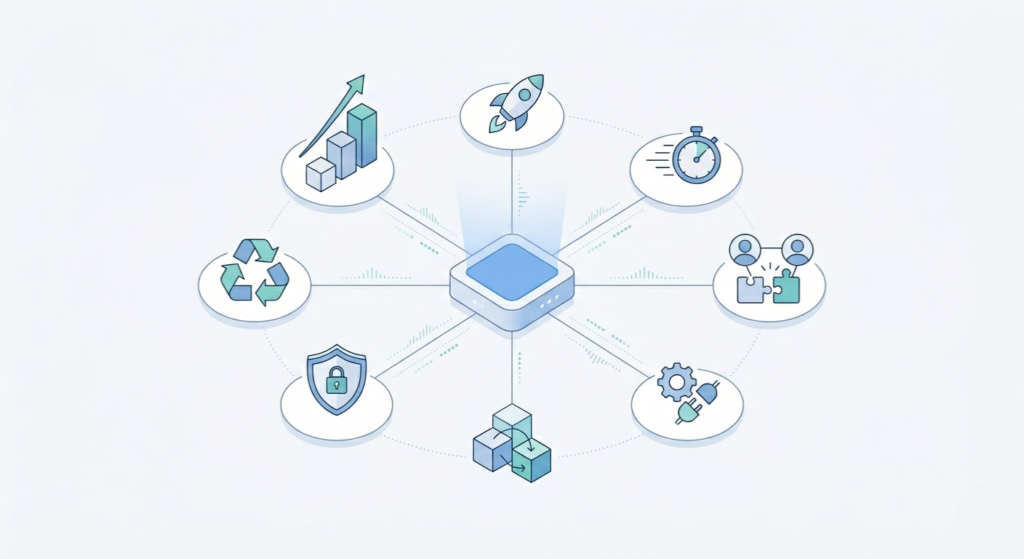
One of the main strengths of API-first development is faster time-to-market. The fact that APIs are established at the initial stages allows frontend and backend engineers to operate separately and concurrently, leading to quicker project completion and faster product release.
2. Enhanced Team Coordination
APIs serve as a universal language and documentation of what systems need to communicate with one another, thus creating a single source of truth. Every stakeholder in a product knows how systems need to communicate and collaborate, leading to better collaboration and understanding between team members.
3. Increased Scalability
Today, many applications need to accommodate huge numbers of customers and a number of services. In such a situation, API-first development helps build more scalable systems.
4. Enhanced Reusability
APIs designed with reuse in mind can serve multiple applications, platforms, and services.
For example, a customer management API can be used by:
- Mobile applications
- Web portals
- CRM systems
- Marketing platforms
- Customer support tools
This reduces duplicate development efforts and increases efficiency.
4. Better Developer Experience
Well-designed APIs with clear documentation improve productivity for internal and external developers. Teams spend less time troubleshooting integrations and more time building valuable features.
API-First Development and Microservices
Microservices architecture has become a popular approach for building scalable applications. In a In the world of microservices architecture, applications comprise autonomous services that interoperate using APIs.
API-First approach is a natural fit for microservices due to the following reasons:
- Boundaries of each service are well-defined
- Services can be developed in isolation from one another
- Integration becomes simpler
- Impact of changes is reduced
- Resilience is increased
Organizations implementing microservices often utilize API-First techniques for their consistency.
API-First Development for Digital Transformation
Efforts towards digital transformation rely greatly on connectivity and information sharing. The concept of an API-First development model allows companies to modernize their legacy systems while laying the groundwork for future innovation.
APIs allow connections between:
- Enterprise Applications: The use of APIs enables communication between enterprise systems such as ERP, CRM, HR, and financial systems. This enhances the sharing of data within and among different enterprise systems.
- Cloud Platforms: APIs can be used to enable secure communication between cloud computing applications and their underlying infrastructure. This enhances management and integration of resources on cloud computing environments.
- End-User Applications: Applications such as websites and mobile apps use APIs to offer various end-user functions such as payments and real-time updates among others. This makes the application easy to use.
- Partner Ecosystems: APIs enable the sharing of data and services between organizations, vendors, and suppliers to enable better collaboration and create opportunities for automation.
- Artificial Intelligence Applications: Integrating AI-based functions such as machine learning, natural language processing, and other related technologies in enterprise systems is made easier using APIs.
From incorporating artificial intelligence features to deploying digital channels, APIs streamline and scale efforts toward transformation.
The Role of API-First Development in Cloud-Native Applications
Cloud-native applications are designed to run in dynamic, distributed environments.
These applications require:
- Flexibility
- Scalability
- Automation
- Continuous deployment
API-First Development supports cloud-native architectures by enabling services to communicate effectively across containers, serverless functions, and cloud platforms.
As businesses increasingly migrate to the cloud, API-centric design becomes even more important.
Best Practices for API-First Development
To maximize success, organizations should follow these best practices:
Design Before Development
Create API specifications before writing application code. This ensures alignment among all stakeholders and reduces development risks.
Use Industry Standards
Adopt standards such as:
- OpenAPI Specification
- REST
- GraphQL
- JSON Schema
Standardization improves compatibility and simplifies integrations.
Prioritize Documentation
Comprehensive documentation is critical for developer adoption and successful implementation. Clear examples, endpoints, authentication methods, and error responses should always be included.
Focus on Security
APIs often expose valuable business data.
Implement:
- Authentication
- Authorization
- Encryption
- Rate limiting
- Monitoring
Strong security practices help protect systems from vulnerabilities and attacks.
Version APIs Properly
As products evolve, APIs will require updates.
Versioning allows organizations to introduce changes without disrupting existing integrations.
Challenges of API-First Development

While API-First Development offers significant benefits, organizations may encounter challenges:
Planning Stage
In API-First Development, there is a need to invest more effort in the planning stage before any code is written. Doing so helps to eliminate future challenges such as expensive adjustments to the design process.
Governance
The complexity involved with governing several APIs increases significantly as more APIs are developed within an organization. The development and implementation of policies on how APIs should be managed is important in this situation.
Documentations
There is a need to document all APIs that are developed in order to facilitate their integration by other users. Documentation needs to be updated when there are changes to the APIs to ensure accuracy.
Security Issues
Cybersecurity threats have increased due to the increase in APIs within organizations. Proper security measures have become very important for API management in today’s world.
Future Trends in API-First Development
Several emerging trends are shaping the future of API-First Development:
| Trend | Impact |
|---|---|
| AI-Powered APIs | Enables intelligent automation and personalization |
| Event-Driven Architectures | Supports real-time communication and responsiveness |
| API Marketplaces | Expands monetization opportunities |
| Low-Code Platforms | Simplifies application development |
| Multi-Cloud Environments | Improves flexibility and vendor independence |
| API Security Automation | Strengthens protection against threats |
As technology ecosystems become more interconnected, API-first strategies will continue to drive innovation.
Why API-First Development Is the Future of Modern Software Architecture
Development of software tends to be modular, interconnected, and cloud-based. The old architectural models that are not scalable and integrable and lack speed are becoming obsolete.
In API-First Development, there is a methodological way to develop a flexible and reusable system. This method allows you to develop products faster, work better with the team, and become more responsive to changes in the business environment.
As companies embrace digital transformation, artificial intelligence, cloud computing, and microservices, APIs will always remain at the heart of software architecture.
Conclusion
Today, API-First Development is no longer confined to being a mere technology; instead, it is an integral part of the strategy that determines how digital products are created in modern times. Modern software requires seamless integration with a range of other services, including cloud services, mobile applications, third-party applications, and new tech innovations like artificial intelligence. The introduction of API as a focal point of software development makes it possible to design flexible architectures that facilitate innovation.
One of the biggest benefits of API-First Development is related to enhanced collaboration. With API contracts established before the start of coding, frontend and backend developers are able to work in parallel without waiting for one team to finish what it has to do. As a result, the time needed to deliver a finished product is significantly reduced, and better software quality is guaranteed.
FAQs
What is API-First Development?
API-First Development is a software development process in which APIs are created and documented even before the development of application code starts.
Why is API-First Development needed?
It assists in developing projects faster, improving integrations, scaling projects, and promoting effective communication between components of the software project.
How does API-First Development differ from other software development processes?
While traditional development involves building applications first and then developing APIs, API-First Development involves creating an API contract before starting to write any code.
Is API-First Development applicable to microservices?
Yes, API-First Development is very compatible with microservices since APIs define communication between various independent services.
Which tools are used during API-First Development?
Popular tools include OpenAPI, Swagger, Postman, GraphQL, Apigee, and other API Management Tools.