

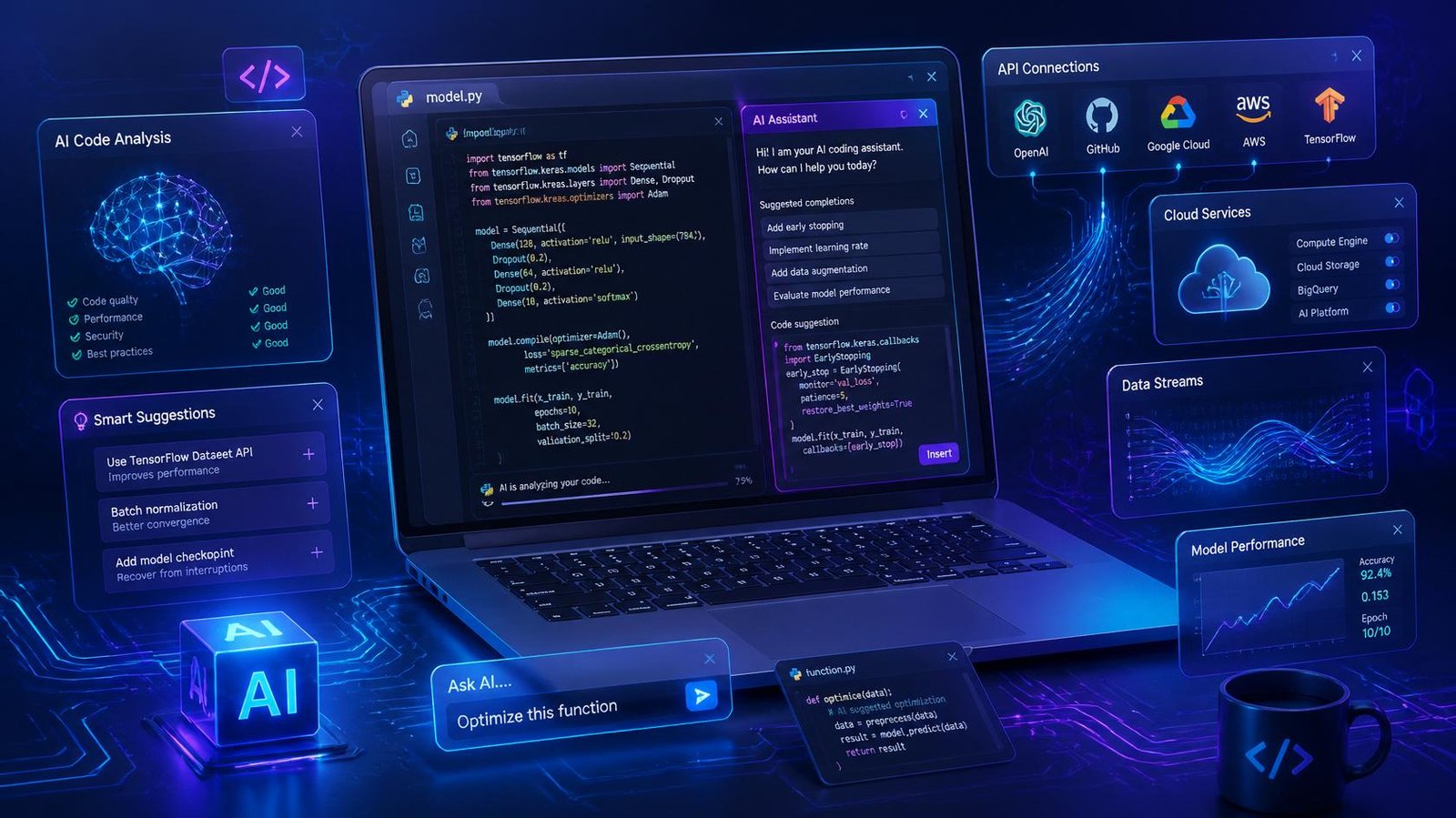
Manual writing of all lines of code. Thanks to artificial intelligence breakthroughs, modern development environments include smart assistants that can create code, find bugs, explain difficult functions, and offer advice on coding best practices.
AI Coding Assistant is perhaps the most revolutionary invention in the field of software engineering. Such assistants allow developers to craft clean code, perform routine operations, increase productivity, and save time during development. From new startups developing their first software applications to multinational companies managing hundreds of projects at once, such AI-assisted coding tools become an essential part of modern software development.
There is a growing need for AI-assisted programming because businesses want to release their software faster without sacrificing its quality. Modern intelligent coding assistants are compatible with multiple programming languages, development environments, and they constantly learn coding patterns to make ever more accurate recommendations.
From professional software engineers to beginners who just started learning programming and from businesses looking for software development solutions based on AI to everyone else, knowledge about AI coding assistants can be helpful.
What Is an AI Coding Assistant?

The AI Coding Assistant is a software application powered by AI technology that assists programmers in the process of writing, editing, reviewing, optimizing, and debugging code. Rather than being an autocompletion function, such software applications make intelligent suggestions by analyzing the context of the whole project using the best practices of programming.
Today’s AI coding assistants are based on large language models that were trained on the programming languages, documentation, frameworks, APIs, and open-source code repositories. As a result, they can interpret the intentions of programmers and generate appropriate code suggestions instantly.
AI does not replace developers but becomes their co-programming assistant that performs repetitive coding tasks and allows engineers to concentrate on scalable application development and business problem-solving.
Common capabilities include:
- Intelligent code completion
- AI code generation
- Bug detection
- Error explanation
- Code optimization
- Documentation generation
- Unit test generation
- Code refactoring
- API integration assistance
- Natural language to code conversion
These capabilities help development teams reduce repetitive work while improving software quality and consistency.
AI Coding Assistant vs Traditional Coding
| Feature | Traditional Development | AI Coding Assistant |
|---|---|---|
| Code Writing | Manual | AI-assisted |
| Productivity | Moderate | High |
| Debugging | Manual | AI-supported |
| Documentation | Time-consuming | Automatically generated |
| Learning New Languages | Slower | Faster with AI suggestions |
| Code Reviews | Human only | AI + Human |
| Error Detection | After writing | Real-time |
| Development Speed | Standard | Significantly faster |
The comparison shows that AI coding assistants complement developers by automating repetitive tasks rather than replacing technical expertise.
How AI Coding Assistants Work
Knowing how an AI coding assistant operates explains the popularity and importance of these services in the software development cycle.
The process starts when a developer types some lines of code within an IDE. At the same time, the AI constantly examines the context of the code written by the developer the content of the files, syntax of the programming language, libraries, variable names, and structure of the project.
With the help of machine learning models and natural language processing, the tool understands what the developer aims at, and, based on this information, generates recommendations for the lines of code, whole functions or classes.
In contrast to standard autocompletion programs, that base their predictions on syntax only, AI coding assistants analyze the context.
Typical AI Coding Workflow
| Step | AI Activity | Benefit |
|---|---|---|
| Project Analysis | Reads project context | Better suggestions |
| Intent Prediction | Understands developer goals | More relevant code |
| Code Generation | Creates code snippets | Faster development |
| Error Detection | Identifies mistakes | Reduced debugging |
| Code Optimization | Suggests improvements | Better performance |
| Documentation | Generates comments | Easier maintenance |
| Continuous Learning | Improves suggestions over time | Higher accuracy |
This workflow enables developers to spend less time on repetitive implementation details and more time solving business challenges.
Benefits of Using an AI Coding Assistant
AI is changing software development, making the process of coding much faster, more collaborative, and accessible.
Productivity is one of the greatest benefits of this technology. Instead of typing code that is used many times, programmers can simply accept AI-generated suggestions and start working on the tasks with more added value, such as architecture and optimization.
Code quality is another important benefit. Code analysis software suggests programming best practices to decrease the number of syntax errors and improve code clarity.
Moreover, AI helps programmers to learn new things. Novice developers can easily get acquainted with programming languages since AI software interprets the code and provides recommendations and alternatives.
The use of AI in software development makes the process faster for companies and helps programmers release software more often.
Major Benefits
- Faster software development
- Reduced repetitive coding
- Better code consistency
- Lower debugging effort
- Improved documentation
- Increased developer productivity
- Faster onboarding for new developers
- Enhanced collaboration across teams
- Better software quality
- Reduced development costs
Rather than replacing developers, AI coding assistants allow teams to focus on innovation while automation handles routine programming tasks.
Why Businesses Are Investing in AI Coding Assistants
Companies in many different sectors have begun using AI coding assistants due to the importance of software development in digital transformation. Companies should release new functionalities fast, keep their applications safe, and deal with increasing complexity of code.
The use of AI in software development can help engineering teams in meeting these requirements through helping in completing routine tasks like creating repetitive codes, review pull requests, create documentation, and bug spotting prior to the release. This will increase the speed of developing the software without compromising its quality.
The second reason for the rising adoption rate of AI coding assistants is due to the shortage of skilled software developers.
Business Benefits at a Glance
| Business Challenge | How an AI Coding Assistant Helps |
|---|---|
| Tight project deadlines | Accelerates code generation and development |
| Developer shortages | Improves productivity across teams |
| High maintenance costs | Assists with refactoring and documentation |
| Frequent software bugs | Detects issues earlier in development |
| Knowledge sharing | Explains code and promotes coding standards |
| Scaling engineering teams | Maintains consistency across projects |
Essential Features of Modern AI Coding Assistants
Today’s AI coding assistants offer much more than simple code completion. They provide intelligent features that support developers throughout the entire software development lifecycle.
Some tools can generate complete functions from natural language prompts, while others specialize in reviewing code, detecting security vulnerabilities, or recommending performance improvements. Many also integrate seamlessly with popular IDEs and version control systems, making adoption easier for development teams.
Key Features
- Smart Code Completion: Predicts and completes code based on project context.
- AI Code Generation: Creates functions, classes, and reusable code snippets from plain-language instructions.
- Bug Detection: Identifies potential errors and suggests fixes before execution.
- Code Refactoring: Recommends cleaner, more efficient code structures.
- Documentation Generation: Automatically creates comments and technical documentation.
- Test Case Generation: Produces unit tests to improve software reliability.
- Security Analysis: Flags common vulnerabilities and insecure coding patterns.
- Code Explanation: Helps developers understand unfamiliar or legacy code.
- Multi-Language Support: Works across languages such as Python, Java, JavaScript, C#, Go, and more.
- IDE Integration: Connects with widely used development environments for a seamless workflow.
Modern AI coding assistants continue to evolve, offering increasingly advanced capabilities that enhance developer productivity while improving software quality.
Popular Use Cases of AI Coding Assistants
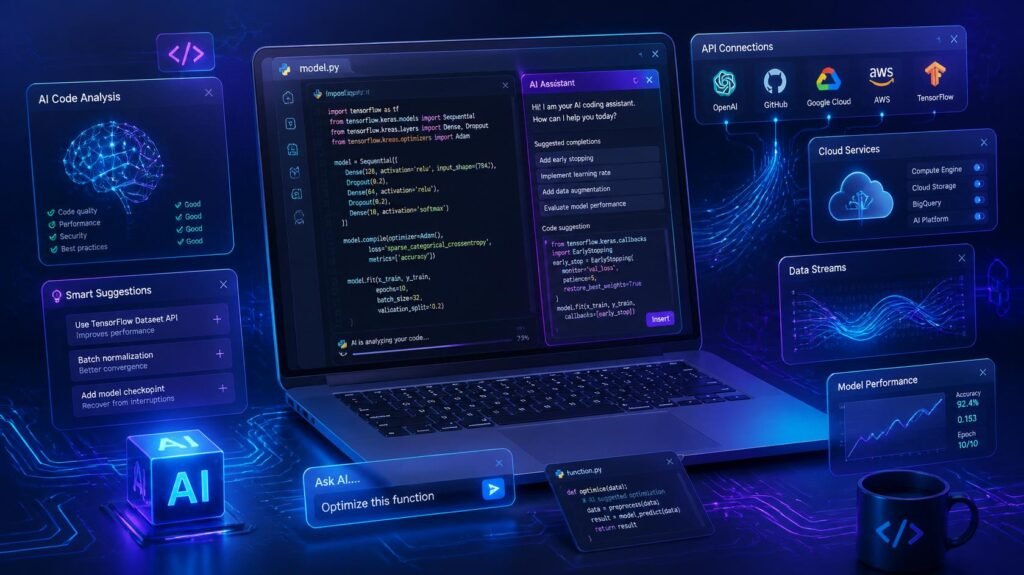
AI Coding Assistant is no longer confined to recommending a handful of lines of code. Modern enterprises employ such smart systems in all phases of the development process. Web application development, mobile app development, cloud solutions, APIs, and enterprise-level software AI has become an indispensable part of the development process for all these areas.
The development process is increasingly dependent on AI that allows automating mundane coding activities, improving software quality, and accelerating development cycles. Developers don’t have to spend numerous hours writing down boilerplate code or going through documentation; AI does the job instantly.
Let’s explore the most common real-world applications.
1. Intelligent Code Generation
One of the biggest advantages of an AI coding assistant is automatic code generation.
Developers simply provide a prompt describing the required functionality, and AI generates clean, structured code that follows programming standards.
Examples include:
- CRUD operations
- Database models
- API endpoints
- Authentication systems
- Form validation
- UI components
- Utility functions
This significantly reduces repetitive coding while allowing developers to focus on solving business problems.
2. Debugging and Error Detection
Debugging often consumes a significant portion of software development time.
AI coding assistants analyze code in real time and identify:
- Syntax errors
- Runtime issues
- Logical mistakes
- Security vulnerabilities
- Performance bottlenecks
Instead of manually inspecting hundreds of lines of code, developers receive instant recommendations for fixing issues.
Benefits
- Faster debugging
- Fewer production errors
- Improved application stability
- Reduced maintenance costs
3. Code Refactoring
As projects grow, maintaining clean code becomes challenging.
AI coding assistants help developers improve existing code without changing functionality by recommending:
- Better variable names
- Cleaner architecture
- Reduced duplication
- Modular design
- Improved readability
Refactoring becomes much faster while maintaining coding standards across the organization.
4. Documentation Generation
Writing documentation is often neglected because developers prioritize feature delivery.
Modern AI automatically generates:
- Function descriptions
- Class documentation
- API documentation
- Code comments
- README files
Good documentation makes projects easier to maintain and improves collaboration between teams.
5. Learning New Programming Languages
Developers frequently switch between languages such as:
- Python
- Java
- JavaScript
- TypeScript
- Go
- Rust
- C#
- PHP
Instead of constantly referring to documentation, developers can ask AI how to write code in another language.
This reduces the learning curve significantly.
Industries Using AI Coding Assistants
AI-powered development is no longer limited to technology companies.
Many industries now integrate AI into software engineering workflows.
| Industry | Primary Use Case |
|---|---|
| Healthcare | Patient management software |
| Banking | Secure financial applications |
| Insurance | Claims automation systems |
| Retail | E-commerce platforms |
| Manufacturing | Industrial automation software |
| Education | Learning management systems |
| Logistics | Supply chain applications |
| Government | Citizen service platforms |
| SaaS Companies | Product development |
| Startups | Rapid MVP development |
Organizations across industries are realizing that AI-assisted programming enables faster software delivery while improving code quality.
AI Coding Assistant Across the Software Development Lifecycle
The software development lifecycle (SDLC) consists of several stages, and AI contributes to each one.
| Development Stage | AI Assistance |
|---|---|
| Requirement Analysis | Suggests technical approaches |
| Planning | Recommends architecture |
| Coding | Generates code |
| Testing | Creates unit tests |
| Debugging | Detects bugs |
| Deployment | Generates deployment scripts |
| Maintenance | Refactors legacy code |
| Documentation | Creates technical documentation |
Instead of helping only during coding, AI supports development from planning to long-term maintenance.
Best AI Coding Assistant Features Developers Love
While every platform has unique capabilities, most developers value these features the most.
Smart Autocomplete
Predicts entire functions instead of individual words.
AI Code Explanation
Explains unfamiliar code line by line.
This is especially useful for:
- Junior developers
- Legacy applications
- Large enterprise projects
AI Documentation
Automatically generates documentation while coding.
Benefits include:
- Easier onboarding
- Better collaboration
- Faster maintenance
Code Review Assistance
AI reviews pull requests and identifies:
- Code smells
- Security risks
- Performance issues
- Unused variables
- Duplicate logic
This improves software quality before deployment.
Test Generation
Writing test cases often requires considerable effort.
AI automatically generates:
- Unit tests
- Integration tests
- Edge case scenarios
Developers can achieve better software reliability with less manual work.
Best AI Coding Assistant Tools Comparison
Several AI coding assistants are available today, each with strengths suited to different development needs.
| Tool | Best For | Strengths | Considerations |
|---|---|---|---|
| GitHub Copilot | General software development | Strong autocomplete and code generation | Subscription required |
| Amazon Q Developer | AWS development | Cloud-focused assistance | Best within AWS ecosystem |
| Cursor | AI-first coding workflow | Deep AI integration and code editing | Learning curve for new users |
| Tabnine | Privacy-focused teams | Local model options and team features | Suggestions may vary by context |
| Codeium | Individual developers | Free tier with broad language support | Advanced enterprise features vary |
| JetBrains AI Assistant | JetBrains IDE users | Integrated with JetBrains tools | Best for JetBrains ecosystem |
The right choice depends on your preferred IDE, programming languages, security requirements, and development workflow.
AI Coding Assistant vs Traditional IDE
Traditional IDEs already provide syntax highlighting, debugging, and autocomplete. AI coding assistants extend these capabilities by understanding intent and generating meaningful code.
| Feature | Traditional IDE | AI Coding Assistant |
|---|---|---|
| Syntax Highlighting | ✔ | ✔ |
| Basic Autocomplete | ✔ | ✔ |
| Intelligent Code Generation | ✖ | ✔ |
| Bug Explanation | Limited | ✔ |
| Code Refactoring Suggestions | Basic | Advanced |
| Documentation Generation | ✖ | ✔ |
| Unit Test Creation | Manual | AI-assisted |
| Natural Language to Code | ✖ | ✔ |
| Context-Aware Recommendations | Limited | ✔ |
| Productivity | Moderate | High |
AI doesn’t replace the IDE—it enhances it by acting as an intelligent development partner.
How AI Improves Developer Productivity
Developers often spend time on repetitive tasks rather than solving complex problems.
An AI coding assistant helps reduce this overhead by:
- Generating repetitive code
- Suggesting reusable functions
- Finding bugs earlier
- Explaining unfamiliar APIs
- Writing documentation
- Recommending optimizations
- Creating test cases
As a result, teams can dedicate more time to application architecture, user experience, scalability, and innovation.
Challenges and Limitations of AI Coding Assistants
Despite their advantages, AI coding assistants are not perfect. Developers should use them thoughtfully and always review generated code before deploying it.
Some common limitations include:
- AI-generated code may contain logical errors.
- Suggestions can be outdated if based on older training data.
- Complex business logic still requires human expertise.
- Generated code may not always follow an organization’s coding standards.
- Security and licensing considerations should be evaluated before using AI-generated code in production.
- Human code review remains essential for quality assurance.
The best results come from combining AI assistance with experienced engineering practices.
The Future of AI Coding Assistants
The future of AI coding assistants extends far beyond autocomplete. As artificial intelligence continues to evolve, these tools are expected to become deeply integrated into every phase of software engineering.
Future capabilities may include:
- Fully autonomous debugging
- AI-driven software architecture recommendations
- Automated DevOps workflows
- Intelligent performance optimization
- Predictive bug prevention
- Automated security remediation
- Multi-agent collaboration for software development
- Voice-driven programming
- Real-time code translation between programming languages
- End-to-end application generation from business requirements
Rather than simply helping developers write code, next-generation AI systems will act as collaborative engineering partners capable of assisting with planning, implementation, testing, deployment, and maintenance.
Organizations that adopt AI-assisted development early are likely to gain advantages in productivity, innovation, and software quality.
| Topic | Summary |
|---|---|
| Definition | AI coding assistants help developers write, review, and optimize code. |
| Benefits | Faster development, improved quality, and reduced repetitive work. |
| Features | Code generation, debugging, documentation, testing, and refactoring. |
| Use Cases | Web apps, mobile apps, APIs, enterprise software, and cloud development. |
| Best Practices | Review AI output, write clear prompts, test thoroughly, and maintain coding standards. |
| Future | Greater automation, intelligent collaboration, and AI-driven software engineering. |
Conclusion
AI coding assistants are revolutionizing the process of software development because they help software engineers write better code. From writing the actual code, generating automated documentation, finding errors, and offering suggestions on how to optimize the code, the AI coding assistant assists the engineer all through the software development process.
But just like any other technology, AI is only useful if used correctly. It is still necessary for the developer to scrutinize the code, practice secure coding and do testing on the software before its release into production. In essence, if used wisely, the AI coding assistant will be a great asset rather than a liability in the development process.
The future is bright as far as AI is concerned, especially in software engineering. Organizations that adopt this technology will find themselves at an advantage in the competitive digital world.
Frequently Asked Questions (FAQs)
1. What is an AI coding assistant?
An AI coding assistant is a software tool powered by artificial intelligence that helps developers write, review, debug, optimize, and document code more efficiently.
2. Can AI coding assistants replace software developers?
No. They automate repetitive tasks and improve productivity, but human developers remain essential for architecture, problem-solving, and decision-making.
3. Are AI coding assistants suitable for beginners?
Yes. They can explain code, suggest improvements, and help learners understand programming concepts more quickly.
4. Which programming languages do AI coding assistants support?
Most support popular languages such as Python, JavaScript, TypeScript, Java, C#, Go, PHP, C++, Rust, Kotlin, and more.
5. Do AI coding assistants improve code quality?
They can recommend best practices, detect potential issues, and suggest optimizations, but developers should always review the generated code.
6. Can AI generate complete applications?
AI can generate significant portions of an application, including APIs, user interfaces, and boilerplate code. However, complete production-ready applications still require human review and customization.
7. Is AI-generated code secure?
Not always. Developers should perform security reviews, vulnerability scanning, and testing before deploying AI-generated code.